
Twenty years ago today, a single blog post published by Jeff Barr introduced the world to the Amazon EC2 Beta, fundamentally altering how organizations think about computing infrastructure. What began as a modest offering of resizable Linux virtual servers billed by the hour, limited to a single instance type known as m1.small in one Region on the US East Coast, has evolved into the bedrock of modern cloud computing. That minimal yet remarkably useful launch proved that infrastructure could be treated as a flexible, on-demand utility rather than a capital-intensive physical asset requiring months of procurement and setup.
Over the last two decades, Amazon Web Services has continually pushed the boundaries of what cloud computing can deliver. The service has expanded from a solitary Region into a vast global footprint spanning 39 geographic regions worldwide. Furthermore, AWS has pushed the boundaries of EC2 beyond traditional data centers through localized models like AWS Outposts for local execution, AWS Local Zones for localized processing, and AWS Wavelength for ultra-low-latency applications embedded directly inside global 5G telecommunications carrier networks. Alongside this geographic expansion, the hardware itself underwent a profound transformation, moving from off-the-shelf components to custom silicon designed specifically for general-purpose computing and artificial intelligence workloads, enabling capabilities that early customers in 2006 could never have imagined.

The Evolution of a Foundation
In looking back at the journey of EC2, major milestones established foundational building blocks that customers continue to rely upon for their mission-critical architectures today. In 2008, the introduction of Amazon Elastic Block Store provided persistent block storage, solving the critical need for durable data attached to virtual machines. The following year brought another wave of innovation with the arrival of Elastic Load Balancing, Auto Scaling, and Amazon CloudWatch, which collectively transformed how applications achieved high availability and elastic scalability. Also in 2009, Amazon Virtual Private Cloud gave enterprises the ability to provision logically isolated networks within the cloud, bridging the gap between public cloud flexibility and stringent security requirements.
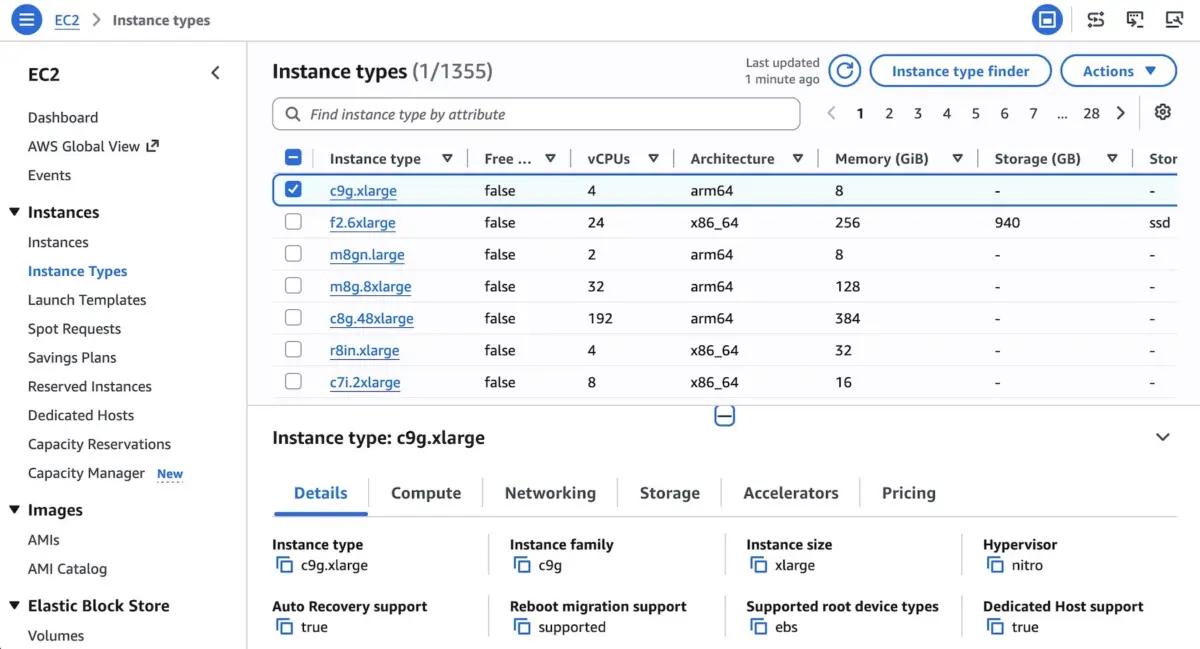
As the scale and complexity of workloads grew, AWS looked deeper into the hardware stack to optimize performance and security. The introduction of the AWS Nitro System in 2017 revolutionized virtualization by offloading I/O functions to dedicated hardware and software, resulting in faster innovation cycles and enhanced security. Shortly after, in 2018, AWS introduced Graviton processors, its custom-designed, Arm-based silicon built specifically to deliver superior price-performance for cost-sensitive, scale-out workloads. Today, the catalog of available options has expanded from that single initial configuration to more than 1,200 distinct instance types. These diverse offerings are meticulously tailored to meet customer needs across general-purpose, compute-optimized, memory-optimized, storage-optimized, accelerated computing, and high-performance computing families.

Despite twenty years of relentless technological evolution and massive architectural scaling, the core value proposition of Amazon EC2 remains remarkably consistent with the vision laid out in 2006. Organizations continue to rely on the service to acquire secure, resizable compute capacity in a matter of minutes, paying strictly for what they consume while scaling dynamically on demand without being locked into rigid, long-term commitments. That exact same flexibility now underpins modern artificial intelligence workloads at a scale that would have seemed unimaginable two decades ago, supporting massive training and inference clusters that power the next generation of technological advancement.
The Engine Driving Modern AWS
Amazon EC2 remains the foundational compute layer upon which the broader ecosystem of AWS services is built. Higher-level services such as Amazon ECS, Amazon EKS, AWS Lambda, AWS Fargate, AWS Batch, Amazon EMR, Amazon SageMaker AI, and Amazon Bedrock ultimately draw their underlying power from EC2 capacity. Virtually every architectural pattern that developers and enterprises have designed over the past twenty years—ranging from simple, single-instance web servers to trillion-parameter foundation model training clusters—begins with the fundamental decision to launch an instance.

Reflecting on the journey, the core strategy that guided the original launch—creating services that are minimal yet useful, launching quickly, and iterating rapidly based on direct customer feedback—continues to define how AWS builds today. The foundational decisions made in 2006 left ample room for the service to grow, adapt, and absorb workloads that span entirely different paradigms. As the industry looks toward the next twenty years of cloud computing, it will undoubtedly demand capabilities that are difficult to fathom today, yet Amazon EC2 is positioned to remain the reliable, enduring foundation where those future workloads will run.