
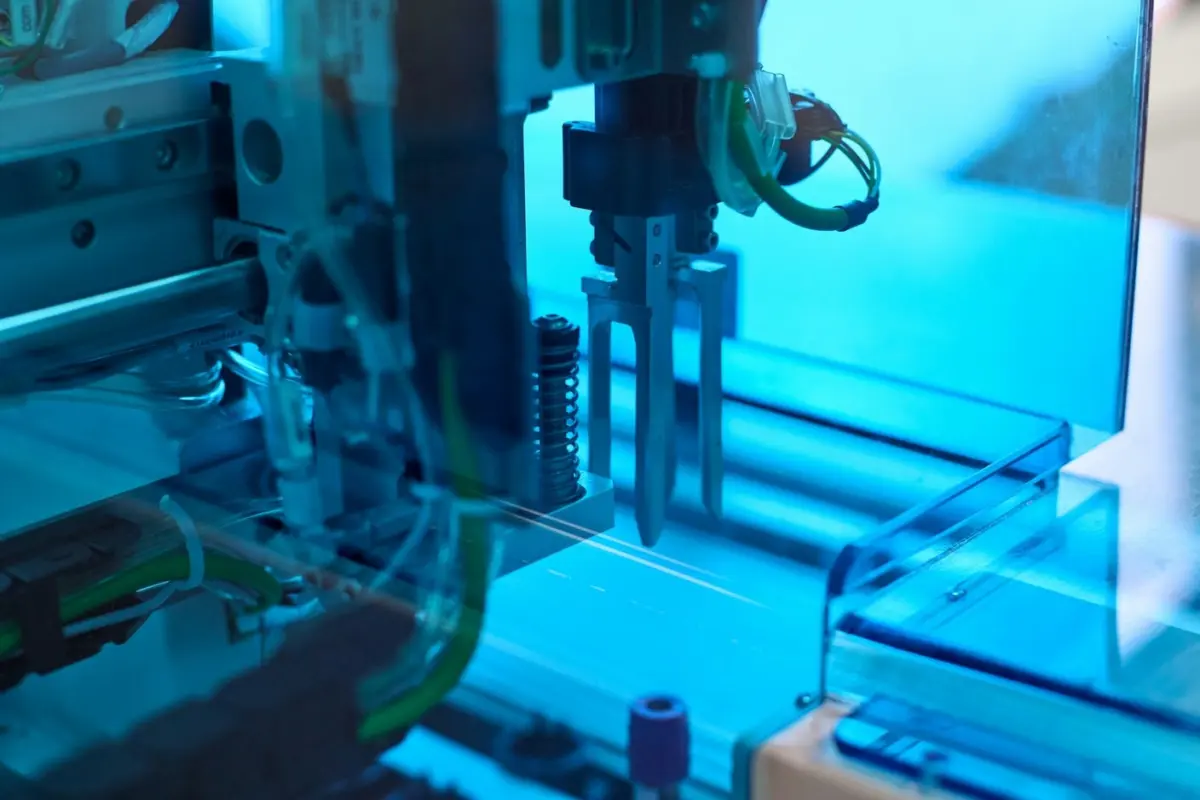
Scientific research has long depended on complex laboratory equipment that requires years of specialized training to operate effectively. However, artificial intelligence company Anthropic is now rolling out a new system designed to bridge the gap between digital intelligence and physical machinery, allowing AI agents to directly control lab devices and autonomously carry out scientific experiments.
Laboratory automation technology itself has been a fixture of modern research for decades, but getting different pieces of equipment to communicate with one another has traditionally presented a major headache for scientists and engineers. Most laboratory instruments rely on proprietary interfaces and closed ecosystems. Connecting a specialized microscope to a robotic arm or a precision liquid handler typically requires bespoke software that takes human specialists weeks, or even months, to build, test, and validate.
To overcome this persistent bottleneck, Anthropic has announced its new Model Hardware Standard, a framework designed to reduce this integration process from months to mere minutes by establishing a common language for devices. The system relies on a standardized driver that enables any programmable device to describe its capabilities and functions to an AI agent, allowing the AI to handle the integration process automatically. The company is initially opening the system up as a research preview to a carefully selected group of external laboratories and hardware manufacturers.
The release marks a strategic expansion for Anthropic as it seeks to extend its capabilities beyond traditional digital environments and into physical laboratory workflows. In a public press release announcing the initiative, the company emphasized its overarching goal for the technology.
"Our hope is that the standard can be of use to researchers, engineers, and other practitioners in speeding up the process of discovery and experimentation in any domain that uses devices with a programmable interface," Anthropic stated.
The new hardware standard shares conceptual similarities with Anthropic’s previously introduced Model Context Protocol, a system that makes it easier for AI models to interact securely with third-party software applications. While the Model Context Protocol focuses on digital tools, the new system turns its attention outward to physical hardware. At its heart, the standardized driver acts as a specialized piece of software positioned between a standard computer and a piece of physical laboratory hardware, translating digital instructions into physical signals that the machinery can execute, while feeding operational feedback back to the system.
Most modern laboratory instruments already run some form of internal driver software to communicate with computers, but each has historically spoken its own unique technical dialect. This fragmentation is precisely why connecting disparate instruments has always required custom code to translate commands between devices. Anthropic’s new driver standardizes that technical dialect by distilling interactions down to deliberately simple, universal commands such as "read" or "write." These fundamental operations can refer to a wide variety of tasks, ranging from checking a precise temperature reading to setting the operational duration of a motorized stage.
Because every compliant device speaks these same basic operational terms, machines can seamlessly discover each other on a local network and exchange data without requiring a custom translation program written by human developers. Furthermore, this universal framework makes it significantly easier for the company’s Claude AI agents to learn how to operate a piece of hardware they have never encountered before.
The standard also incorporates flexible configuration options, allowing users to encode crucial physical details—such as the exact weight, reach, or operational range of a robotic arm—using ordinary natural language. Researchers can either write out their hardware configuration parameters themselves or engage in an interactive interview with an AI agent that asks relevant questions about the setup. The system then automatically compiles this information into a comprehensive reference file detailing what a given device can measure, what parameters can be adjusted, and what safety thresholds apply to its operation.
According to Anthropic, this capability enables its AI agents to orchestrate complex experimental workflows across multiple instruments in ways that are often highly intricate and interactive. Rather than merely executing rigid, pre-programmed scripts, the AI can adapt dynamically to ongoing results in real time.
"We’ve found that Claude interacts with experiments and hardware in an exploratory manner, much as a scientist would," the company noted in its official communications. "We observed Claude make an adjustment to a laser, observe the results through a camera to assess how its adjustment moved the laser beam, and repeat the process, seeking to understand the sequence of events."
Describing a practical demonstration to the Financial Times, Anthropic scientist Alek Kemeny recounted watching Claude successfully locate a specific, unfamiliar structure within a live brain tissue sample during a live neuroscience experiment. By manipulating a microscope’s internal mirrors and lasers entirely on its own, the AI navigated the sample until human validation was achieved.
"The neuroscientist sitting there said: ‘Yep, that’s right,’" Kemeny told the publication.
This technological leap could prove fundamental to Anthropic’s broader ambition to move beyond its primary markets of software development and digital knowledge work, enabling its AI systems to exert a tangible, productive impact in the physical world. However, granting advanced artificial intelligence systems the ability to control real-world hardware also introduces considerable risks and safety challenges, particularly given that current AI models are still susceptible to occasional hallucinations or unpredictable behaviors.
These concerns were highlighted by industry experts following the announcement. Speaking on the Mixture of Experts podcast hosted by IBM, Kaoutar El Maghraoui, a principal research scientist at the company, addressed the balance between innovation and operational security.
"It is an impressive proof of concept, but how do we ensure safety in the physical world? Because small errors can matter here," El Maghraoui said.
These very risks explain why Anthropic is taking a measured approach by releasing the standard to only a small, trusted group of partners during the initial preview phase. The company has committed to working closely with these early collaborators to develop robust safety evaluations and rigorous guardrails specifically tailored for AI systems operating physical laboratory hardware. If this initial launch phase proves successful and safety protocols hold up under scrutiny, AI agents equipped with the Model Hardware Standard could soon begin accelerating research workflows across much wider swathes of the scientific and industrial economy.