
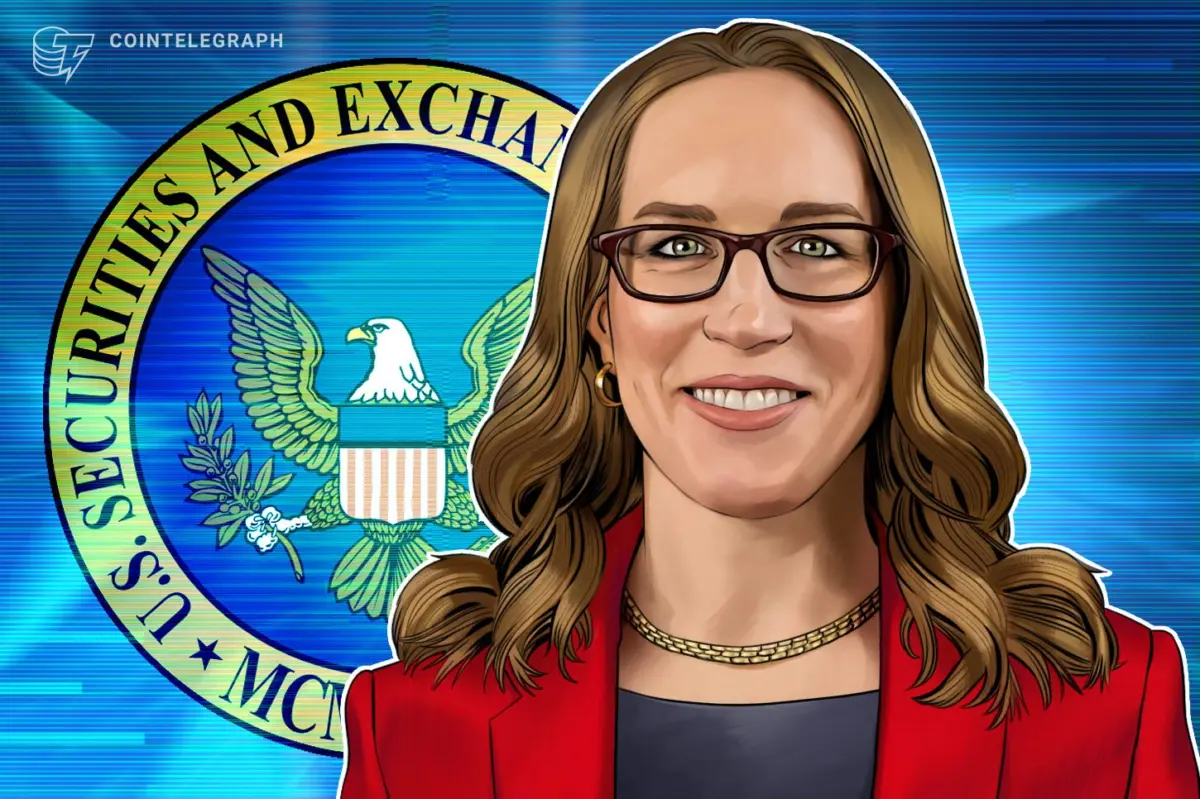
United States Securities and Exchange Commission (SEC) Commissioner Hester Peirce has officially announced her formal resignation from the agency, setting October 2 as her final day in office.
Known widely across the financial sector and digital asset ecosystem as "Crypto Mom" due to her persistent advocacy for clear, rules-based regulation of the cryptocurrency industry, Peirce revealed her departure on Friday by publishing a copy of her resignation letter on her official X account.
In her letter addressed to the President, Peirce expressed deep gratitude for her time at the regulator, describing her service as a commissioner over the past eight years as the "honor of her professional lifetime." She noted that she leaves the agency under the capable leadership of Chairman Paul Atkins and Commissioner Mark Uyeda, who represent the remaining two members of the commission. Both Atkins and Uyeda are Republicans, maintaining conservative leadership at the helm of the nation’s primary securities regulator.
Peirce’s departure marks the end of an influential eight-year tenure on the commission, during which she consistently advocated for market innovation, regulatory transparency, and administrative restraint. While her official term at the SEC expired in June 2025, agency rules permit commissioners to continue serving for up to approximately 18 months after their terms expire if a successor has not yet been confirmed or appointed. Rather than remaining through the full post-term extension period, Peirce chose to conclude her tenure in early autumn as she prepares for her next professional endeavor.
In addition to her role as commissioner, Peirce assumed added responsibilities within the agency’s administrative structure earlier in the year. On February 4, 2025, she was named director of the SEC’s Crypto Task Force. In that role, she led internal initiatives aimed at re-evaluating how legacy securities statutes should apply to modern digital assets, tokenized instruments, and decentralized financial protocols.
Peirce will join law school as associate professor
Following her departure from the regulatory agency on October 2, Peirce will transition into academia. As reported in May, she is slated to join the faculty at the Regent University School of Law in Virginia as an associate professor, beginning her academic appointment in November.
According to details released by Regent University, Peirce is expected to bolster the law school’s legal curriculum across several key focus areas. Her teaching and research efforts will center on federal litigation, securities regulation, and digital assets—areas that directly reflect her extensive background in legal policy, market oversight, and administrative law. The faculty appointment brings decades of high-level regulatory experience directly into the classroom, bridging practical federal governance with academic legal study.
Peirce’s seat at the SEC may not be filled immediately following her departure. The commission has operated below its full five-member capacity for several months. Caroline Crenshaw, the agency’s previous Democratic commissioner, departed the SEC in January, 18 months after her term officially ended without a re-nomination or replacement. Since President Donald Trump took office in January 2025, no formal nominations have been submitted to fill Crenshaw’s vacant seat, nor have any replacements been announced for Peirce’s outgoing position.
Changing Priorities and Policy Shifts at the SEC
Peirce’s departure occurs against the backdrop of a significant shift in the SEC’s regulatory strategy. Since President Trump assumed office in January 2025, the commission has radically overhauled its approach to the oversight and enforcement of digital asset markets.
Under the leadership of Chairman Paul Atkins, the SEC moved away from what he and other critics previously characterized as "regulation by enforcement"—an approach marked by litigating against market participants in lieu of establishing explicit statutory or administrative rules. Over the course of 2025, the commission systematically closed numerous open inquiries and dropped several active enforcement actions against digital asset firms. Among the dropped cases and investigations were those involving commercial entities linked to President Trump and members of his family, marking a notable departure from the agency’s previous enforcement trajectory.
Throughout her tenure, Peirce served as one of the most prominent internal critics of regulatory ambiguity. As director of the Crypto Task Force, she focused the agency’s attention on fundamental legal questions surrounding public blockchains and decentralized networks.
A central highlight of her recent tenure on the task force involved defining the boundaries of regulatory jurisdiction over software development. In June, Peirce publicly addressed the ongoing legal debate surrounding developer liability in decentralized finance (DeFi), stating that the mere act of writing and publishing open-source software code should not subject developers to federal securities regulations. Her remarks tackled a core point of contention within the tech and legal communities, arguing for a clear distinction between background protocol development and regulated financial intermediation.
Peirce also prioritized the modernization of disclosure framework expectations. She consistently advocated for simpler, tailored disclosure rules adapted specifically for digital assets, pointing out that applying traditional corporate disclosure templates to decentralized token networks often yields ill-fitting requirements that fail to provide meaningful clarity to investors while creating undue burdens for builders. Furthermore, her work on the task force highlighted the growing debate surrounding asset tokenization, encouraging regulators to engage constructively with market participants seeking to bring traditional financial instruments onto blockchain infrastructure.
With Peirce’s upcoming departure on October 2, the commission will operate with just two sitting members—Atkins and Uyeda. This duo will oversee the SEC’s ongoing regulatory agenda, rulemakings, and administrative proceedings as the agency continues its broader recalibration of federal securities enforcement.