
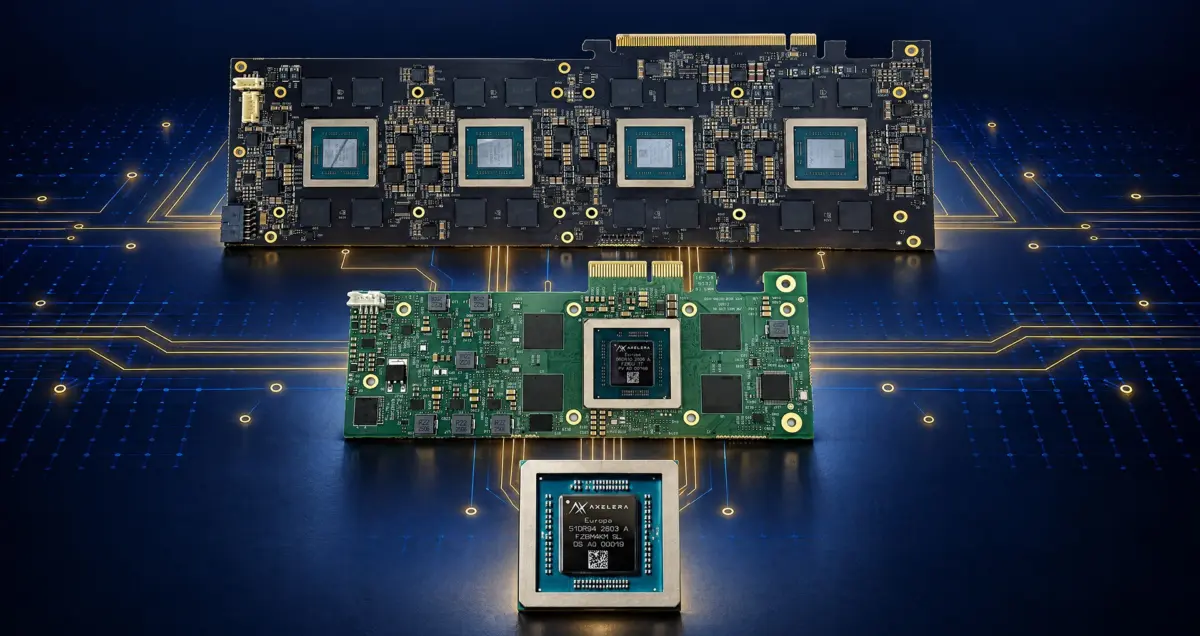
Netherlands-based AI accelerator start-up Axelera is taking direct aim at one of the most stubborn bottlenecks in enterprise technology: the massive power and cooling constraints that prevent standard corporate data centers from running serious artificial intelligence workloads. With the introduction of its new Europa platform, the company is betting that businesses do not need Google-scale power bills or radical facility overhauls to execute high-performance AI inference. Instead, Axelera believes the solution lies in smarter silicon designed to fit seamlessly into the servers organizations already own.
The explosive growth of artificial intelligence applications has triggered a severe infrastructure crisis across the technology landscape. While hyperscale cloud providers and massive AI labs can secure dedicated power generation capacity, negotiate directly with utility companies, and invest heavily in entirely new greenfield facilities to support towering AI clusters, typical corporate data centers enjoy no such luxuries. As enterprises transition their artificial intelligence initiatives from experimental sandboxes into full-scale production environments, performance-per-watt has rapidly emerged as the definitive metric for success. Compute capacity must fit strictly within the existing electrical envelopes, physical rack densities, and cooling thresholds of legacy facilities.
Axelera’s approach addresses this challenge by scaling its power-efficient architecture—originally proven in edge and physical AI deployments—up to server-class enterprise workloads. The flagship Europa AI Processing Unit (AIPU) forms the foundation of this new strategy, engineered to deliver substantial inference performance while operating within tightly managed thermal and electrical budgets.
Bringing Power-Efficient AI into Existing Enterprise Infrastructure
The Europa AIPU is initially being introduced to the market through two distinct PCIe add-in card formats: the half-height, half-length Edge 232p and the full-height, full-length Server 250p. By utilizing standard PCIe card upgrades, organizations can integrate advanced AI inference capacity directly into their existing server ecosystems without necessitating a wholesale replacement of their hardware infrastructure.

This strategy represents a natural evolution of Axelera’s initial product roadmap, which concentrated heavily on intelligent edge applications. In edge environments, power is an inflexible design constraint, requiring consistent inference performance under strict latency, thermal, and electrical limitations. The core premise behind Europa is that an architecture meticulously designed around those unforgiving constraints can scale upward with remarkable effectiveness into enterprise servers as additional power, cooling, and physical space become available.
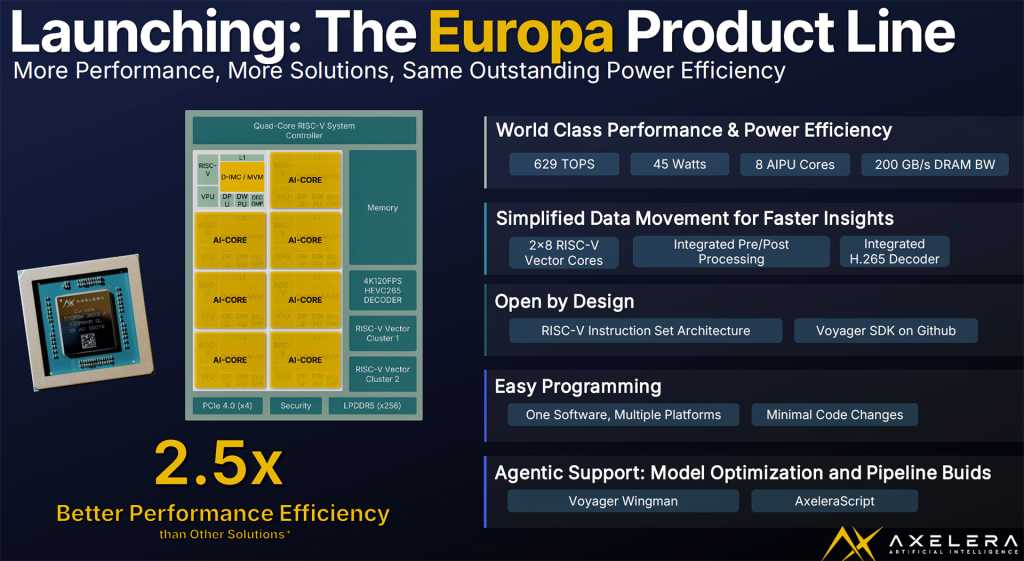
The technical specifications of the Europa AIPU highlight this efficiency-first methodology. The processor delivers an impressive 629 TOPS (tera operations per second) within a modest 45-watt power envelope, supported by eight dedicated AIPU cores and 200 GB/s of memory bandwidth. Furthermore, the architecture integrates RISC-V vector cores dedicated to pre- and post-processing tasks, alongside an integrated H.265 decoder. This clever consolidation reduces unnecessary data movement between the primary accelerator and the host processor, making it exceptionally well-suited for machine vision-oriented workloads such as enterprise surveillance and industrial monitoring systems.
These operational characteristics carry immense weight as enterprises scale their AI deployments across hundreds of individual servers. In such large-scale deployments, the power consumption of an accelerator directly dictates server configuration choices, rack density limits, facility cooling requirements, and the total amount of inference capacity that can be squeezed into a given electrical footprint.
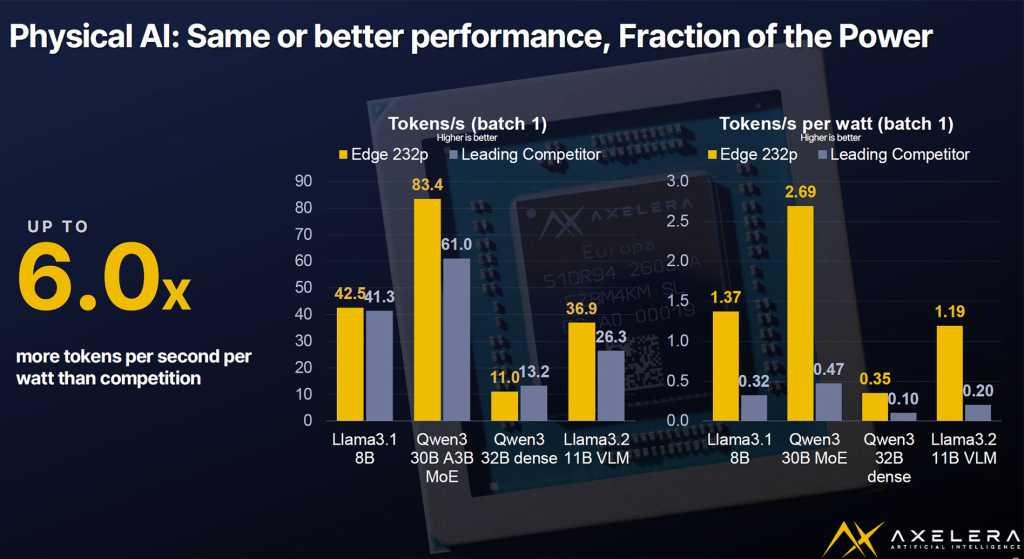
Axelera claims that its Edge 232p card can deliver up to six times more tokens per second per watt than competing GPU-based solutions across several prominent large language models, including variants of Llama and Qwen. Because these efficiency figures blend Axelera’s internal testing data with publicly available competitor benchmarks, independent validation across a wider spectrum of enterprise workloads will undoubtedly be necessary. However, historical evidence suggests the company’s architectural philosophy holds merit. In independent studies examining AI accelerators for machine vision, Axelera’s first-generation Metis accelerator demonstrated top-tier performance in multi-stream inference testing while consistently delivering industry-leading energy efficiency across its PCIe and M.2 implementations. Europa effectively extends this proven power-conscious design philosophy into the realm of demanding enterprise workloads.

Scaling from a PCIe Card to Enterprise Servers
From an enterprise data center perspective, the Server 250p represents an especially compelling option. As a full-height, full-length dual-slot PCIe accelerator, it is configurable with either 128GB or 256GB of high-speed LPDDR5 memory.
According to Axelera, a single Server 250p card is capable of delivering 4,205 tokens per second when running the Qwen3 8B model at INT4 precision while serving a large batch of simultaneous requests. This translates to an efficiency rating of 32.1 tokens per second per watt. For organizations looking to expand their capabilities, up to eight of these cards can be installed into a single standard server, establishing a straightforward pathway to scale local inference capacity within conventional server architectures.
This deployment model addresses a vital operational need for enterprises servicing internal AI applications to thousands of simultaneous users. By keeping inference local, organizations can scale their hardware footprints incrementally as utilization grows, bypassing the need to route every routine request through the public cloud or construct dedicated, power-hungry GPU facilities on-premise.
Data security, privacy, and regulatory governance represent equally powerful drivers for this local infrastructure model. Industries bound by strict compliance frameworks—such as financial services, healthcare, legal, defense, and government sectors—face stringent legal restrictions regarding where sensitive information is processed, handled, and stored. The Europa platform offers these risk-averse institutions a viable mechanism to execute complex workloads on-premises within local infrastructure that they directly control.
Of course, novel silicon solutions must ultimately be packaged into complete, fully supported system solutions that enterprise IT departments can easily purchase, deploy, and maintain. To that end, Axelera has secured broad industry backing. The Edge 232p card is already available in fully validated systems from major enterprise vendors including Dell and Supermicro, while Axelera’s broader roster of validated original equipment manufacturer partners includes prominent names like Hewlett Packard Enterprise, Lenovo, Advantech, and Axiomtek.
Software Is Still the Gatekeeper
Hardware efficiency and raw performance metrics, while critical, represent only one side of the enterprise adoption equation. In the modern technology landscape, software ecosystem maturity remains the ultimate gatekeeper for any new silicon architecture.
To address this challenge, Axelera has unified its software enablement through the Voyager SDK. This software development kit spans both the company’s legacy Metis products and the newly minted Europa architecture, establishing a consistent development environment across embedded, edge, and server deployments. The SDK provides extensive support for a wide array of workloads, including computer vision models, large language models, vision-language models, diffusion models, and advanced speech processing systems.
To simplify and accelerate deployment, Axelera has introduced Voyager Wingman, a tool that utilizes natural-language prompts to assist developers in building or porting inference pipelines. Additionally, AxeleraScript—referred to as AxScript—offers a Python-enabled domain-specific language that grants developers lower-level AIPU control for crafting custom operators and specialized transformer models.
This robust software layer could prove just as important to market adoption as Europa’s hardware performance and energy efficiency. Enterprise IT departments already maintain entrenched models, complex development environments, and established application stacks. Forcing developers to completely rewrite applications or acquire rare, highly specialized expertise adds substantial operational costs that can quickly negate any initial savings realized on hardware acquisition and power consumption.
Defining a New Enterprise AI Infrastructure Model
Axelera is careful not to position Europa as hardware intended for training the next generation of massive frontier artificial intelligence models. Instead, the company’s strategic focus is squarely centered on production enterprise inference—delivering high performance while rigidly respecting existing power, cooling, security, and budgetary boundaries. Commercial traction appears to be building around this thesis, with the company reporting successful deployments across more than 600 global customers and a total sales pipeline that exceeds $1.5 billion.
For Chief Information Officers and enterprise infrastructure engineers, Europa introduces a pragmatic middle ground, offering an alternative to relying entirely on public cloud services or building out power-draining, dedicated GPU infrastructures on-site. If Axelera’s performance-per-watt claims consistently hold up across a diverse range of everyday corporate workloads, the underlying economics could prove remarkably compelling.
While hyperscale technology giants possess the capital, resources, and sheer scale required to chase novel power sources and design revolutionary rack architectures exclusively for artificial intelligence, the vast majority of enterprises do not. Most businesses must operate strictly within the power limits, cooling capacities, and physical data center footprints they already own. That hard reality makes energy efficiency a foundational infrastructure constraint, opening a significant market opportunity for power-efficient architectures like Axelera’s Europa within the rapidly expanding enterprise AI market.