
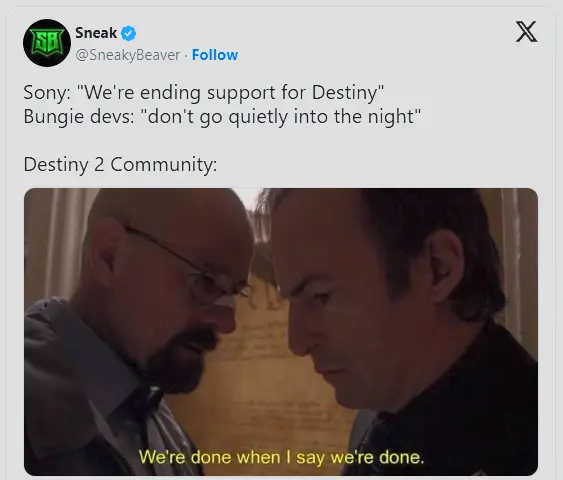
The reaction from Destiny 2 content creator SneakyBeaver was typical of the overwhelming wave of joy and validation that met Bungie’s announcement that Destiny 2 is officially being taken out of end-of-life maintenance mode. For a community that spent the last three months mourning the effective death of a beloved hobby, the sudden shift caught everyone off guard, transforming a period of bitter acceptance into an unexpected celebration.
Only slightly over three months ago, the live-service shooter was sent out to pasture, with Bungie and parent company Sony placing the title on a path where it would no longer receive any sort of content updates. The decision was communicated as a definitive transition, marking the end of an era for a franchise that had dominated the multiplayer gaming landscape for a decade. Yesterday, however, that decision was dramatically and publicly reversed. In a startling corporate about-face, Bungie announced that Destiny is once again considered "foundational" to the studio’s future.
To demonstrate good faith and signal a genuine change in trajectory, studio leadership confirmed that work has already begun on restoring previously cut content to the game. Much of this returning material consists of paid expansions, raids, and planetary destinations that had been unceremoniously stripped from the game as part of the infamous Destiny Content Vault scheme—a controversial measure originally implemented because the game had supposedly grown too bloated for the studio to manage efficiently.
Much of the reaction from the core player base has naturally centered on the aggressive, sustained campaign waged by content creators and dedicated players alike. This vocal segment of the community made it abundantly clear to Sony and Bungie that they were not going to simply accept the end of Destiny without putting up a severe pushback. The campaign manifested across digital spaces, with players systematically pinging Sony’s social media accounts wherever they could be found. It became a ubiquitous presence in the chat windows of live showcases and streaming events, where participants continuously spammed demands for "We Want Destiny 3."
The resistance was not limited to chat rooms and social media commentary. A massive Change.org petition demanding that Sony commission and develop Destiny 3 quickly surpassed 400,000 signatories. Furthermore, player concurrency for Destiny 2 stubbornly refused to wither away, remaining approximately six times higher than that of Marathon, Bungie’s heavily pushed extraction shooter. In an unexpected display of cross-community solidarity, even fans of competing titles like Warframe showed up in digital spaces to lend moral support to the besieged Guardians.
Given the sheer scale of the grassroots opposition, it was hardly a surprise that Sony and Bungie’s surprise change of strategy was greeted with a massive victory lap from the very people who had campaigned against the cancellation. It is easy to picture virtual gatherings of Guardians congregating in the Tower to fire their Khvostovs joyously into the air in celebration of the reprieve.
Prominent figures within the community wasted no time sharing their elation with their audiences. Lore master My name is Byf published a reaction video titled "We did NOT go quietly. We Won." The triumphant title was a direct reference to Dylan Thomas’s famous poem, "Do Not Go Gentle Into That Good Night," which also served as a poignant nod to a post made by Bungie principal communications manager dmg04. Around the time Destiny 2’s mothballing was originally announced, the communications manager had posted the exact same literary quote, which many loyal players interpreted at the time as a subtle call to arms and a sign to fight back against corporate mandates.
Elsewhere, YouTuber Mactics titled his celebratory video "DESTINY IS BACK… WE DID IT!" Meanwhile, Aztecross, one of the most prominent content channels that had relentlessly maintained pressure on Sony throughout the ordeal, opted for the triumphant headline, "Destiny Community, You Did It." While Cross is known to have deep sources within Bungie and had been quietly hinting that something significant was brewing behind the scenes for a few weeks, watching his exuberant reaction offered a compelling glimpse into the collective relief of the community.
Perhaps the most visceral and emotionally resonant reaction came from streamer Llama. In his video, titled "I’m so happy, we actually WON!", viewers can watch him receive the monumental news in real time while actively playing Destiny 2 on stream. His emotional trajectory shifts rapidly from initial shock and disbelief to infectious laughter and, ultimately, visible tears. For individuals who have not only loved the game deeply but have also built their entire livelihoods around covering its intricate universe, it is almost impossible to overstate how much its resurrection means to their daily lives and professional futures. That sentiment resonates deeply with veteran players who have poured thousands of hours into the digital world and felt profoundly adrift since its effective termination was announced.
Yet, not every response from the wider community has been marked by unalloyed enthusiasm. Over on the main Destiny Reddit community, several prominent threads have sprung up calling for cautious optimism rather than blind celebration. One widely discussed thread is titled "Please keep expectations in check," while another reads, "I’m so happy to hear the news today, but I genuinely hope Bungie understands why we engaged with Monument of Triumph." Both sentiments reflect a deep-seated weariness; after all, the player base has navigated broken promises and shifting corporate strategies many times before.
Several prominent content creators also expressed a healthy degree of skepticism regarding the sudden resurrection. Datto, one of the most recognizable and pragmatic faces in the Destiny 2 community, took to social media to manage expectations. Writing on X, he stated, "to anyone wondering: i am not unretiring from destiny. happy for y’all though! but i am gonna keep trying to do something new :)" In a separate post, he addressed the return of vaulted content more bluntly, noting that he had no immediate plans to return for previously sunset material. In a similar vein, Gladd, a veteran player who stepped away from Destiny 2 long before its content was initially sunset, sounded a stark note of caution to his followers.
"Here we go. Now everyone’s hopes are up. Most likely more unfulfilled promises," Gladd wrote on social media. "The ‘I-told-you-so’ people are gonna spam ‘We Won!’ And the folks with a single personality trait are gonna be let down… again. This seems like another repeated cycle."
While such commentary might strike some as overly cynical, it is objectively fair to point out that the underlying structural problems that have long plagued the franchise remain unresolved. It remains entirely unclear how Bungie plans to solve the core logistical puzzle the game has always faced: how to generate a sufficient volume of fresh content to keep a notoriously rabid fanbase satisfied, without letting development costs and file sizes balloon out of control. This challenge is made infinitely more complicated by the fact that the studio recently laid off nearly half of its workforce, parting ways with an enormous amount of institutional knowledge and veteran talent in the process.
For industry observers, the most fascinating question is the precise extent to which the sustained fan campaign actually managed to shift the minds of Sony’s executive suite. For a live-service game of this massive financial magnitude to get the corporate bullet, only to make a complete about-face and stage a comeback just a few months later, is an almost unprecedented occurrence in modern gaming history.
Having dealt with major console manufacturers for many years, industry veterans know how sensitive senior corporate executives tend to be regarding public perception. Even if the initial decision to sunset the game made cold, calculated business sense on a spreadsheet, Sony likely never anticipated the sheer scale, persistence, and ferocity of the player response. It is difficult to imagine that the executives enjoyed having their every online corporate announcement inundated by a horde of pitchfork-wielding Guardians—especially while the company was simultaneously managing separate controversies surrounding physical media holdouts and hardware pricing.
What remains undeniably clear is that this sudden reversal was never part of the original corporate roadmap. A publisher simply does not cancel a massive, established franchise only to uncancel it three months later without something fundamentally shifting behind closed doors. While the exact financial calculus and internal politics behind the decision may never be fully revealed, the episode demonstrates that a passionate community can indeed exert tangible influence over corporate titans. For a video game universe fundamentally built around the concept of unkillable, resurrected warriors refusing to stay down, the triumphant return feels entirely fitting.