
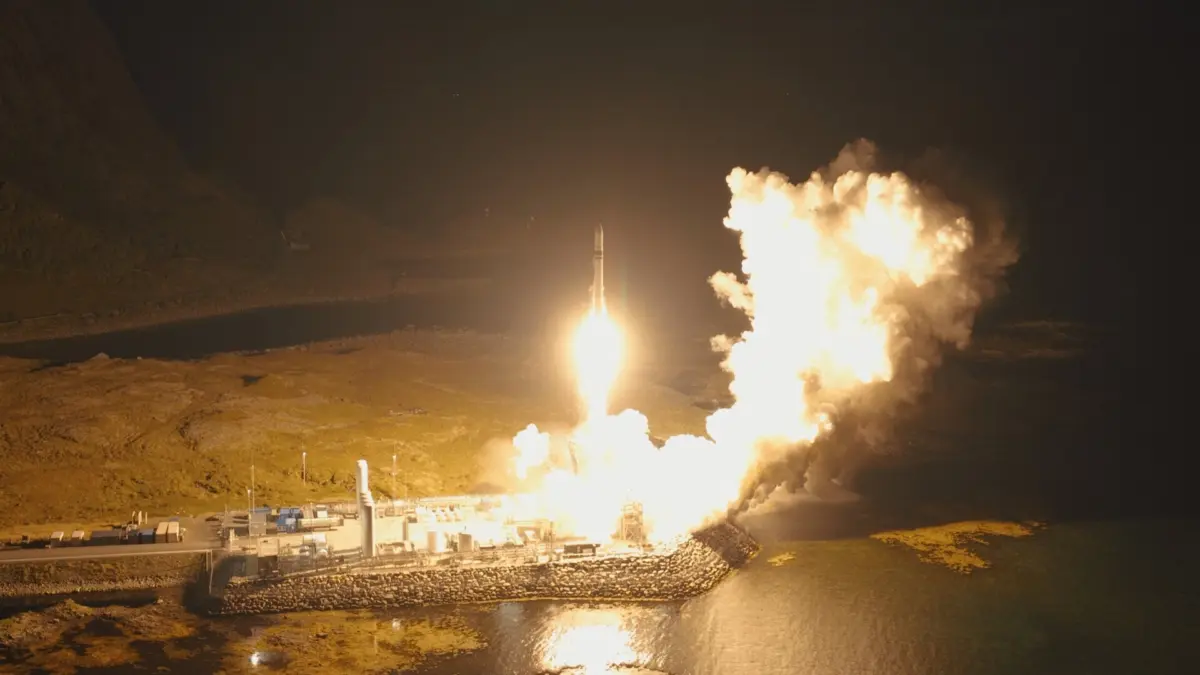
Europe has long faced a restrictive dichotomy when looking to send satellites into the cosmos, forced to choose primarily between state-backed legacy rocket manufacturer Arianespace and a select handful of foreign launch providers. That landscape shifted fundamentally over the weekend when German rocket startup Isar Aerospace achieved a monumental milestone, becoming the first private company in history to reach orbit directly from continental Europe.
The successful launch marks a watershed moment for the European aerospace sector, which has spent years grappling with sovereign access limitations and persistent launch bottlenecks. Amid intensifying geopolitical tensions and shifting global dynamics, policymakers around the world have placed a renewed, urgent focus on developing independent sovereign launch capabilities. In Europe, a heavy reliance on foreign commercial players—most notably Elon Musk’s SpaceX—has sparked serious strategic concerns among continental leaders.
To bridge this widening capability gap, the European Space Agency (ESA) launched a major funding initiative earlier this year known as the European Launcher Challenge. Designed to inject vital capital into promising private launch startups, the program aimed to accelerate development cycles and foster a competitive domestic ecosystem. Isar Aerospace, one of the premier awardees of this rigorous funding initiative, has now emphatically proven its worth, successfully lifting a rocket off the pad from the Andøya Spaceport in Norway on Saturday.
The triumphant flight was the vehicle’s second attempt, following a dramatic debut in March 2025 that ended prematurely when the rocket lost control and plunged into the sea roughly 30 seconds after liftoff. This time, however, Isar’s two-stage launch vehicle executed a flawless flight, successfully punching through the atmosphere, reaching orbit, and precisely releasing its payload.
“Today, Isar Aerospace opened space from continental Europe,” said Isar Aerospace CEO Daniel Metzler in an official company press release. “Launch continues to be the largest bottleneck for the global space industry and from today on, there is a true alternative for commercial and institutional customers.”
Standing an impressive 28 meters tall, the Spectrum rocket is engineered to carry up to 1,000 kilograms to low Earth orbit. This capacity represents more than three times the payload capability of the Electron launch vehicle produced by leading competitor Rocket Lab. While Spectrum remains smaller and less powerful than SpaceX’s workhorse Falcon 9 rocket, it punches above the weight class of SpaceX’s inaugural Falcon 1. For this historic mission, the vehicle carried a diverse manifest featuring five commercial and educational CubeSats, alongside a technology experiment selected through a rigorous competition run by the German Aerospace Center.
The achievement drew immediate praise from international space authorities and institutional leaders who recognized the profound implications for Europe’s technological autonomy.
“All launches are special, but what Isar Aerospace achieved today is historic: the first European company to reach orbit with their own launch vehicle,” Géraldine Naja, the European Space Agency’s director of space transportation, said in an official ESA press release. “A huge congratulation to the teams involved.”
Building on this foundational success, Isar Aerospace is already looking aggressively toward the future. The company reports that it currently has five additional Spectrum vehicles in active production. Furthermore, it is nearing the completion of a massive 40,000-square-meter manufacturing facility near Munich, Germany, which is designed to eventually churn out up to 40 launch vehicles per year to meet skyrocketing global demand. Beyond its European footprint, the startup is also constructing a dedicated launch complex in Nova Scotia, Canada, a strategic move that will enable the company to reach specialized orbits critical for Earth observation and global communications satellites.
Isar’s chief commercial officer, Stella Guillen, revealed in an interview with CNBC that the company has already accumulated a staggering pipeline of deals worth roughly €10 billion, equivalent to about $11.6 billion, though the company did not clarify precisely what proportion of that pipeline represents firm, binding contracts versus soft commitments. “The demand is so big,” Guillen noted, adding that the broader commercial launch industry remains “desperate” for additional capacity as satellite constellations proliferate.
To date, Isar Aerospace has raised roughly €870 million, or about $1 billion, in private capital. This financial backing has been significantly bolstered by a €198 million—approximately $230 million—contract secured through ESA’s European Launcher Challenge. The grant came with a strict stipulation: the company was required to achieve a successful orbital launch by 2027, a challenging milestone that Isar has now decisively cleared well ahead of schedule. Because the European Launcher Challenge has also provided vital funding to other private contenders such as PLD Space and Rocket Factory Augsburg, it may not be long before additional home-grown European launch providers emerge right on Isar’s heels.
At the same time, the broader global private launch market is experiencing a historic wave of competition. A new generation of advanced rockets from outside Europe are also aggressively targeting debut flight windows over the coming year, including Rocket Lab’s Neutron, Relativity Space’s Terran R, Stoke Space’s Nova, Astra’s Rocket 4, and the Eclipse vehicle developed jointly by Firefly Aerospace and Northrop Grumman.
While Isar’s strong European pedigree and institutional backing will undoubtedly position it to command a major share of the continent’s domestic launch requirements, the company faces the ongoing challenge of rapidly converting this high-profile early win into a regular, highly reliable, and commercially repeatable launch service. If Isar Aerospace can successfully navigate that transition, Europe may finally secure the robust, autonomous launch capacity it has sought for decades.