
Belgium has quickly transformed into one of Europe’s most aggressive enforcement jurisdictions in the ongoing battle against online digital piracy. Although the country was initially considered a latecomer to the site-blocking movement, the establishment of a dedicated anti-piracy department has rapidly accelerated its legal posture. Rather than targeting only traditional Internet Service Providers, the nation’s anti-piracy regime has expanded its regulatory reach to encompass major technology infrastructure providers, setting up a high-stakes legal showdown over how the Domain Name System functions on a global scale.
The foundational moment for this aggressive enforcement strategy occurred in April 2025, when sports broadcasting rightsholder DAZN secured a landmark blocking order targeting pirate streaming domains. Designed to cripple unauthorized broadcasts of live sporting events—including the lucrative Jupiler Pro League—the order pushed far beyond conventional boundaries. In addition to forcing major local ISPs to block pirate domains at the network level, it also legally compelled prominent public DNS providers Cloudflare, Google, and Cisco to stop resolving those same domains through their recursive resolution services. Non-compliance carried the threat of severe financial penalties, amounting to €100,000 in fines per day.
The reaction from the technology sector was immediate and polarized. Cisco adopted an uncompromising stance, choosing to pull its popular OpenDNS service out of Belgium entirely rather than comply with the mandate. Google and Cloudflare, by contrast, chose to comply with the directive through their own customized technical implementations, though all three infrastructure providers ultimately joined forces to challenge the legality of the order in court.
By July 2025, the legal landscape shifted temporarily when a Belgian court suspended the DNS blocking requirement against Cisco pending a definitive final ruling. This judicial pause allowed OpenDNS to restore its services within the country while putting a temporary hold on supplementary DNS-level blocking mandates. However, that reprieve was short-lived, signaling that the broader legal questions surrounding the accountability of infrastructure providers were far from settled.

Court Upholds DNS Blocking
That final judicial word has now arrived, delivering a clear defeat for the major DNS resolvers. On August 20, the President of the French-speaking Business Court of Brussels rejected the core arguments presented by the tech companies, determining that the mandatory DNS blocking requirement must stand.
Although the complete judicial order itself has not been publicly released, a comprehensive implementation decision issued by Belgium’s anti-piracy department outlines the outcome and details the operational mechanics of the upcoming blockades. According to the document, the court dismissed the technical and financial pushback from the companies, ruling that it is indeed technically feasible for alternative DNS resolvers to filter specific domains. Furthermore, the court concluded that the providers failed to demonstrate that compliance costs would be disproportionately burdensome. Arguments raised by the companies regarding potential geolocation overblocking errors affecting users residing near national borders were likewise deemed insufficient to overturn the injunction.
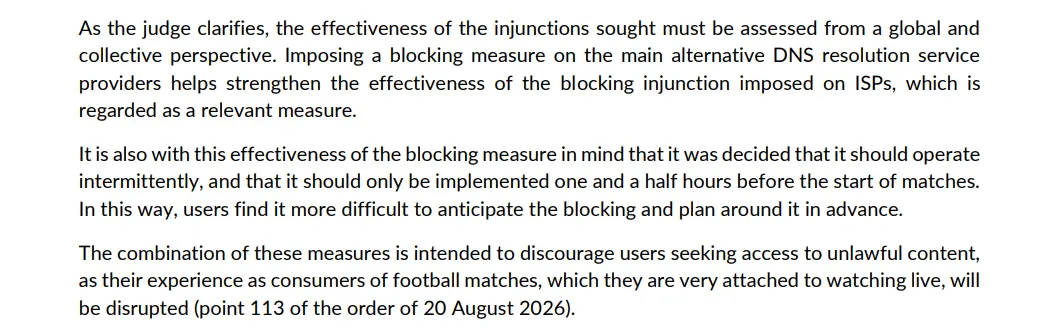
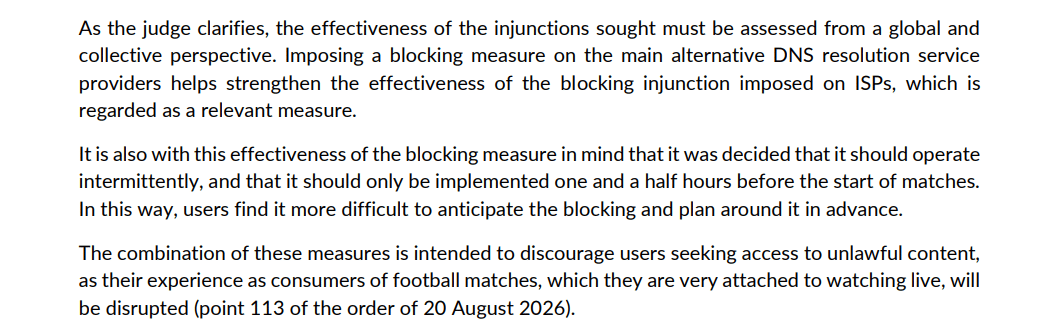
The implementation order emphasizes that integrating alternative DNS resolution services into the national blocking architecture significantly closes loopholes left by traditional ISP-level filters. The regulatory rationale is straightforward: by attacking the resolution layer directly, rights holders can effectively degrade the user experience for consumers attempting to access unauthorized streams of live football matches, a form of digital consumption to which dedicated fans are intensely attached.
Despite upholding the core framework, the court ruling did provide a few measured concessions to the DNS providers. Most notably, the court scrapped a previously mandated requirement forcing resolvers to redirect blocked users to an explanatory warning page, acknowledging that such active user interaction cannot be reasonably imposed on passive DNS resolution infrastructure.
The punitive framework for non-compliance was also modified to be somewhat more moderate. While the steep €100,000 daily fine remains intact, it will only accrue on days when DAZN matches are actively broadcast live. Additionally, the court instituted a cumulative cap of €20 million per company and clarified that technical under-blocking caused by exceptional and unforeseen geolocation errors will not trigger financial penalties.
Evolving Blocklist with a 90-minute Clock
The newly detailed enforcement mechanism outlines precisely how the blocking orders will operate in practice. Covering core Belgian football competitions such as the Jupiler Pro League, the framework allows DAZN to submit a single blocklist update per week, containing a maximum of 100 newly identified domains.
Rather than adhering to a rigid, predictable schedule, DAZN can select which specific matchday it wishes to target for a blocklist update, provided it submits the request at least seven working days in advance. Once notified, the DNS resolvers are given a window of five working days to implement the requested changes within their systems.
To maximize the disruption of illicit broadcasts, the actual blockades are mandated to go live precisely 90 minutes before the opening whistle of a targeted match. This dynamic timing is intentionally designed to catch unauthorized streaming operators and their audiences off guard. By operating the blocks intermittently and restricting their activation to a narrow window shortly before kickoff, regulators aim to make it exceedingly difficult for users to anticipate disruptions, find alternative workarounds, or migrate to unblocked proxy domains in advance.
Data illustrating the evolution of these measures highlights their dynamic nature. Publicly available statistics indicate that the number of domains actively targeted under this specific order has expanded significantly, growing from 58 to 258 since the initial enforcement action was launched.
OpenDNS Exit Looms
While Google and Cloudflare previously adapted their systems to comply with the initial directives—and will maintain their current operational posture under the latest ruling—Cisco faces a vastly different operational reality.
During the court hearings, Cisco made its position unequivocally clear, informing the anti-piracy department that it has no alternative but to withdraw OpenDNS from Belgium once again. The networking giant explained that its global public DNS infrastructure is fundamentally architectural in a way that "does not allow for the implementation of selective, geolocated and dynamic blocking as required by the order." Cisco warned that attempting to hardcode such localized filtering mechanisms into its global public architecture would actively compromise the overall performance, stability, and security of the service.
Faced with these technical constraints, the company maintained that pulling out of the Belgian market is the only concrete and viable measure it is technically equipped to implement. The Belgian anti-piracy department has formally accepted this drastic withdrawal as a valid form of compliance under the terms of the injunction.
Under the current timeline, the DNS resolvers have a three-month window to fully implement the mandated blocking measures. At the time of publication, OpenDNS remains fully operational in Belgium, and Cisco has indicated its intention to pursue an appeal against the Brussels court ruling. However, unless higher judicial intervention alters the course of the litigation, local OpenDNS users face the distinct prospect that the service will go dark for a second time later this year.
In a brief statement following inquiries regarding the timeline, a Cisco spokesperson reiterated the current status, noting that "OpenDNS currently remains available in Belgium."
A complete copy of the Belgian anti-piracy department’s implementation decision has been made publicly available for legal and technical review.