
For well over a decade, copyright holders have utilized U.S. federal courts as a routine mechanism to unmask anonymous BitTorrent users, transforming the civil litigation process into a standardized operational model. Among the most prolific entities in this space is adult film producer Strike 3 Holdings, which has built an entire legal enterprise around filing thousands of "John Doe" copyright infringement lawsuits every year.
In a typical case of this nature, the studio petitions the court for a subpoena directed at the Internet Service Provider associated with a targeted IP address. Once the ISP hands over the subscriber’s identity, the copyright holder often approaches the alleged pirate with a monetary settlement offer, effectively resolving and concluding the litigation before it ever reaches a trial. This repetitive cycle has fueled countless legal filings across federal jurisdictions nationwide.
However, last summer, Strike 3 shifted its legal strategy toward a significantly larger target. Partnering with Counterlife Media, the adult film producer filed a high-stakes lawsuit against social media titan Meta, accusing the tech giant of systematically downloading thousands of its copyrighted films via the BitTorrent peer-to-peer network to train artificial intelligence models. With 2,973 distinct motion pictures allegedly at stake, the ongoing corporate lawsuit carries potential statutory damages reaching up to $446 million.
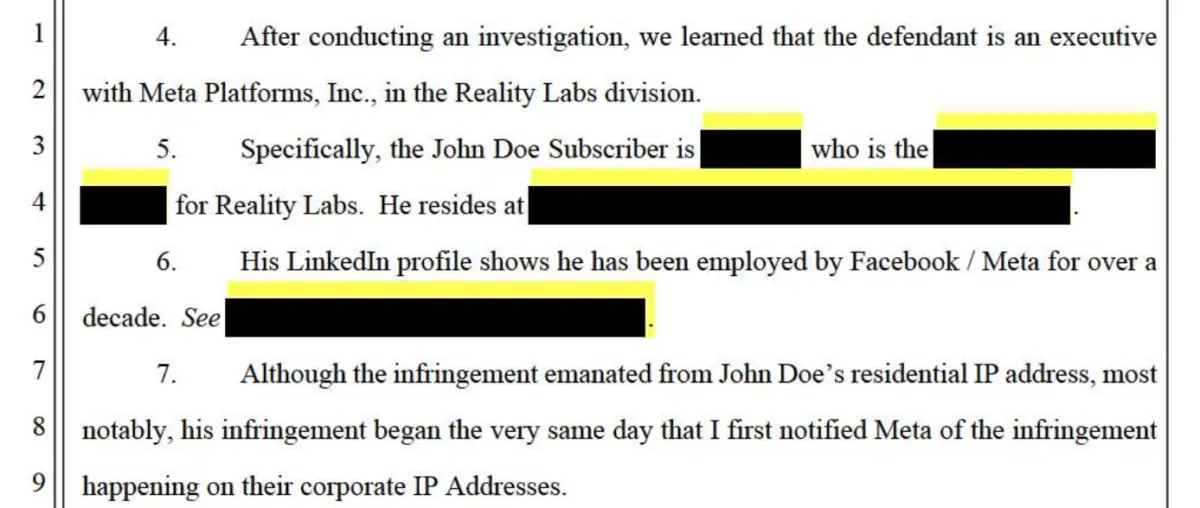
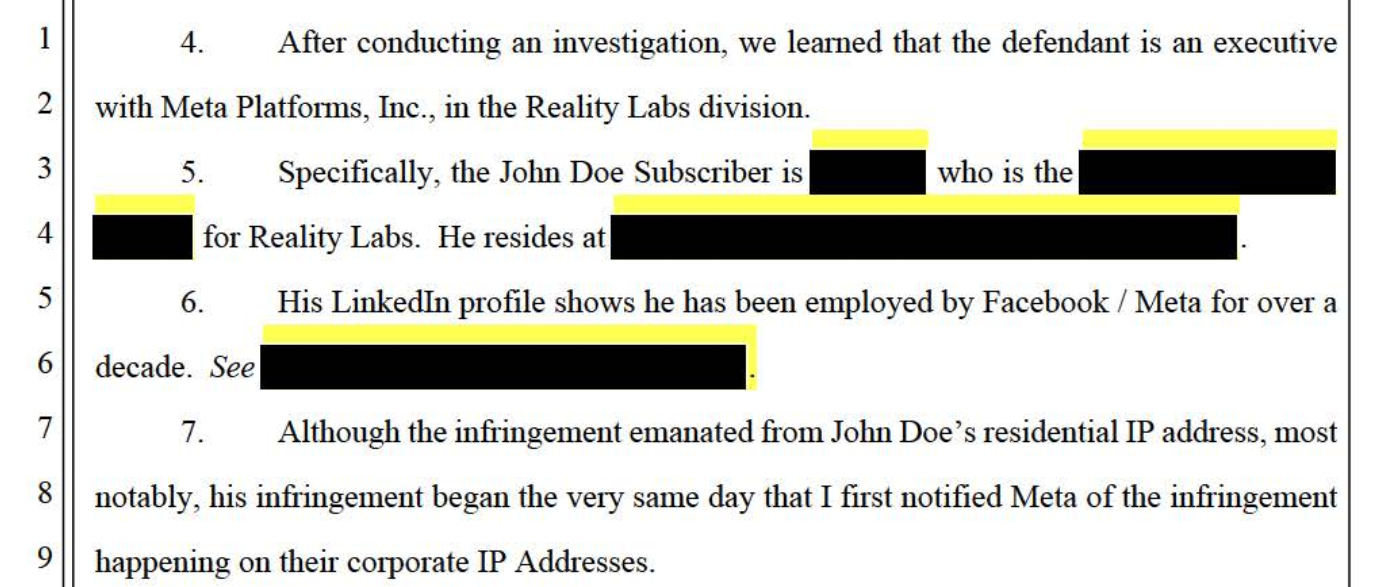
This multi-million-dollar copyright infringement battle has now unexpectedly collided with one of Strike 3’s standard, routine John Doe investigations. According to a legal motion filed in federal court last week, an anonymous residential BitTorrent user operating behind an AT&T internet connection has been identified as an executive within Meta’s Reality Labs division—the specialized department responsible for developing the company’s Quest virtual reality hardware ecosystem and immersive software environments.
From John Doe to Reality Labs Exec
The origin of this specific John Doe proceeding dates back to March, when Strike 3 filed a formal civil complaint at a California federal court targeting the subscriber assigned to the residential IP address 162.192.7.34. Shortly thereafter, in April, U.S. Magistrate Judge Virginia K. DeMarchi granted a formal third-party subpoena directed at AT&T, explicitly stipulating that the subscriber’s personal identity should be protected from immediate public disclosure to preserve procedural fairness while the preliminary investigation unfolded.

Following compliance from the telecom provider, Strike 3 asserts that its internal investigation successfully traced the account details back to an individual holding an executive position within Meta’s Reality Labs division. Pointing to professional networking data retrieved from the executive’s public LinkedIn profile, the copyright holder noted that the individual has maintained a continuous employment history with Facebook and subsequently Meta for more than ten years.
While the executive’s specific name and corporate title remain heavily redacted within public court filings—following a formal request by Meta to keep the identifying information under seal, mirroring similar treatments afforded to two other individuals previously named in the broader Meta litigation—Strike 3 argues that the subscriber is far from a standard home internet user.
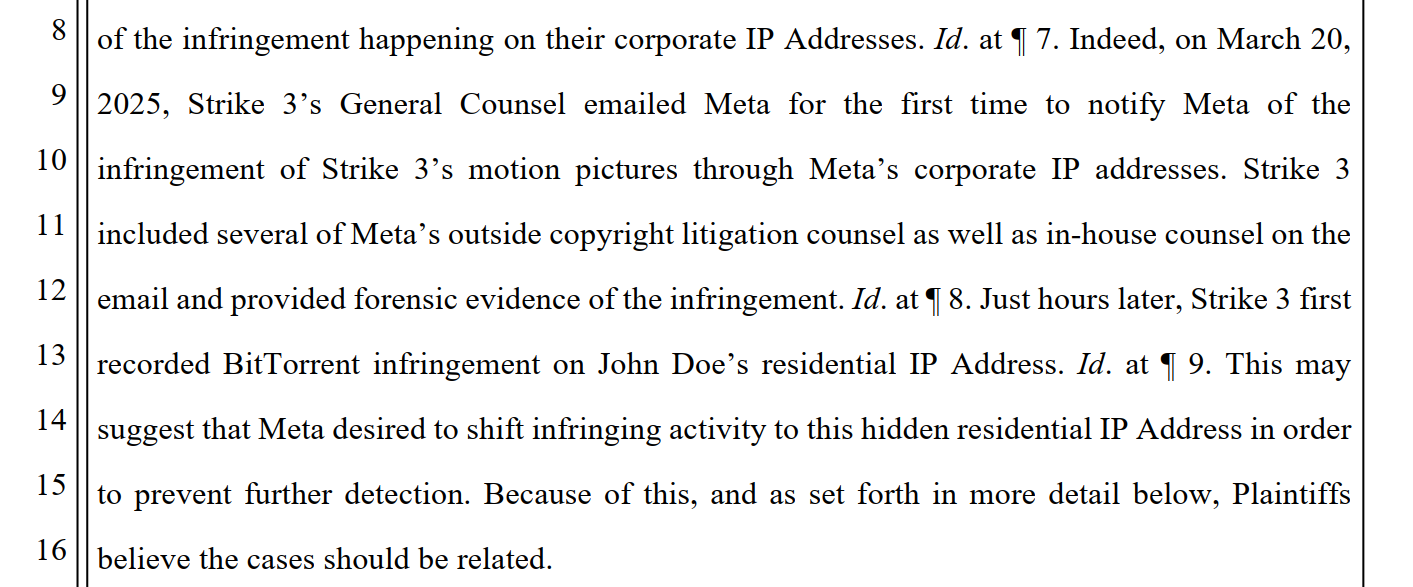
To support this assertion, the adult film studio points directly to the peculiar chronological timing of the BitTorrent activity. On March 20, 2025, Strike 3’s general counsel transmitted an initial electronic mail message to Meta’s legal representatives containing formal forensic evidence detailing unauthorized BitTorrent activity originating directly from the technology corporation’s official corporate IP addresses.
According to legal filings submitted by the plaintiff, just hours after that forensic notice was delivered, Strike 3’s monitoring systems recorded BitTorrent infringement occurring for the very first time on the John Doe defendant’s residential IP address. The copyright holder argues in its motion that this striking chronological proximity suggests Meta may have attempted to divert its unauthorized downloading operations away from corporate networks and onto a concealed residential internet connection to evade further detection by copyright enforcement software.
Nearly 20,000 Files
Beyond the suspicious timeline of events, Strike 3 heavily emphasizes the sheer volume of downloaded files associated with the John Doe connection to bolster its legal arguments. Over the course of monitoring the account, the company logged all detected BitTorrent traffic linked to the executive’s residential connection, resulting in a staggering total of nearly 20,000 downloaded files.
This massive repository of peer-to-peer traffic notably includes virtual reality adult media titles specifically engineered for compatibility with Meta’s Quest hardware line. Strike 3 contends that the nature and volume of these specific downloads align closely with internal research and development objectives aimed at ensuring the Quest headset ecosystem successfully integrates with adult entertainment content.
Furthermore, the plaintiff’s filings indicate that as recently as August 25, automated monitoring systems recorded more than 150 daily downloads from the same residential IP address. This daily influx included multi-language "Mega Packs" spanning television shows, mainstream feature films, complex software packages, digital books, and what the company characterizes as AI-generated pornography alongside specialized VR adult films—a batch that included nearly a dozen titles owned directly by Strike 3.
Arguing the improbability of these figures for a single domestic user, the company stated in its motion that the volume represents an exceptional amount of data for one individual to torrent during an average day, particularly someone holding a demanding corporate executive position. Instead, Strike 3 maintains that this relentless download pattern aligns much more logically with systematic AI training data acquisition or corporate technical research.
This development marks the second instance in which an employee or contractor from Meta’s Reality Labs division has materialized within the broader litigation landscape. Earlier in the summer, Meta formally confirmed that a former data engineer previously employed within the same hardware division was responsible for a Comcast internet connection linked to the unauthorized downloading of 97 copyrighted films.
Through its latest legal maneuver, Strike 3 is formally petitioning U.S. District Judge Eumi K. Lee to declare the John Doe proceeding "related" to the primary multi-million-dollar Meta lawsuit. Such a judicial determination would effectively consolidate the cases before a single judge, streamlining the judicial process by avoiding redundant depositions and discovery phases.
However, the implications of the motion extend significantly further. Granting the request would effectively convert the executive’s personal home downloading history into admissible evidence within the overarching $446 million copyright infringement suit. If the cases are successfully linked, Strike 3 intends to amend its original John Doe complaint to name Meta directly as a party, assert that the executive shares joint liability for the infringement, and move to compel Meta to appoint a specialized Reality Labs custodian while turning over comprehensive corporate torrenting records.
Meta: ‘Nothing Ties’ Downloads to Company
Responding to the plaintiff’s motion to relate the separate judicial proceedings, Meta filed legal arguments addressing the claims. Officially, the social media corporation adopted a neutral position regarding the administrative consolidation of the cases, noting that it cannot independently investigate whether the targeted subscriber is even a current employee without knowing the individual’s redacted identity. However, the tech giant firmly maintains that even if the subscriber matches Strike 3’s description, absolutely no factual nexus connects the residential downloads to corporate operations.
In its written response, Meta criticized the plaintiff’s logic, arguing that the studio simply assumes the residential subscriber is personally responsible for every data packet transmitted across their home IP address, and then leaps to the additional, unsupported assumption that those actions were executed on behalf of Meta.
In doing so, Meta relies on a defense frequently deployed in BitTorrent copyright infringement litigation, emphasizing that a numerical IP address fundamentally identifies a network connection rather than a specific individual infringer. This exact vulnerability in peer-to-peer evidence was previously highlighted by Magistrate Judge DeMarchi when she initially evaluated and granted the third-party subpoena against AT&T.
Additionally, Meta pointed out a fundamental contradiction within Strike 3’s overarching legal theories. While the plaintiff’s new motion speculates that the executive abruptly shifted unauthorized downloading operations to a home connection mere hours after receiving a March 2025 warning, the core complaint filed by Strike 3 alleges that Meta’s unauthorized "off-infra" downloading activities actually commenced as early as 2018, and asserts that downloads across corporate IP addresses continued unabated long after formal legal notices were served. Consequently, Meta argues that the plaintiffs’ shifting theories cannot be logically reconciled with the claims they are already pursuing in court.
Meta has previously invoked similar personal-use defenses in related litigation. When a separate Reality Labs worker—identified as a former contractor—surfaced in the separate Kadrey copyright lawsuit, Meta maintained through internal investigations that the individual’s downloading activities were strictly personal and entirely unrelated to their official job responsibilities.
Whether U.S. District Judge Eumi K. Lee ultimately decides to formally link the residential John Doe proceeding to the $446 million Meta lawsuit remains to be determined. For the time being, the Reality Labs executive at the center of the dispute remains legally anonymous, shielded from public scrutiny even as the high-stakes legal battle moves forward in federal court.