
If there is one thing robotics founders and investors broadly agree on, it is that the elusive "ChatGPT moment"—the point in time when a general-purpose robot can seamlessly adapt to any environment and perform arbitrary tasks—has not yet arrived. Across the industry, opinions vary sharply on whether this monumental breakthrough is just around the corner or still a decade away.
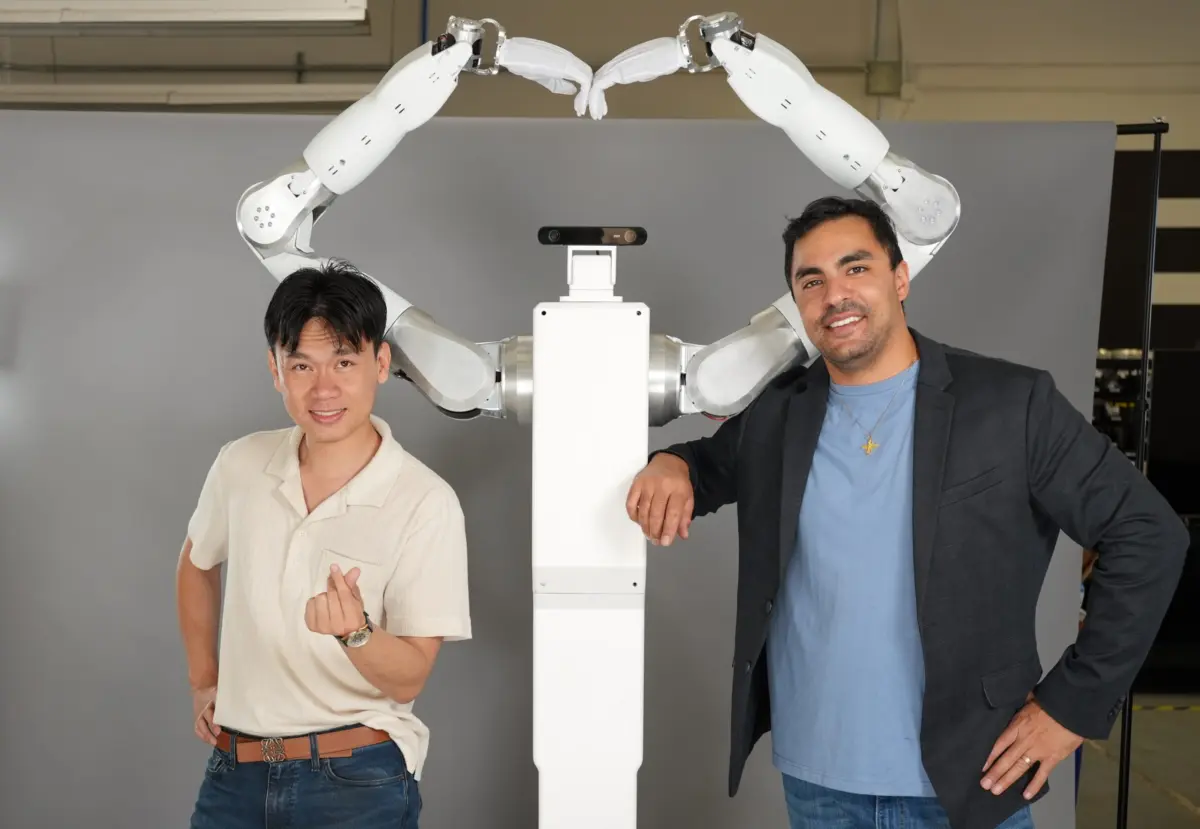
Rather than trying to guess the exact timeline, humanoid startup Feather Robotics is deliberately developing products designed to thrive under either scenario. Founded last year, Feather is taking a fundamentally different path from high-profile competitors like Tesla or Figure. While those heavyweights are tackling the extraordinarily ambitious mission of simultaneously building both the physical robot body and a proprietary foundational "brain" that is not yet widely deployed to third-party developers, Feather is taking a modular approach. The startup provides a versatile hardware and software toolkit designed to empower developers to tackle real-world tasks right now.
"You can’t buy a Tesla robot today and develop on top of it," Feather co-founder Hoa Mai explained in an interview. "We realized that this is not how most companies became successful. Hardware players like Nvidia or Apple started with a product that worked and was deployable, and then they added complexity over time."
The startup was born out of deep industry expertise. Following the acquisition of his previous humanoid robotics startup by 1X, Mai teamed up with Parsa Bakhtiari, a former Tesla Model 3 engineer who at one point reported directly to Elon Musk. Together, the co-founders set out to build what they hope will ultimately become the ubiquitous Android operating system equivalent for the robotics industry.
That expansive vision quickly caught the attention of venture capital firm Gradient Ventures. The firm backed Feather at its inception, leading the startup’s previously announced $7.6 million pre-seed funding round. Since that initial injection of capital, Feather has moved rapidly from concept to commercialization, rolling out a modular robotic system that allows developers to easily customize hardware configurations for diverse use cases, such as adjusting arm lengths to suit specific operational environments.
The strategy is already yielding financial results. Feather has quietly begun selling its modular systems to commercial customers, successfully surpassing $1 million in revenue. While the startup is currently keeping its customer roster under wraps, it notes that its robots are already performing active duties in the real world, working as cooks in commercial kitchens and handling cleanup tasks in delicate science laboratories.
On the software side, Feather’s hardware is designed to be completely open and adaptable. The robots are capable of running models from any leading robotics artificial intelligence provider currently operating in the market, including major players like Nvidia, Skild, and Physical Intelligence.
"We’ve been selling small quantities of these robots, and now that we resolved like almost all the issues over the last year of field testing, we’re getting ready for a big product launch," Mai said, signaling an impending expansion for the young company.
According to Darian Shirazi, a general partner at Gradient Ventures, Feather currently occupies a unique position with virtually no direct competitors in the United States. Shirazi breaks down the current hardware robotics landscape into three distinct categories: startups focused on domestic household applications, such as Sunday; heavyweights like Figure and Tesla, which are aiming directly at general-purpose machines; and Feather, which he believes stands alone as the only U.S. startup developing a modular humanoid platform explicitly designed for developers and immediate commercial deployment.
Mai openly admits that Feather took a page from the playbook of Chinese robotics companies like Unitree, which have made significant strides in hardware development. However, with new foreign-made models facing strict regulatory restrictions preventing them from entering the U.S. market, Feather finds itself uniquely positioned as a homegrown, accessible alternative of its kind.
Another major pillar of Feather’s competitive advantage is its aggressive pricing strategy. The startup’s robot is priced at $30,000, which is roughly half the cost of competing models like Unitree’s H2 Edu.
Shirazi believes the potential market size at that price point could be exceptionally large, shifting the economic calculations for businesses struggling with labor shortages and operational expenses.
"You would hire a laborer for $50,000 to $60,000 a year, you’d have to train them. They’d have to have HR. They’d have to have all these different support mechanisms," Shirazi noted. "You can now buy a Feather robot to do that."
Beyond its pricing strategy, the startup has maintained strict financial discipline. According to Shirazi, Feather has operated with remarkable capital efficiency, having spent only a fraction of its pre-seed funding to achieve its current product maturity and revenue milestones.
At its core, Feather’s foundational business bet is that the long-term economic value in the robotics revolution will not reside in the hardware alone, but in the vibrant software ecosystem that develops around standard, reliable platforms.
"If we think about the market size today for physical AI companies, it’s very small," Mai said. "But if you think about how many physical AI application companies will probably exist in five years, we expect it to be in the thousands."
With its modular hardware, flexible software integrations, and developer-first mentality, Feather hopes to become the foundational platform that powers every single one of them.