
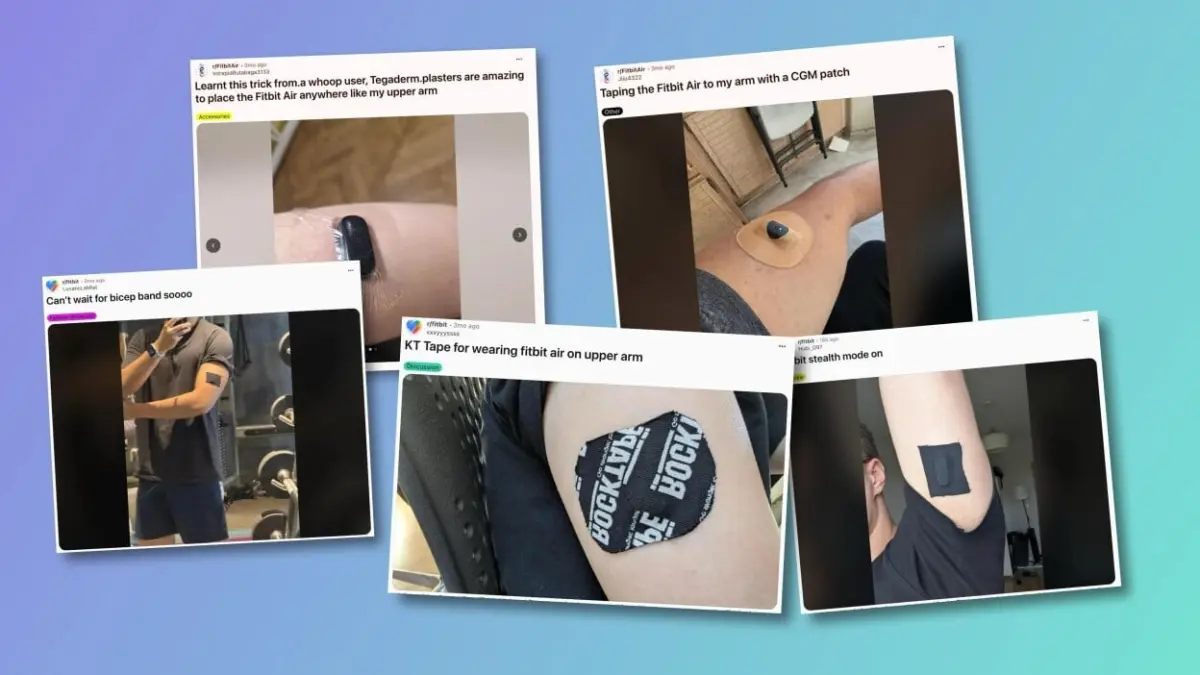
The modern wearable technology market has long operated on an implicit assumption: fitness trackers belong on your wrist. Whether it is a traditional smartwatch, a minimalist band, or an advanced biometric ring, the wrist has traditionally served as the default real estate for digital health monitoring. However, a growing subculture of fitness enthusiasts is pushing back against this ergonomic standard, trading wristbands for rolls of medical tape and adhesive patches.
On online communities such as Reddit, users have increasingly documented an unconventional modification: removing the standard strap from devices like the Fitbit Air and taping the tracker directly to their upper arms. While brands like Whoop have successfully popularized alternative placement options—such as bicep bands and specialized athletic garments—companies like Google have yet to officially release dedicated upper-arm accessories for every model in their lineup. Left without official hardware alternatives, consumers are taking matters into their own hands, sparking a quirky yet surprisingly functional viral trend.
Why Are People Taping Fitbits to Their Arms (and What Kind of Tape Works Best)?
The motivation behind abandoning the wrist is largely centered around comfort, utility, and aesthetic preference. Taping a fitness tracker to the upper arm removes the device entirely from the wrist area. For individuals engaging in heavy weightlifting, cross-training, or combat sports, a wrist-mounted tracker can frequently interfere with wrist wraps, lifting straps, and kettlebell handles. Furthermore, moving the tracker off the wrist allows wearers to style their clothing, sleeves, and accessories without interference from a bulky piece of plastic and glass. While these may be considered minor inconveniences in daily life, the appeal of a wearable device that completely fades into the background is significant for dedicated athletes and casual users alike.
As this trend has gained momentum online, early adopters have begun experimenting with various adhesive products to keep their devices secure. Initially, many turned to KT tape—the stretchy, synthetic athletic tape commonly used by runners and weightlifters to stabilize sore muscles or minor joint injuries. However, practical testing reveals that standard athletic or medical tape often falls short of long-term expectations. During intense, sweat-inducing workouts followed by routine showers, smaller strips of traditional athletic tape frequently begin peeling at the edges within a single day. While a large, continuous strip of tape possesses enough surface area to maintain a strong hold, cutting a small piece to secure a compact tracker provides far less adhesive power.
To solve this durability issue, some of the most resourceful users have turned to continuous glucose monitor (CGM) overpatches. CGMs are small, specialized medical devices typically applied to the back of the upper arm, where a tiny filament pierces the skin to monitor blood sugar levels. Because these medical devices must remain firmly attached for up to two weeks through sleep, heavy perspiration, and daily showers, patients often secure them with large, waterproof overpatches. These heavy-duty adhesive stickers have proven to be exceptionally well-suited for anchoring a strap-less Fitbit to the arm for extended periods. Given that a typical CGM lasts roughly two weeks and a device like the Fitbit Air features a battery life of about one week, these overpatches offer more than enough structural integrity to bridge the gap between charging cycles.
Does Taping a Fitbit to Your Arm Actually Work?
While internet trends often prioritize novelty over functionality, putting an adhesive-mounted fitness tracker through rigorous real-world testing yields surprisingly positive results. Health journalists and tech reviewers who have tested the upper-arm method report that devices attached with proper CGM overpatches remain remarkably secure, even during strenuous outdoor runs and high-humidity workouts. Furthermore, biometric data collection remains largely intact; heart rate readings captured from the back of the upper arm frequently align closely with data from traditional wrist-worn devices and alternative tracking monitors.

Nevertheless, relocating a biometric sensor from the wrist to the upper arm introduces distinct technical trade-offs. One primary variable is physiological consistency. Because human anatomy varies significantly from person to person, the upper arm may not offer the same optimal vascular access for optical heart rate sensors on every body. On the positive side, placing the tracker underneath a thick, opaque overpatch successfully blocks out ambient light—a factor that can frequently interfere with optical sensors on loose wristbands—thereby helping to maintain consistent sensor contact against the skin.
Activity detection algorithms, however, present a more noticeable hurdle. Modern fitness trackers are meticulously programmed to interpret movement based on the biomechanical patterns expected from a human wrist during daily routines and athletic training. When the device is strapped to an upper arm instead, its accelerometer registers entirely different motion profiles. Consequently, automated workout detection features often fail to recognize when a run or cycling session has begun. Users attempting this method frequently find that manual workout tracking becomes necessary if they want precise start and time stamps for their training sessions.
How a Week of Fitbit Taping Went in Practice
Living with an adhesive-attached fitness tracker for an entire week reveals a unique mixture of seamless convenience and minor operational friction. For starters, the passive tracking experience reaches an unprecedented level of invisibility. Without a rigid rubber or metal band constricting the wrist, wearers often forget they are monitoring their biometric data entirely. Receiving smartphone notifications from health companion apps regarding sleep quality or completed physical activity often serves as the only reminder that the tracker is even there, outperforming even minimalist smart rings in terms of set-it-and-forget-it comfort.
Yet, the logistical realities of managing a taped-on device eventually catch up with the user, particularly when it comes to battery maintenance. Most fitness trackers require weekly recharges, a routine that usually involves simply unclasping a wristband and dropping the unit onto a magnetic dock. When the tracker is securely glued to the back of the arm beneath a medical-grade overpatch, however, popping it off for a quick charge is no longer a casual option. Users are forced to endure low-battery warnings from companion apps for hours, waiting for an opportune moment to remove the adhesive entirely.
Peeling off a high-strength medical overpatch is rarely a trivial task, and the process demands strategic timing. The most effective approach involves removing the patch during or immediately after a warm shower, allowing hot water and steam to loosen the industrial-strength adhesive against the skin. Even so, once the patch is successfully removed, users face secondary inconveniences, such as safely managing the loose tracker in a wet environment while stepping out of the shower.
Ultimately, while the upper-arm taping trend involves notable compromises—including the recurring cost of replacement patches, the annoyance of adhesive residue cleanup, and the loss of automated motion detection—it offers a viable alternative for individuals who despise traditional wristbands. For those willing to navigate the minor logistical hurdles of medical-grade adhesives, relocating the fitness tracker to the arm provides an unobtrusive, comfortable path to round-the-clock health monitoring.