
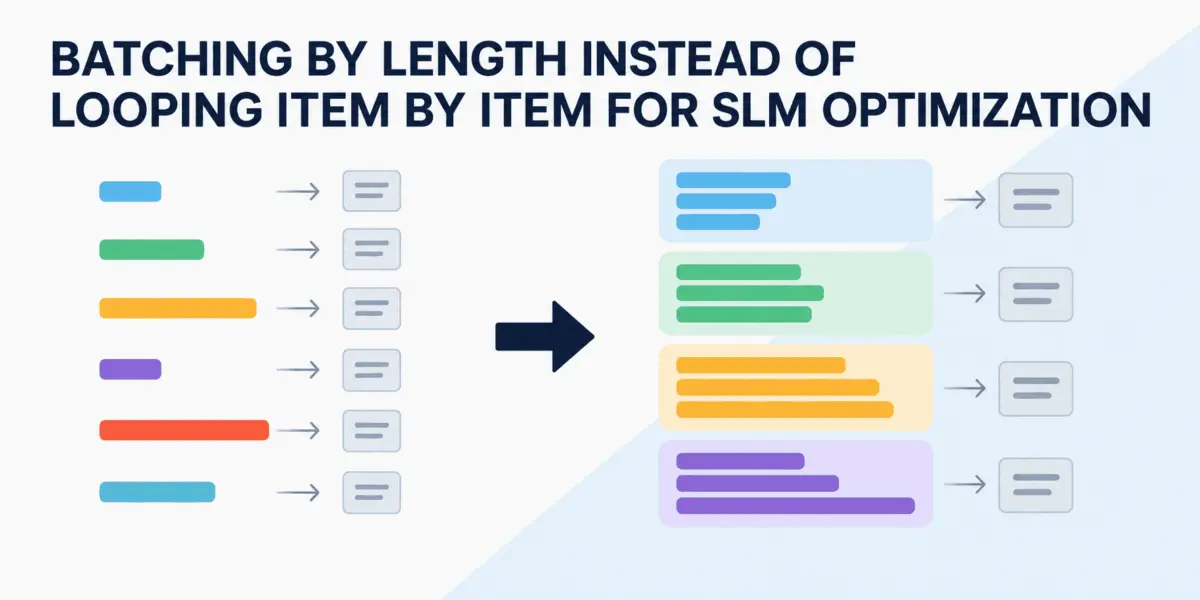
As the artificial intelligence community shifts focus toward edge deployment and efficient localized applications, optimizing inference pipelines for small language models (SLMs) has become a primary engineering focus. In the final installment of a technical series exploring narrow automation optimization for SLMs, developers are turning their attention away from individual item processing and toward an essential hardware-level efficiency technique: batching by token length instead of looping item by item.
Previous analyses in the series examined strategies such as constraining output spaces to narrow automation parameters and reusing prompt prefixes via key-value caches. While those methods significantly reduce computational overhead and memory repetition, processing requests one by one remains a massive bottleneck in typical production workflows. Throughout these benchmarks, evaluations rely on the Qwen2.5-0.5B-Instruct model in float16 precision via Hugging Face Transformers, running locally on hardware representative of modern edge environments, specifically an M2 MacBook Air equipped with 24GB of RAM and a 16-core Neural Engine.
The underlying inefficiency of processing a single support ticket or text classification request per forward pass stems from memory bandwidth constraints rather than raw compute limitations. When operating at a batch size of one, a small model is fundamentally memory-bandwidth bound. The hardware must stream every single model weight out of memory to process a single sequence, discard or cache the intermediate states, and then repeat the exact same expensive memory read process for the next sequence. Consequently, the processor’s arithmetic execution units sit largely idle between memory fetches. This performance bottleneck occurs consistently whether running on dedicated graphics hardware or the local CPU environments where sub-billion-parameter models are frequently deployed.
Batching multiple requests together naturally amortizes the cost of reading model weights across many sequences, dramatically improving overall throughput. However, standard batching introduces its own form of computational waste. Because standard machine learning frameworks require all sequences within a given batch to share an identical tensor shape, shorter texts must be padded with placeholder tokens to match the length of the longest item in that specific batch.
In real-world text classification tasks—such as processing customer support tickets—the length distribution typically exhibits a long tail. While the median text length might sit well under a hundred tokens, the longest items in the dataset can stretch to several hundred tokens. If every batch is naively padded to the global maximum length of the entire dataset, a vast majority of the computed tokens end up being useless padding rather than actual signal.
The architectural solution to this problem is sorting requests by token length before assembling them into batches. By organizing the dataset by sequence length, each resulting batch contains similarly sized items and only needs to pad up to its own local maximum. This drastically reduces the total volume of padding tokens processed by the model, preserving hardware efficiency without sacrificing data integrity.
To understand the scale of improvement, performance baselines can be measured against a simulated long-tailed ticket distribution. In a sequential, item-by-item loop where each classification step costs a single forward pass, the system processes requests individually. Due to the constant memory reloading required for every single ticket, processing hundreds of distinct items takes minutes of wall-clock time, yielding a modest throughput measured in single-digit items per second. Furthermore, calculations reveal that padding such a dataset to a single global maximum length would force the hardware to compute nearly four times the number of necessary tokens, compounding resource waste.
Transitioning to a batched architecture fundamentally alters these performance dynamics. When processing the same dataset using length-bucketed batches, the time required to complete the workload drops significantly. By grouping similarly sized inputs, the padding overhead—the percentage of processed tokens that carry no semantic value—plummets to single-digit percentages.
A crucial aspect of validating any model optimization is ensuring functional correctness. Performance enhancements that alter model outputs or introduce classification regressions are entirely counterproductive. Rigorous testing comparing batched predictions against unpadded, single-item baseline runs verifies that length-bucketed batching preserves complete alignment in model outputs. The speedup is achieved purely through intelligent workload scheduling and reduced padding overhead, rather than any alteration to the underlying mathematical weights or inference logic.
Engineers must also consider how different optimization techniques interact when deployed together. For instance, combining prefix caching with length-bucketed batching requires careful implementation. Because prompt prefix caches typically operate under a batch dimension of one, reusing a cache across a dynamic batch requires explicitly expanding tensor dimensions to match the batch size and correctly cropping them afterward. While complex, such compositions yield substantial efficiency gains when handling extended prompt prefixes, provided developers rigorously verify predictions against unpadded reference paths.
This technique concludes the technical exploration into narrow automation optimization for small language models. By replacing inefficient item-by-item loops with length-sorted batches, developers can effectively navigate the hardware-bound constraints of edge inference. The resulting performance gains demonstrate that substantial efficiency improvements are often achievable simply through better workflow organization and resource scheduling, without requiring compromises in model accuracy or output reliability.