
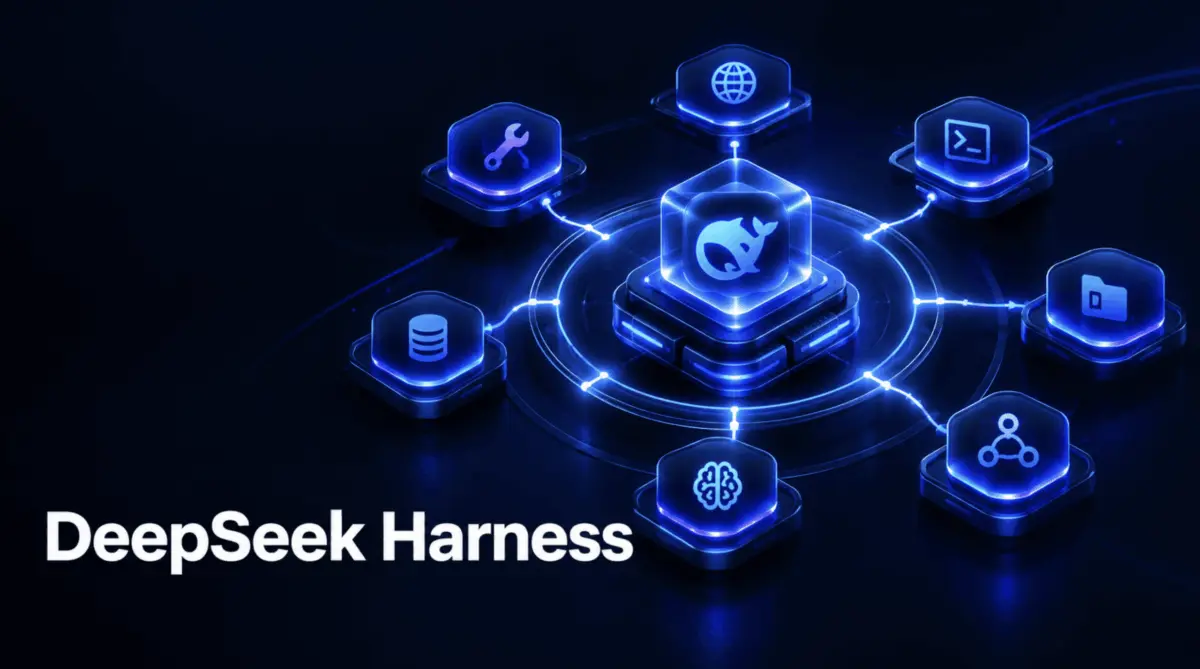
On August 13, 2026, DeepSeek quietly open-sourced an agent runtime called DeepSeek Harness, operating under the command-line interface name dsh, and the reaction from the global software engineering community was anything but quiet. The repository captured roughly 50,000 GitHub stars in its first twelve hours, climbed to approximately 92,000 by hour twenty-eight, and ultimately surpassed 186,000 stars with over 20,000 forks within just ten days. Such velocity is exceptionally rare even by the rapid standards of modern artificial intelligence tooling, prompting a closer examination of what actually drove this unprecedented adoption. The straightforward answer is that it represents something fundamentally different from merely another improved coding agent.
What’s the Buzz About DeepSeek Harness?
The central architectural claim championed by DeepSeek throughout the release is that literally every layer of an agent is treated as an independent plugin. This modular design encompasses the model adapter, the tool registry, the session log, the sandbox, the user interface, and even the core agent loop itself. The entire system is built upon Cordis, a plugin framework with a proven production track record spanning four years inside the Koishi chatbot project before DeepSeek adopted it for this initiative, rather than a framework hastily manufactured solely for this launch. Furthermore, this design is thoroughly documented in an accompanying academic paper titled "A Programming Paradigm for Spatiotemporal Composability," providing a level of rigorous theoretical grounding that most agent tooling releases rarely bother to establish.
To understand the scope of the project, it is essential to recognize that this is not a ready-to-use coding agent that developers can immediately point at an existing repository to solve everyday tasks. Instead, it serves as the foundational machinery and infrastructure from which sophisticated coding agents can be assembled.
This strategic move aligns with DeepSeek’s history of prioritizing open infrastructure over closed, walled gardens. The release of DeepSeek-R1 in January 2025 marked a watershed moment as the first open, MIT-licensed frontier-class reasoning model originating from outside the traditional dominant United States laboratories. Trained for a fraction of the capital required by comparable Western models, DeepSeek-R1 fundamentally reset industry assumptions regarding who possesses the capability to ship frontier artificial intelligence in the open. The launch of Harness reads like that exact same philosophy applied one layer higher up the technology stack. Rather than limiting open access to model weights alone, DeepSeek has open-sourced foundational agent infrastructure, publishing the repository simultaneously with the announcement rather than relying on prolonged pre-launch hype cycles.
What I Found When I Ran It
Because the project ships as a standard npm package, developers can install and interact with it directly through the command line. Executing the version check reveals the underlying release structure, aligning with the version history maintained on the project’s official GitHub releases page and confirming that the package is an active, current distribution.
The command-line interface provides distinct profiles that dictate how the runtime behaves upon execution. Booting the web profile launches the browser-based user interface, while the headless profile is designed to answer a single task, output the result, and immediately exit. Additional configurations include textual user interface and rescue profiles, each representing a unique stack of mounted plugins operating under the unified launcher. Similarly, managing capabilities is handled as an ordinary package installation process rather than relying on a proprietary or separate mechanism.
A particularly revealing diagnostic capability within the tool is a configuration dump flag, which prints the entire composed plugin tree for a given profile before the system formally boots. When executed against the default web profile, the output details a massive collection of separately named, independently swappable plugins. Every component, ranging from the sidebar and the primary chat window down to the approval prompt, the sub-agent panel, and a scheduling interface shipped disabled by default, operates as its own installable package equipped with a unique identifier. Once observed in practice, this confirms that the architecture is genuinely fine-grained down to individual user interface panels that conventional tools typically treat as a single monolithic frontend.
Testing the one-shot headless pathway without a pre-configured model credentials key triggers an immediate, precise error message rather than a generic or obscure stack trace. This targeted notification clearly identifies the missing API key for the designated provider route, demonstrating a deliberate design focus on helpful error handling and thoughtful developer experience during failure states.
My Take
The genuinely distinctive bet embedded within DeepSeek Harness is not merely the sheer volume of its plugins, but the radical decision to treat the core agent loop itself as a standard plugin. In conventional platforms, altering how the core reasoning loop behaves typically requires modifying and recompiling a compiled binary. Within dsh, however, the execution loop resides within an ordinary package that can be swapped directly via configuration settings in the exact same manner one would substitute a user interface panel. This represents a profound architectural distinction rather than a superficial rebranding of standard extensibility, which explains why engineers dedicated to building core agent infrastructure are paying close attention.
Despite this architectural elegance, the project is not yet suited for broad, mainstream recommendations. It is explicitly and repeatedly characterized as a developer preview by its creators, and the surrounding ecosystem is still in the process of initial assembly. Independent plugin directories tracking early community contributions catalog a growing collection of community-developed plugins spanning multiple functional categories, illustrating an active but nascent ecosystem.
Who Should Actually Care Right Now
For developers and organizations actively building agent infrastructure, or for engineers who prefer the flexibility to swap out session stores or sandboxing backends without resorting to extensive code forks, DeepSeek Harness warrants serious evaluation today. The underlying architecture is robust and functionally operational, avoiding the common pitfalls of vaporware. However, for practitioners whose primary objective is acquiring a polished, daily-driver coding agent to immediately replace existing tools in their morning workflows, that destination has not yet been reached, and the project’s maintainers make no claims to the contrary.