
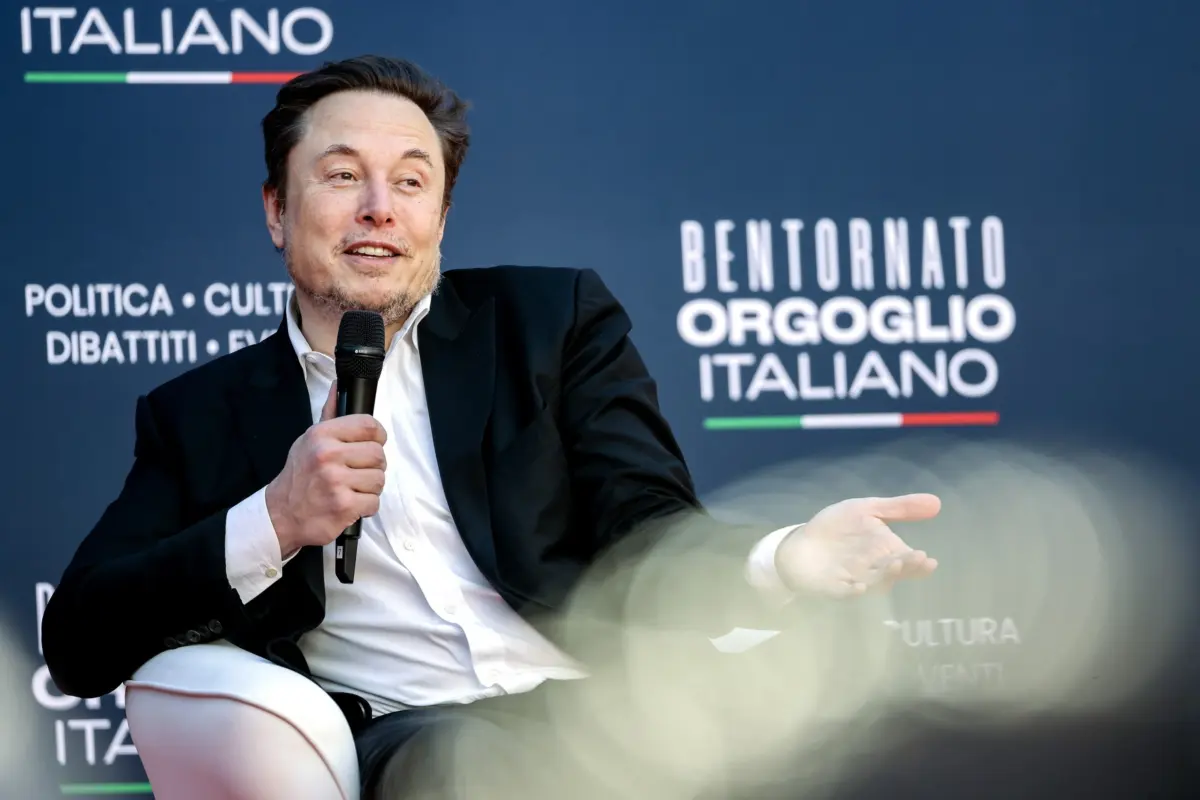
Is being recognized as the world’s wealthiest individual simply not enough to satisfy Elon Musk’s desire to be viewed as a singular, peerless intellect? For the billionaire entrepreneur, the answer appears to be a resounding no. Musk seemingly feels a constant compulsion to remind the public of a mind so mighty and expansive that it is allegedly wasted on traditional, highly respected intellectual pastimes like chess.
So convinced is Musk that the ancient board game is fundamentally beneath his cognitive architecture that he has recently entered into a public, digital dispute about the matter with Chess.com, one of the leading global authorities on chess expertise, theory, and artificial intelligence integration.
The latest inane saga kicked off on X, the social media platform formerly known as Twitter and currently owned by Musk, when the tech executive responded to a post detailing the staggering number of possible move combinations in a game of chess. To a mind as accustomed to cosmic-scale thinking as Musk’s, the actual number—which sits at a mind-boggling scale of roughly 40 orders of magnitude greater than the total number of atoms in the entire observable universe—apparently failed to be sufficiently large or complex enough to hold his lasting interest.
Instead of marveling at the combinatorial depth of the game, Musk chose to minimize it. "The actual number of moves that are not utterly stupid in chess is tiny," he claimed on the platform, adding his prediction that "chess will be fully solved one day."
It was at this juncture that the social media manager for Chess.com entered the digital fray, offering a succinct, modern internet rejoinder designed to poke fun at the billionaire’s grandstanding: "skill issue."
Naturally, the bait worked precisely as intended.
Stung by the casual dismissal of his intellectual framing, Musk doubled down on his assertions regarding the mechanical nature of the game and the inevitable triumph of computing power over human strategy. "Chess is hard for humans, but not for computers. One day, it will be fully solved like checkers," Musk wrote, essentially repeating his initial premise. "Between now and then, or even after, have fun. People enjoy many games/sports where machines are vastly better."
The irony of the exchange appeared to elude few observers. Indeed, ordinary human beings—those allegedly not possessing Musk’s extraordinary level of intellect—manage to spend their finite, fleeting time on this planet enjoying various recreational activities, games, and sports. They do so blissfully unburdened by the existential dread that a hypothetical machine might one day make absolute mincemeat of those activities through raw computational brute force. And yet, by his own admission, the head of Tesla, SpaceX, and xAI chose to spend a portion of his valuable day publicly arguing on the internet with what he initially assumed was "some random intern."
The digital sparring continued when the official Chess.com account politely clarified its operational structure to the platform’s owner, noting, "I’m a full-time employee."
From there, the conversation predictably devolved into broader ruminations on the nature of artificial intelligence and machine capability. Musk pontificated about how an artificial superintelligence—a theoretical milestone of computer science that researchers are still striving to determine is even physically and technically possible to build—will eventually "figure out ways to solve and compress that are far beyond what we could possibly comprehend." To seal his argument, he leaned heavily on conversations he claimed to have had with his own generative artificial intelligence chatbot, Grok, treating the machine’s echo as if it firmly settled the philosophical debate.
There is, of course, a genuinely fascinating intellectual discussion to be had regarding the mathematical concept of "solving" chess—a theoretical milestone that actual mathematicians, computer scientists, and theorists have explored and wrestled with for generations, long before the modern era of silicon chips and neural networks. Researchers have long noted that while checkers has indeed been weakly solved by computers, chess remains vastly more complex, making a complete computational solution a monumental hurdle. However, Musk’s arguments on the subject rarely read as objective mathematical inquiry; instead, they appear driven largely by a deep-seated personal contempt for the game. The board game, it turns out, is a long-held bugbear of his.
This skepticism toward the cultural reverence afforded to chess is not a newly minted perspective for the entrepreneur. Back in 2022, in a now-infamous post on the platform, Musk opened up about his childhood relationship with the game, explaining that he ultimately stopped playing chess when he was young because he "found it to be too simple to be useful in real life." In the same breath, he pivoted to extolling the virtues of Polytopia, a tactical mobile strategy game, positioning it as a far superior intellectual sandbox and the preferred activity of choice for the true cognoscenti.
He struck a nearly identical chord amid his recent public battle with Chess.com. Responding to another user’s commentary on the platform, Musk elaborated on his historical disillusionment, writing that he "felt diminishing returns from chess in terms of transfer learning to understand reality." The next time an opponent completely dominates you across the checkerboard, you might consider deploying that particular phrase as a sophisticated philosophical excuse for your defeat.