
The artificial intelligence landscape moves at a breathless pace, often alternating between genuine architectural breakthroughs and overhyped marketing cycles. Recently, social media feeds, YouTube channels, and tech influencers have been flooded with commentary surrounding "Jev," a newly introduced model from TypeSafe AI. While many online commentators have framed the release as a paradigm-shifting invention that completely rewrites the rules of machine learning, a closer examination reveals a more nuanced reality.
For industry practitioners and machine learning engineers who have spent years navigating classifiers, natural language processing pipelines, and language models, much of what Jev accomplishes feels surprisingly familiar. This familiarity, however, does not diminish its potential utility. TypeSafe AI has seemingly engineered a specialized architecture and training methodology designed to solve a very specific, highly practical problem within modern software applications. Yet, a vast gulf remains between refining an existing class of NLP systems and inventing an entirely new category of artificial intelligence. Furthermore, because public details regarding Jev’s internal architecture, model size, and precise training parameters remain scarce, many of the loftiest performance claims currently rely heavily on TypeSafe AI’s internal benchmarks rather than independent verification.
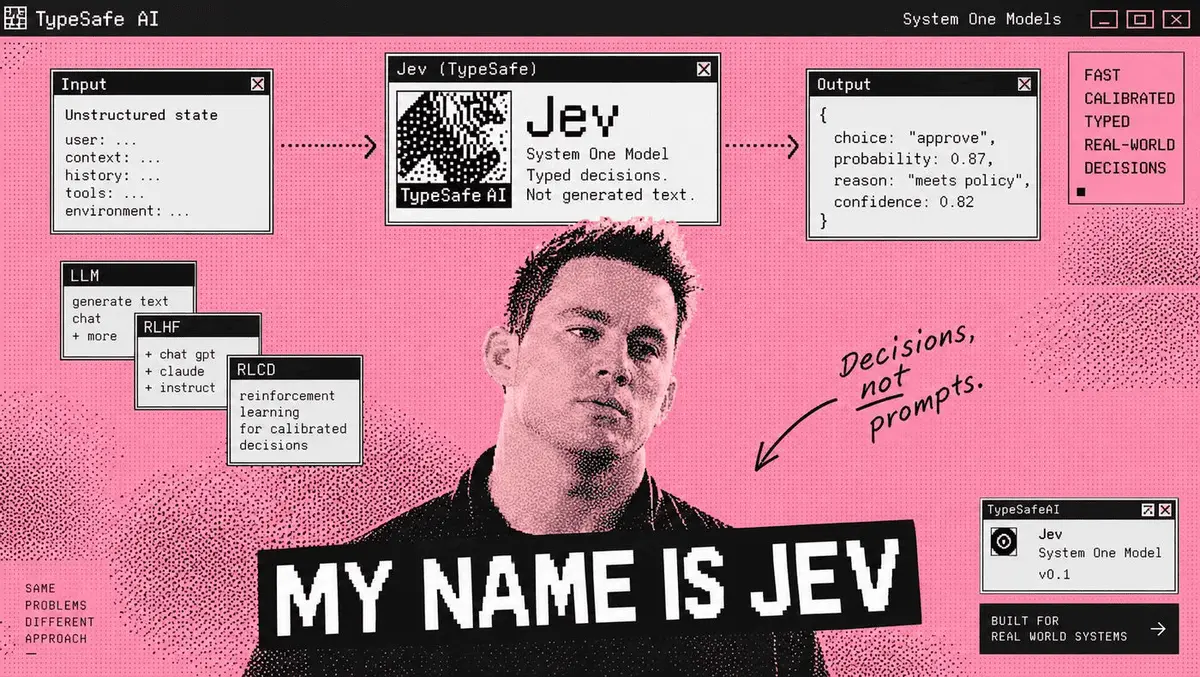
To understand the core utility of the technology, it is necessary to look past the superficial marketing and examine what the model is actually designed to do. Jev is an artificial intelligence model built specifically for fast, structured decisions rather than open-ended text generation. TypeSafe AI categorizes it as a "System One Model," explicitly distinguishing it from conventional large language models. When a standard customer support message is fed into a general-purpose LLM, it typically drafts an expansive, conversational response. When the same message—such as a complaint about an upgraded account lacking paid features—is routed through Jev, the model evaluates the input against a fixed set of predefined choices and returns a probability distribution across those categories.
Rather than writing a support reply, Jev might evaluate the message and output probabilities assigning high likelihood to technical issues, moderate likelihood to sales inquiries, minor likelihood to billing questions, and zero likelihood to cancellations. In this scenario, the model selects the technical category as the primary choice, but the accompanying probability distribution reveals inherent ambiguity in the user’s request. This distinction is critical for software applications, which can leverage both the primary decision and the model’s underlying confidence score to automate workflows. For instance, high-confidence classifications can trigger automated routing, while lower-confidence outputs can be flagged for human review.
Classification, intent detection, scoring, and routing are foundational machine learning problems with decades of research behind them. What TypeSafe AI has done differently is construct a model explicitly optimized around these typed, probabilistic decisions, bypassing the need to prompt a general-purpose large language model to behave like a classifier.
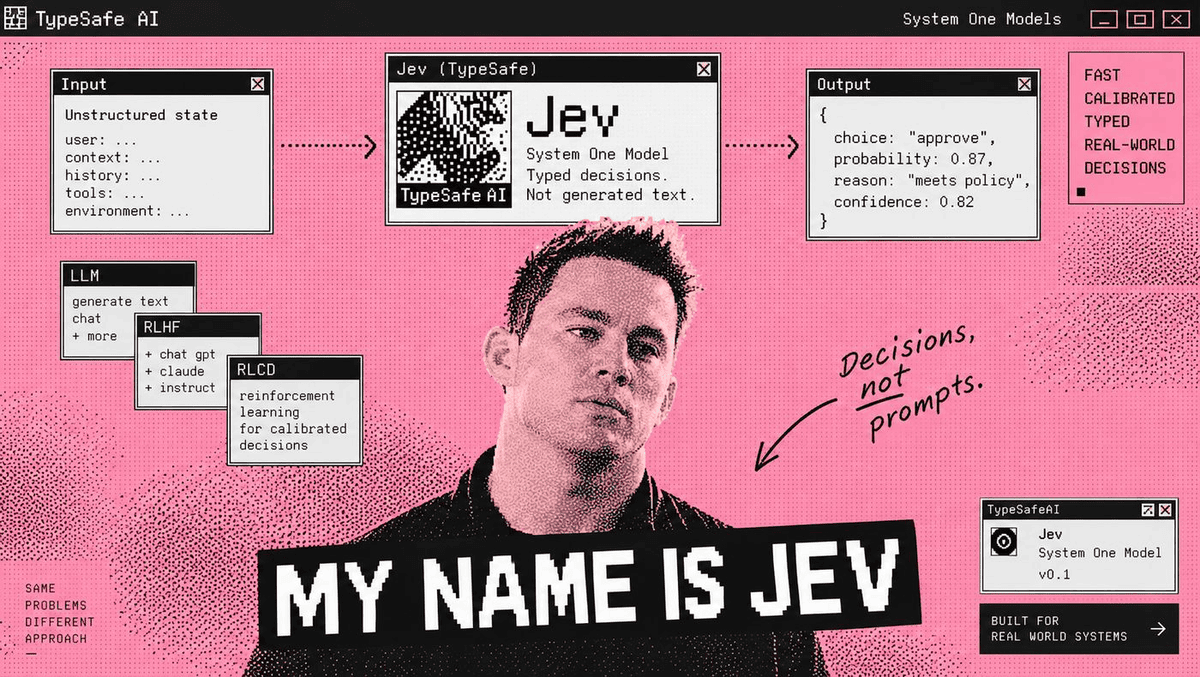
This design philosophy brings into focus TypeSafe AI’s description of Jev as a System One Model, drawing inspiration from behavioral psychology’s framework of System 1 and System 2 thinking. System 1 thinking is characterized as fast, instinctive, and automatic, making rapid decisions based on immediate information without requiring deep deliberation. Jev mirrors this concept by generating structured decisions and probabilities instantaneously, completely avoiding the computationally expensive generation of long chains of text. System 2 thinking, by contrast, is slower, deliberate, and analytical—closely resembling how reasoning-focused frontier LLMs operate when tackling complex problem-solving, multi-step planning, or intricate coding challenges. Within a modern enterprise architecture, the two paradigms are complementary rather than competitive: System One handles high-frequency, rapid-fire operational decisions, while System Two remains available when deeper cognitive reasoning is required.
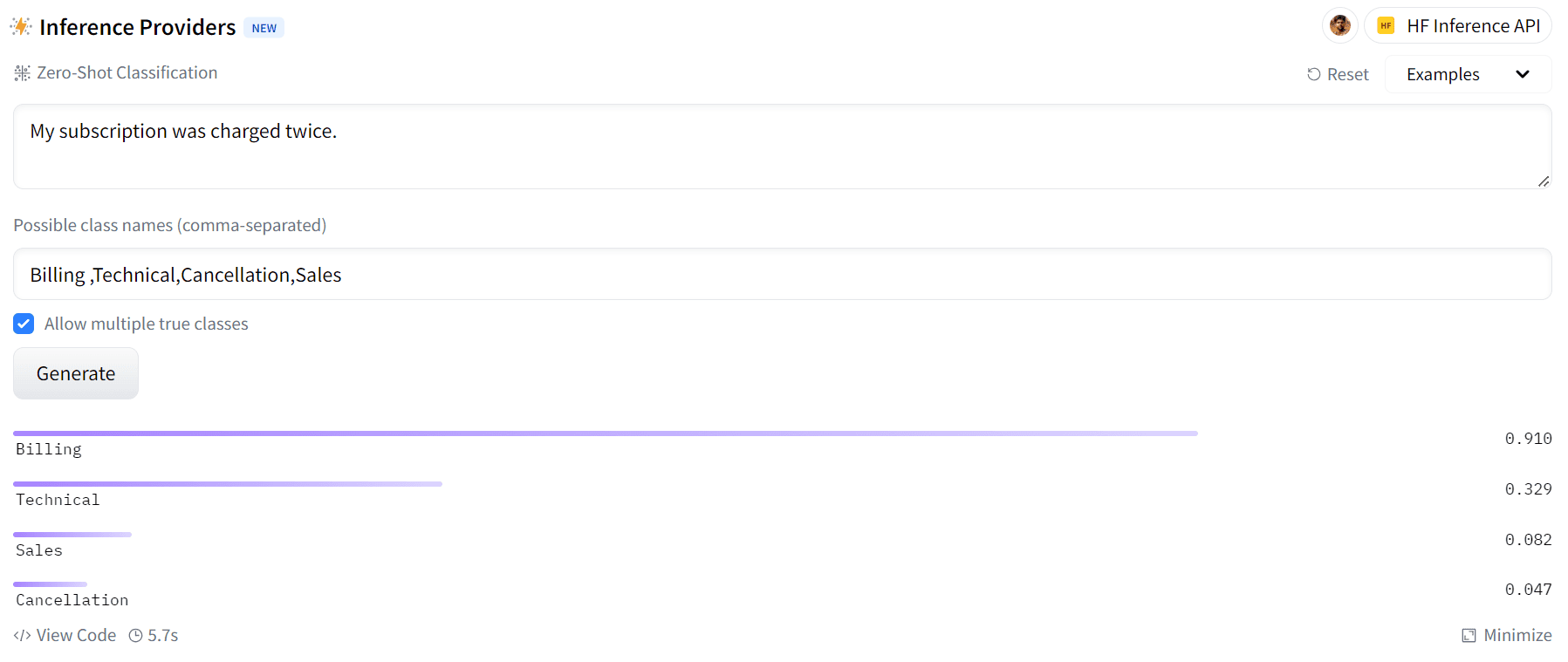
A natural question raised by machine learning engineers is whether Jev is essentially a rebranded zero-shot classifier. In spirit and execution, the two concepts share a profound lineage. Zero-shot text classifiers have long enabled developers to supply raw text alongside arbitrary candidate labels, evaluating the text against those categories without requiring a dedicated, custom-trained model for every unique classification task. Modern natural language inference-based zero-shot classification gained widespread adoption in the data science community around 2019 and 2020, while foundational zero-shot learning concepts extend even further back into machine learning history.
Despite these similarities, dismissing Jev as merely an old zero-shot classifier would overlook several key engineering choices. TypeSafe AI has engineered Jev to handle multiple structured decisions simultaneously, process parallel inference, and utilize a calibration-focused training paradigm. The underlying computational problem is mature, but the product packaging, architecture, and optimization around it represent a modern engineering iteration.
Similarly, Jev must be viewed through a distinct lens when compared directly against frontier large language models like GPT, Claude, or Gemini. Those systems are general-purpose powerhouses engineered for open-ended text generation, advanced coding, multi-step reasoning, and dynamic tool use. Jev is intentionally narrow in scope. While developers can force modern LLMs to produce structured outputs or utilize function calling to mimic classification tasks, doing so requires deploying a massive, computationally expensive general-purpose model for a relatively straightforward task. Jev is built from the ground up for that specific, narrow workload, which largely explains its operational efficiency.
The architectural focus on a single, well-defined task enables Jev to operate with notable speed and cost-effectiveness. Instead of generating text token by token through sequential decoding, the model delivers structured decisions directly and in parallel. TypeSafe AI attributes this performance advantage to its specialized architecture, parallel sampler, and calibration-focused training routines. While the foundational concept of lightweight classification models has existed for years through open-source architectures like Meta’s BART models configured for natural language inference, the industry value lies in how efficiently Jev’s architecture has been tuned specifically for high-speed, structured decision-making pipelines.

Evaluating Jev’s true accuracy remains a challenge due to the current lack of independent, large-scale benchmarks. TypeSafe AI reports a performance metric of approximately sixty-eight percent on its internal workflow evaluations, but internal benchmarks are not equivalent to verified real-world ground truth, particularly because reference answers are often generated by frontier models rather than human-verified outcomes. While early independent tests—including small-scale fact-checking evaluations and limited document classification trials—have shown promising high-agreement rates, these samples remain too small to establish definitive industry standards. Consequently, technical leaders view TypeSafe AI’s metrics as a promising indicator rather than definitive proof of universal accuracy, highlighting the industry’s need for rigorous, independent third-party evaluations.
Discussions surrounding Jev often touch upon the controversial claim that the model completely eliminates hallucinations. Technically speaking, this assertion is accurate, but it is easily misinterpreted. If Jev is constrained to a schema containing only billing, technical, and sales options, it cannot output a category like legal, because that option simply does not exist within the defined schema. However, the model can still mistakenly categorize a technical issue as a billing inquiry. Therefore, Jev is still entirely capable of making incorrect classification decisions. The reality of "zero hallucinations" in this context translates more accurately to zero out-of-schema outputs, establishing a strict boundary on the formatting of the response rather than guaranteeing absolute semantic correctness.
When comparing Jev to frontier LLMs, the primary differentiator is not raw intelligence, but rather the economic and computational trade-off. Because Jev handles a vastly narrower workload, it requires fewer computational resources and transmits significantly smaller output payloads. The central question for software developers is not whether Jev outperforms a frontier model on complex reasoning, but whether it can maintain adequate quality on narrow classification tasks to allow engineering teams to replace expensive frontier model API calls without degrading overall application reliability. If Jev can deliver sufficient accuracy at a fraction of the cost and latency, its value proposition becomes immediately clear within production environments.
To achieve this reliability, TypeSafe AI utilizes a proprietary training methodology known as RLCD, or Reinforcement Learning for Calibrated Decisions. The core innovation of this approach lies in the concept of calibration. Standard machine learning models can occasionally make accurate predictions while demonstrating poor self-awareness regarding their own certainty. Calibration ensures that a model’s assigned probabilities accurately reflect the statistical frequency with which those predictions prove correct in practice.
In a calibrated system, when Jev assigns a high probability to a specific category alongside a strong confidence score, that decision should statistically align with higher correctness rates. This calibration transforms raw uncertainty into a usable software engineering variable. Application logic can be programmed to automatically execute decisions that exceed a designated confidence threshold while safely routing lower-confidence cases to human operators for review. Unlike reinforcement learning from human feedback, which optimizes models to align with subjective human-preferred conversational styles, RLCD focuses explicitly on generating reliable probabilities that communicate genuine uncertainty.
In practical application, Jev finds its most effective role as a high-speed decision layer embedded within a larger software application rather than as an end-user interface. Developers are currently experimenting with the model for automated ticket routing, content filtering, intent detection, and orchestrating subsequent agent actions within complex microservice architectures.
Ultimately, characterizing Jev as a revolutionary, unprecedented breakthrough in artificial intelligence would be premature. Classification, intent detection, zero-shot learning, calibrated probabilities, and specialized models outperforming general-purpose architectures are all well-established concepts within the data science community. What TypeSafe AI has accomplished is a thoughtful, cohesive re-engineering of the architecture, training pipeline, inference mechanics, calibration protocols, and developer experience surrounding these familiar challenges. That refinement alone may position Jev as a highly effective product for enterprise software development, even if it stops short of inventing an entirely new form of artificial intelligence.