
Integrating large language models into traditional machine learning workflows has long presented data scientists with a distinct methodological divide. On one side lies the structured, cohesive ecosystem of scikit-learn, characterized by reliable pipelines, standardized cross-validation, and comprehensive metrics reports. On the other side stands a chaotic approach dominated by bespoke Python scripts: loops over external API calls, brittle string parsing, and protective try/except blocks thrown around responses that occasionally return verbose prose instead of a clean, structured label. While both methodologies ultimately achieve classification, only the former provides a sustainable, modular architecture worth reusing across production environments.
A development addressing this architectural gap is Scikit-LLM, an open-source library that wraps advanced language models directly within the familiar scikit-learn estimator application programming interface. By adopting the standard design patterns of scikit-learn, every model in the Scikit-LLM framework implements core methods such as fit and either predict or transform. This standardization allows advanced language models to drop seamlessly into a standard scikit-learn pipeline or cross-validation loop without requiring custom boilerplate code or specialized orchestration frameworks.
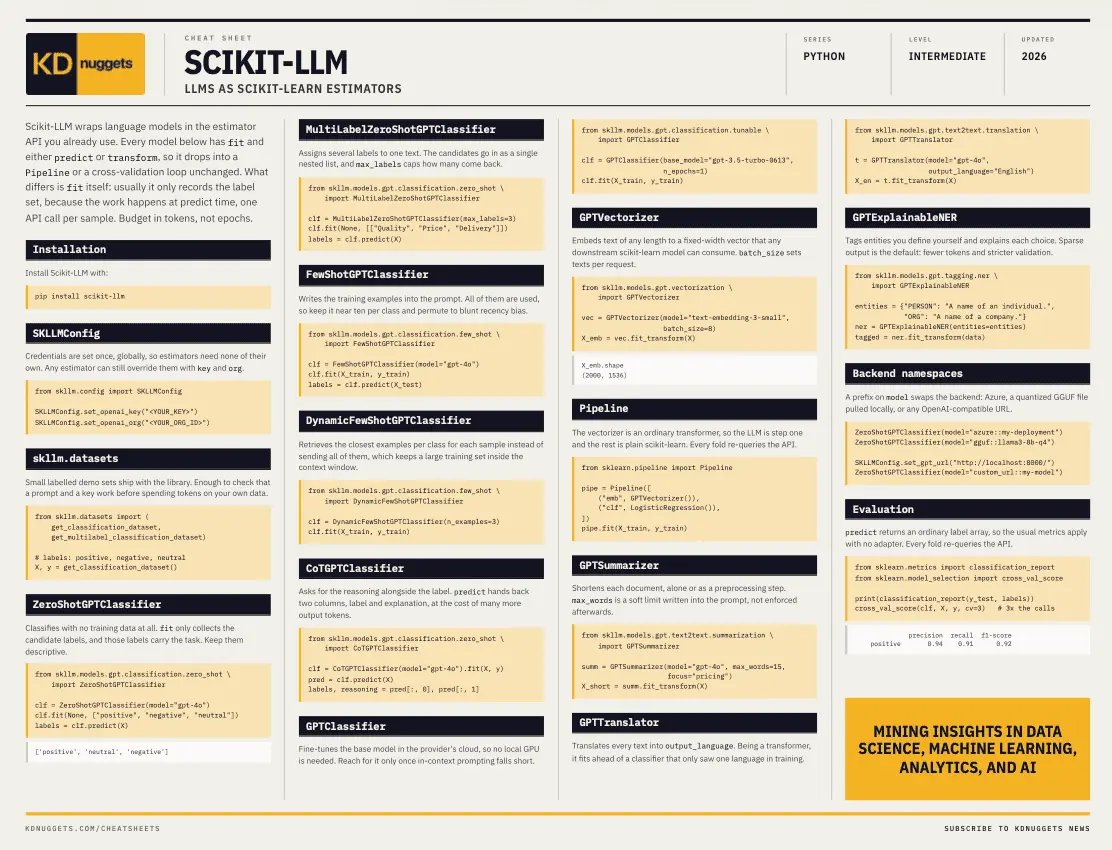
The underlying mechanics of these estimators reveal a fascinating intersection between traditional statistical learning and modern generative artificial intelligence. For instance, the fit method in many Scikit-LLM estimators simply records the target label set rather than performing heavy numerical optimization. The actual computational heavy lifting occurs during the prediction phase, executing one API call per data sample. This paradigm shifts how engineers conceptualize computational workflows, forcing practitioners to think and plan meticulously in terms of token usage and API latency. To assist practitioners in navigating these mechanics, a newly released reference guide, the Scikit-LLM Estimators Cheat Sheet, provides a comprehensive overview of how these estimators function within established machine learning pipelines.
Among the various components available in the library, the ZeroShotGPTClassifier emerges as one of the most frequently utilized yet conceptually distinct estimators. Working with this model requires a shift in traditional machine learning intuition. Initiating the estimator by calling the fit method with None alongside a list of candidate labels feels counterintuitive initially. However, this process becomes natural once developers internalize the core principle that the candidate labels themselves function as the task specification. Because vague labels yield ambiguous results, practitioners quickly learn to treat these labels as detailed descriptions rather than mere categorical tags.
When zero-shot classification proves insufficient for complex tasks, the framework offers more advanced alternatives. Rather than relying on standard, static few-shot learning, the DynamicFewShotGPTClassifier serves as the recommended default approach. This estimator employs a sophisticated retrieval mechanism that dynamically selects the most relevant few-shot examples per class for each individual data sample, avoiding the inefficiencies of stuffing the entire training set into every single prompt.
Beyond classification, the library introduces several other powerful tools designed to integrate language models into broader data processing pipelines. The GPTVectorizer transforms text of arbitrary length into a fixed-width numerical vector. This capability allows the language model to act as the initial step of a traditional pipeline, feeding its output directly into classical algorithms such as logistic regression. Similarly, the GPTTranslator functions as a transformer component that can be positioned upstream of a classifier. This enables a classification model that was exclusively trained on English text to process multilingual inputs seamlessly, eliminating the need to retrain the entire downstream model on a multilingual corpus.
Despite the elegance and convenience of these integrations, experienced practitioners must remain mindful of the practical trade-offs, particularly regarding computational costs and API expenses. Running a standard cross-validation evaluation with three folds translates directly to multiplying the volume of API calls threefold. This multiplication effect becomes even more pronounced when executing automated hyperparameter tuning or grid searches that data scientists previously ran routinely without a second thought. The casual operational habits developed within traditional scikit-learn workflows—where computing cycles on local hardware were essentially free—carry substantial financial and latency implications when operating over paid external language model APIs.
For engineers and data scientists deeply embedded in the Python ecosystem who frequently leverage scikit-learn, Scikit-LLM provides a valuable addition to the modern artificial engineering toolkit. It offers an accessible entry point for experimenting with generative models without requiring developers to abandon their established development environments or learn entirely new orchestration frameworks. As practitioners begin exploring these capabilities, resources like the newly published cheat sheet offer a practical way to keep the core essentials of Scikit-LLM close at hand during development and ongoing reference.