
When front-end developers and user experience engineers are tasked with building a web interface that feels tactile, bouncy, or destructive, the industry instinct is almost always the same: reach for a physics engine. Frameworks like Matter.js, Cannon.js, or custom WebGL solutions have long stood as the gold standard for creating immersive, gamified websites. Yet, choosing the path of least algorithmic resistance does not always serve the core vision of an interactive project.
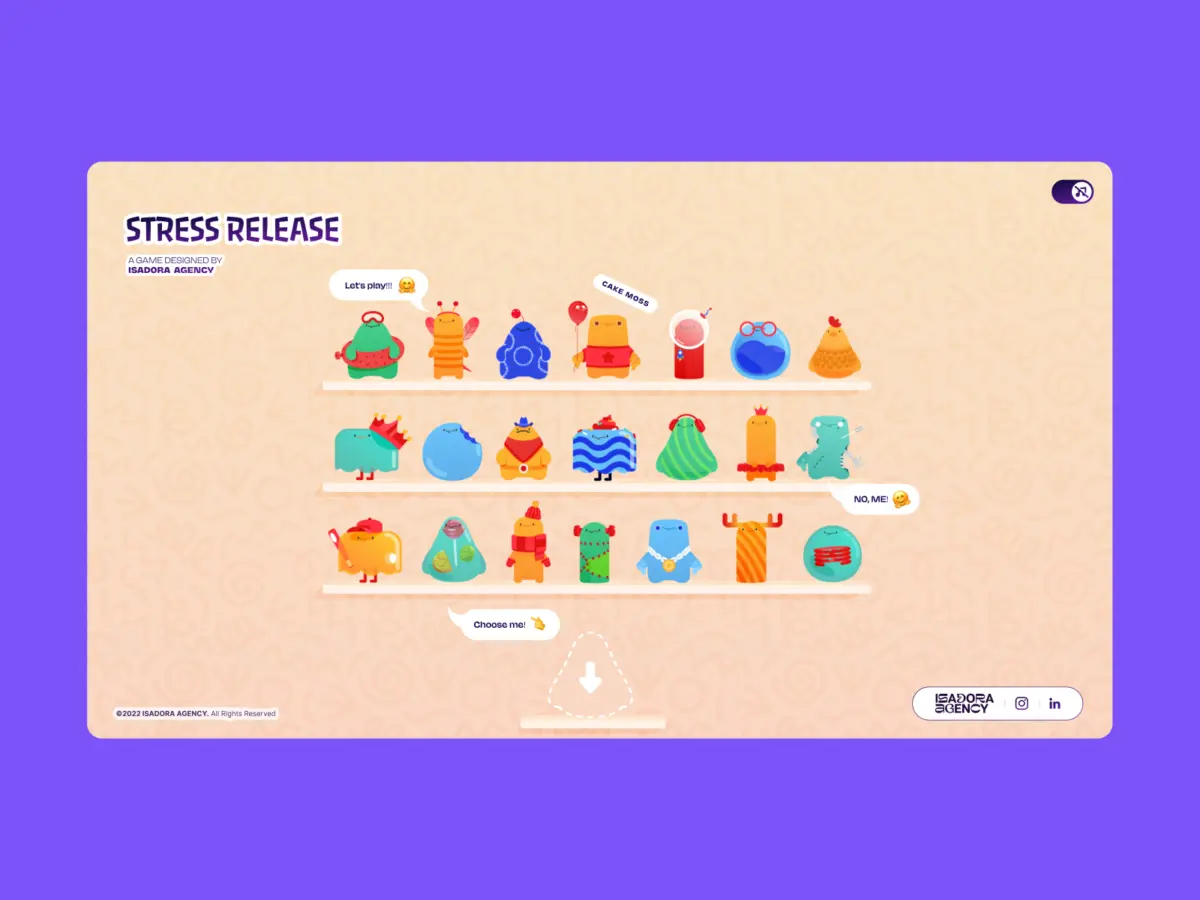
When the creative and technical team at Isadora Agency set out to build "Stress Release," a digital stress-relief squeeze toy designed to let burnt-out creatives smash, stretch, and distort animated UI characters, they initially explored that conventional route. The overarching goal was to build a highly tactile experience where every single click yielded a satisfying, squishy reaction that could help alleviate daily workspace fatigue through playful digital interaction.
However, as the team began prototyping the digital toys, they realized something crucial about how digital motion works in practice. Physics engines produce plausible motion, but in the case of their specific project, the animators had produced strictly intentional motion. The developers did not need their characters to act like realistic rubber balls bouncing unpredictably around an open canvas. Instead, they needed them to react in very specific, highly designed ways that matched the personality of the illustrations. Consequently, the team made the bold decision to scrap the physics engine entirely.
By relying entirely on programmatic Lottie state controls, standard Document Object Model manipulation, and fundamental distance-based math, Isadora Agency constructed a real-time stress-relief squeeze toy without a single line of WebGL or Matter.js code. The resulting architecture demonstrates how front-end developers can maintain absolute control over complex art direction while delivering a deeply responsive, satisfying user experience.
The Design Requirements: Prioritizing Intentional Motion
The core requirement for the Stress Release project was absolute deterministic control over the visual assets. The team’s animators had crafted bespoke JSON-formatted Lottie files that required exact, frame-by-frame sequencing to achieve the intended humorous and stress-relieving effect. For instance, the project’s signature "mega squeeze" reaction required a precise 181-frame build-up followed by a meticulously timed release sequence.

To honor this level of design craftsmanship, the engineering architecture had to ensure that algorithmic approximations would not overwrite the handcrafted keyframes. The tighter the click-feedback loop—mapping a user click directly to a squish reaction and updating the score—the more critical deterministic frame control becomes. By choosing programmatic state control using Lottie’s native application programming interface, the agency ensured that the interaction layer acted as a flawless, predictable trigger for the underlying animation layer.
Creating Tactile Feedback: Mapping DOM Elements to Lottie States
Because the architecture relied on Lottie and the standard DOM, rendering was handled directly by the Lottie runtime, which internally plays vector animations as Scalable Vector Graphics. The developers selected interface elements directly by their IDs and CSS classes, driving their behavior using a combination of Lottie animation segments, CSS transforms, and click-event mathematics.
To achieve a deeply satisfying tactile feel upon hitting a character, the developers implemented radial input mapping. The first technical step required converting the user’s click from broad page coordinates into the character’s local coordinate space. Every click was measured against the character’s exact center point, and then translated into a score, feedback intensity rating, and explosion placement coordinate.

By measuring the straight-line distance from the center of the click using the Pythagorean theorem, the application generated a single numerical value that drove multiple outputs simultaneously: the score awarded to the user, the visual feedback intensity, and the precise coordinate where the explosion animation would appear. This established a concentric zone system—a perfect circle of scoring rings around the character’s center, functioning much like a traditional dartboard.
The visual complexity of the Lottie SVG became entirely irrelevant to hit detection because the hitbox was always treated as a clean circle. Critically, the explosion Lottie animation was repositioned to the exact vector used for scoring, ensuring it always appeared precisely where the player clicked. This spatial accuracy created the tactile sensation of physically striking the character entirely through mathematics and DOM positioning.
Interaction Handling and Controlling the Narrative
Because the experience utilized DOM-managed SVG elements, desktop clicks and mobile taps could be handled directly through native event listeners. This approach avoided extra raycasting or coordinate remapping layers while keeping the interaction model seamlessly aligned with how the animations were rendered on screen.

Since the game required a visual reaction at a specific point, Lottie handled all the squish and bounce feelings internally through its pre-compiled animation curves. Each character came equipped with a defined set of animation sections, including idle loops, reaction frames, and end states, stored securely as frame ranges. When a click landed on the interface, the application jumped directly to the exact segment that matched the current game state, stepping methodically through the predefined play order before returning the character to its idle loop once the animation sequence completed.
The Responsive Benefit of DOM Elements
Another major factor in the team’s architectural decision was responsive behavior across different screen sizes. By building the application within the DOM, the developers bypassed the usual complexities of scaling bounding boxes and collision vectors across a fragmented device landscape.
The team handled responsive resizing entirely through CSS variables. By recalculating CSS custom properties on every window resize event, the entire layout reacted fluidly to the updated variables, allowing the Lottie SVGs to scale naturally inside their respective containers without losing their active animation states.

Mobile Performance Optimization and the Cost of Lottie
While this DOM-based architecture granted the development team total control over the art direction, it introduced a distinct engineering challenge regarding file size and performance. Lottie JSON files can be notoriously heavy, especially when dealing with twenty-one different character animations alongside multiple explosion variants that all needed to load smoothly.
To ensure the experience remained fluid—particularly on resource-constrained mobile devices—the team implemented aggressive optimization strategies. They adjusted rendering quality parameters and playback speeds for background shelf elements where multiple animations played simultaneously, reducing interpolation calculations and lowering the number of frame calculations required per second. Meanwhile, the primary gameplay screen maintained full rendering quality for the single focused character on display, striking a careful balance between visual fidelity and runtime performance.
Ultimately, the Stress Release project underscores a vital lesson for web developers and UX designers alike: when determining the technology stack for a gamified web experience, the design requirements must dictate the technology. By opting for programmatic state control over emergent physical simulation, Isadora Agency empowered its animators to dictate the exact feel of the experience, leaving the code to execute its foundational role of listening, calculating, and triggering precise visual reactions.