
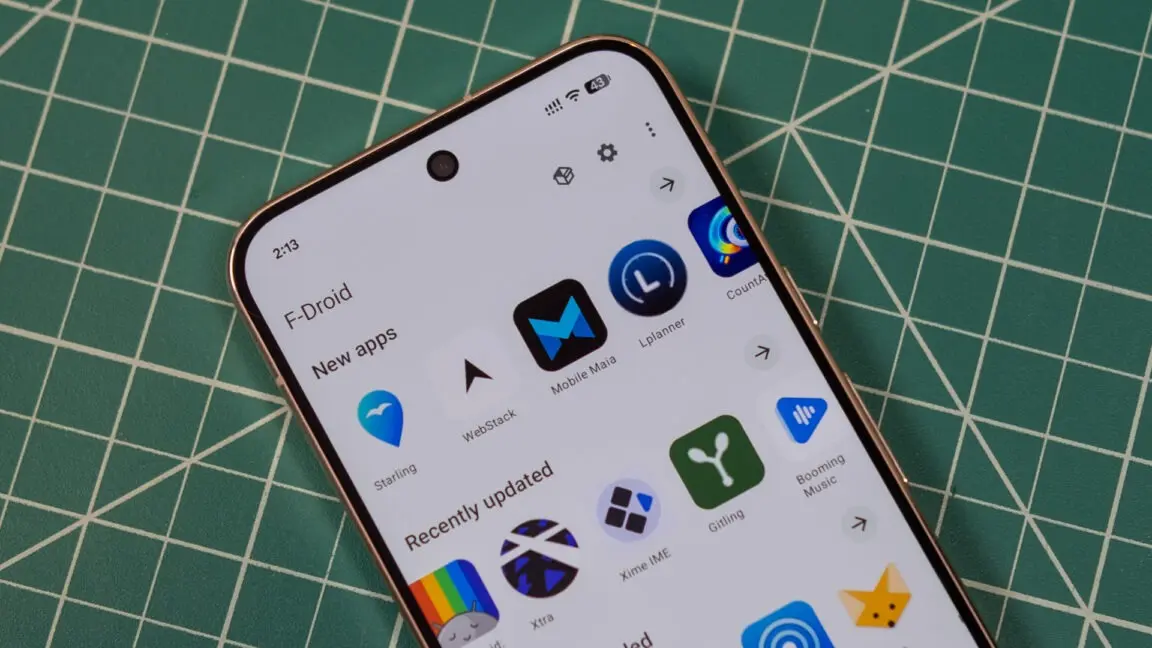
For the vast majority of the global Android user base, the Google Play Store is the undisputed gatekeeper of mobile software. Virtually every certified Android device shipped outside of mainland China comes preloaded with Google’s proprietary storefront, cementing its position as the default destination for downloading and updating applications. However, the Android operating system was built on open-source foundations, which theoretically allows users to bypass Google’s ecosystem entirely and source their software elsewhere. Among the alternative marketplaces that have emerged over the years, F-Droid has long stood out as a beacon for digital sovereignty. Operating as a community-driven, non-profit repository, F-Droid is dedicated exclusively to free and open-source software. Yet, despite its critical role in the privacy and open-source communities, F-Droid’s official client application has spent a decade stuck in the past, lacking the modern design and usability features expected by contemporary smartphone users. That era of stagnation has finally come to an end, as the development team has announced the official rollout of F-Droid 2.0, representing the most significant overhaul in the platform’s history.
The launch of F-Droid 2.0 is the culmination of a intensive, multi-year development effort aimed at modernizing a codebase that had grown increasingly archaic. For ten years, the F-Droid client functioned as a reliable but visually dated utility, reflecting the design sensibilities of the Android Jelly Bean and KitKat eras. While the core philosophy of the repository remained steadfast, the application itself struggled to keep pace with the rapid evolution of Android’s user interface guidelines and performance standards. By rebuilding the client entirely from scratch, the F-Droid development team has not only refreshed the visual appearance of the marketplace but has also fundamentally transformed how users interact with open-source software on their devices. This release marks a new chapter for Android software freedom, proving that a privacy-focused, community-run app store can deliver a user experience that rivals proprietary alternatives.
At the heart of this transformation is a complete architectural shift in how the application is constructed. The F-Droid 2.0 client has been rewritten from the ground up using Kotlin Compose, which has established itself as the modern standard for Android user interface development. By moving away from legacy XML layouts and adopting Google’s declarative UI toolkit, the developers have dramatically improved the responsiveness and fluidness of the application. Animations are smoother, page transitions are instantaneous, and the overall resource footprint of the app has been optimized. To complement this technical modernization, the update introduces optional support for Android’s Material theming system, allowing the storefront to dynamically adapt its color palette to match the user’s system-wide wallpaper and personalization preferences. The interface has also undergone a rigorous decluttering process; primary features and essential navigation controls have been brought to the forefront, while advanced configuration settings and niche administrative tools have been elegantly tucked away into overflow menus to prevent overwhelming new users.
While the visual enhancements of F-Droid 2.0 are immediately apparent, the underlying motivation behind the redesign was to address the growing challenges of app discovery. When F-Droid first launched over a decade ago, its repository hosted a modest selection of basic utilities, making it relatively easy for users to browse the entire catalog. Today, however, the platform hosts thousands of sophisticated open-source applications, ranging from productivity suites to complex system utilities. Finding specific tools within this vast ecosystem had become increasingly difficult under the old client. Unlike the Google Play Store, which relies heavily on telemetry, user tracking, and invasive data collection to serve personalized recommendations and targeted advertisements, F-Droid operates under a strict privacy-first mandate. The platform does not monitor user taps, search histories, or installation patterns. Consequently, the developers had to improve discovery mechanisms without resorting to the tracking algorithms that power commercial marketplaces, ensuring that the app store remains a neutral tool that helps users find what they need and then gets out of the way.
To bridge this gap, F-Droid 2.0 introduces a highly refined categorization and search infrastructure. The updated client now features a vast array of specialized categories, allowing users to drill down into highly specific software niches such as local firewalls, encrypted password managers, and virtual private networks. These granular groups are now prominently displayed within the dedicated search tab, making thematic browsing far more intuitive. Additionally, broader, high-level categories have been integrated into the primary Discover page to help users organically explore popular open-source software. The search functionality itself has received a major technical upgrade. Previously, users were largely limited to searching for applications by their exact names, which required prior knowledge of the software. In F-Droid 2.0, the search engine is capable of parsing and returning results based on full app descriptions. This means that a user searching for a term like "text editor" or "calculator" will be presented with all relevant tools, even if those terms are not explicitly included in the application’s title.
Beyond discovery, the update addresses one of the most persistent pain points of the alternative Android ecosystem: the installation process. Historically, Google has maintained strict controls over how applications are installed outside of the Play Store, citing security concerns as the primary justification for restricting sideloading. While these security measures protect users from malicious software, they have also served as a practical barrier to entry for alternative marketplaces, forcing users to navigate warning prompts, toggle system permissions, and manually confirm installations for every single update. This friction has been a constant source of tension between Google and the wider open-source community, particularly in light of Google’s upcoming developer verification systems, which critics argue could further restrict the ability of independent developers to distribute software freely.
F-Droid 2.0 mitigates this friction by integrating support for Google’s package installer pre-approval API. This technical addition represents a massive usability leap forward for users accustomed to the seamless installation flow of the Play Store. In previous versions of F-Droid, installing or updating an application required downloading the Android Package (APK) file, waiting for a system-level installer to launch, and manually confirming a series of security warnings. Under the new pre-approval system, this multi-step process is streamlined into a simple, two-tap interaction. When a user decides to install an app, they tap the "Install" button within the F-Droid client. F-Droid then communicates with the operating system to pre-approve the installation, triggering a single, standard system prompt asking the user to confirm. With a second tap on the system’s "Install" button, the download and installation proceed automatically in the background. While this still requires one more interaction than the single-tap process of the pre-installed Play Store, it drastically reduces the cognitive load and visual clutter associated with traditional sideloading warnings.
This integration of the pre-approval API is a critical compromise in the ongoing debate over platform security and user freedom. By leveraging native Android APIs, F-Droid 2.0 demonstrates that alternative app distribution can be both secure and user-friendly, undermining the argument that strict gatekeeping is the only way to protect mobile operating systems from malware. However, the broader regulatory environment remains highly volatile. F-Droid and other alternative app store operators have frequently raised concerns about Google’s long-term plans for sideloading, calling on regulatory bodies worldwide to intervene and prevent dominant platform holders from implementing restrictive developer verification schemes that could choke out independent distribution channels.
Ultimately, F-Droid 2.0 is more than just a software update; it is a vital modernization of an essential piece of open-source infrastructure. By replacing a decade-old codebase with a highly responsive, Kotlin Compose-powered interface, and by streamlining the installation process through modern APIs, the F-Droid team has successfully closed the usability gap between open-source alternatives and proprietary giants. For privacy-conscious users, developers, and digital rights advocates, the release of F-Droid 2.0 ensures that the pursuit of software freedom on Android remains viable, accessible, and visually aligned with the standards of modern mobile computing.