
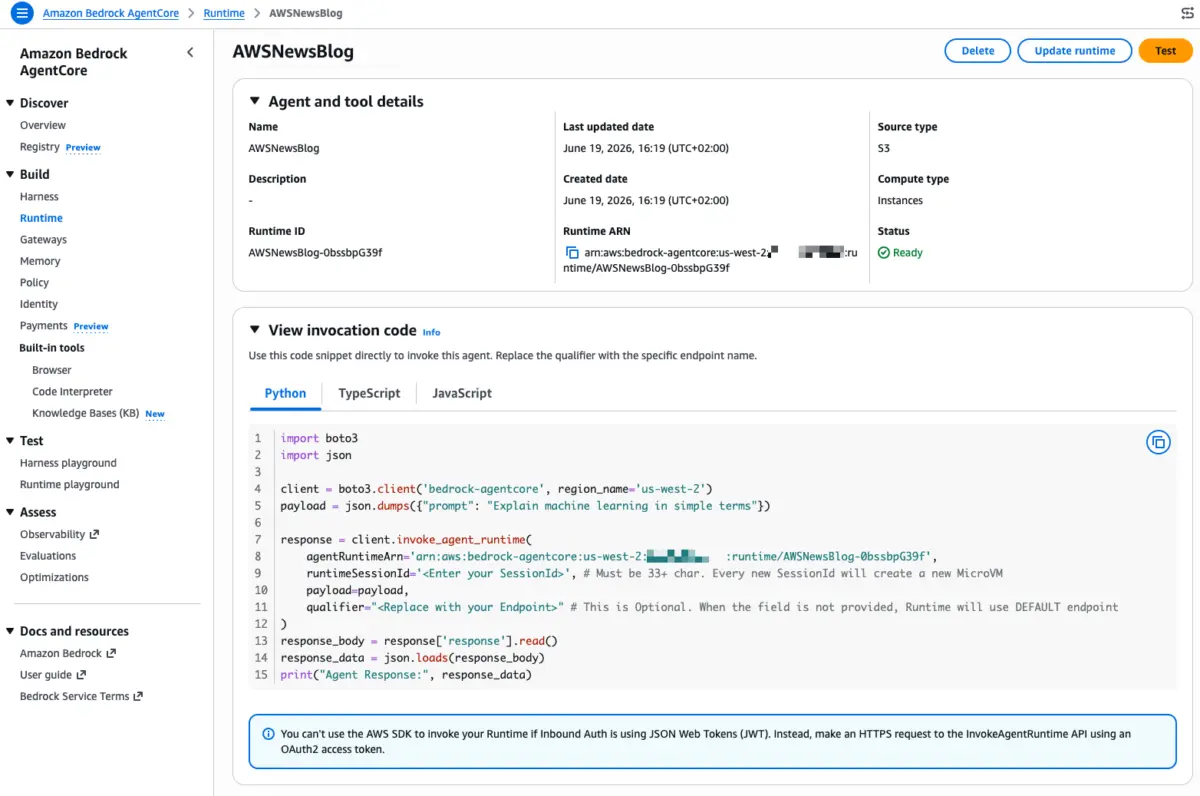
As artificial intelligence agents transition from experimental prototypes to mission-critical production environments, the underlying infrastructure requirements have grown increasingly complex. Moving beyond simple chat-based interactions, modern enterprise workflows often demand that autonomous agents maintain state across multi-step processes spanning hours or even days. They must frequently coordinate with specialized worker agents, share contextual information seamlessly, and occasionally tap into high-performance hardware accelerators like graphics processing units to execute heavy computational workloads.
To address these expanding operational demands, Amazon Web Services has announced the introduction of runtime instances, a major new complementary compute option designed for Amazon Bedrock AgentCore Runtime. This newly unveiled capability provides developers with persistent, fully managed infrastructure engineered specifically to support advanced, multi-agent workflows that require deep system integration and extended session lifespans.
Scaling Beyond MicroVMs for Advanced AI Workloads
Previously, organizations scaling AI applications on Amazon Bedrock AgentCore relied primarily on runtime microVMs. These lightweight microVMs deliver a secure, fully managed environment optimized for invocations lasting up to eight hours, leveraging managed session storage to preserve stateful workflows. However, certain sophisticated enterprise use cases necessitate dedicated, higher-capacity environments. Workloads requiring continuous operation for multiple consecutive days, direct operating system access, specialized GPU acceleration, or the simultaneous hosting of multiple collaborating agents on a single node often exceeded the boundaries of standard microVM architectures.
Before the introduction of runtime instances, engineering teams wishing to sustain long-running agents or incorporate heavy hardware acceleration had to construct and maintain custom infrastructure entirely on their own. This manual approach required provisioning Amazon Elastic Compute Cloud instances, configuring intricate networking rules, establishing persistent session management systems, designing scaling policies, and stitching together disparate monitoring tools.

Runtime instances completely abstracts away this operational overhead by providing AWS-managed EC2 infrastructure. This allows developers to deploy multiple autonomous agents within a single runtime environment, each equipped with its own distinct dependencies and artifact types. Crucially, these agents can collaborate directly on the same physical or virtual host within shared sessions that remain active for up to 14 days. The service natively supports GPU acceleration for compute-intensive processing, session pausing and restarting to optimize cost efficiency during idle intervals, and containerized deployments tailored for independent engineering teams.
Bridging Persistence and Collaboration
For data persistence that must outlive individual sessions, runtime instances integrate smoothly with Amazon Elastic Block Store and AgentCore Memory. This combination grants agents reliable long-term recall capabilities across separate sessions and environments. Furthermore, the architecture eliminates traditional communication bottlenecks. Agents can invoke one another as internal tools within a shared session, iterating autonomously until a designated task is fully completed.
Development teams retain complete architectural flexibility, as the platform supports any major framework, including CrewAI, LangGraph, LlamaIndex, and Strands, alongside any preferred foundational model. Packaging requirements have been streamlined to a minimum, requiring only a simple entrypoint decorator and a standard zip archive or container image. If a complex workflow extends over multiple days, developers can hibernate the system on a Monday evening and resume execution on Wednesday morning with all contextual state fully intact.
The newly released runtime instances and the existing runtime microVMs are engineered to function as complementary compute options. Developers can deploy them independently or combine them within the same AgentCore runtime APIs to build hierarchical architectures. For instance, a lightweight orchestrator agent running on a runtime microVM can efficiently handle incoming API requests, dynamic task routing, and final result aggregation. Meanwhile, specialized worker agents operating on runtime instances can execute demanding computational operations—such as heavy code compilation, automated security vulnerability scanning, or browser-based graphical user interface automation—that necessitate persistent state and direct operating system access.
Demonstrating Multi-Agent Collaboration in Shared Environments
To showcase the practical application of runtime instances, developers can construct multi-agent systems where distinct models share a common operational workspace without relying on traditional network messaging APIs. A representative demonstration involves two cooperating entities: a code writer agent tasked with generating Python scripts from natural language descriptions, and a code reviewer agent responsible for analyzing that code for potential bugs, security vulnerabilities, and style violations.
By housing both agents on the same underlying EC2 infrastructure backed by a shared file system associated with a specific session identifier, the code reviewer can instantly read the files produced by the writer agent. When a user initiates a prompt through the runtime playground—such as requesting the implementation of a Fibonacci sequence generator—the writer agent generates the requested Python module and writes it directly to the designated session directory.
Switching the active agent in the interface to the reviewer while retaining the exact same session identifier allows the reviewer agent to immediately access the freshly generated file path. The reviewer then performs a thorough code evaluation, returning structural suggestions, style recommendations, and bug assessments without requiring any intermediate API calls or data transfers between the agents. This shared workspace paradigm can be scaled across an arbitrary number of specialized entities, enabling testing agents, documentation generators, and security scanners to collaborate efficiently within a unified operational boundary.
Getting Started with Managed Capacity
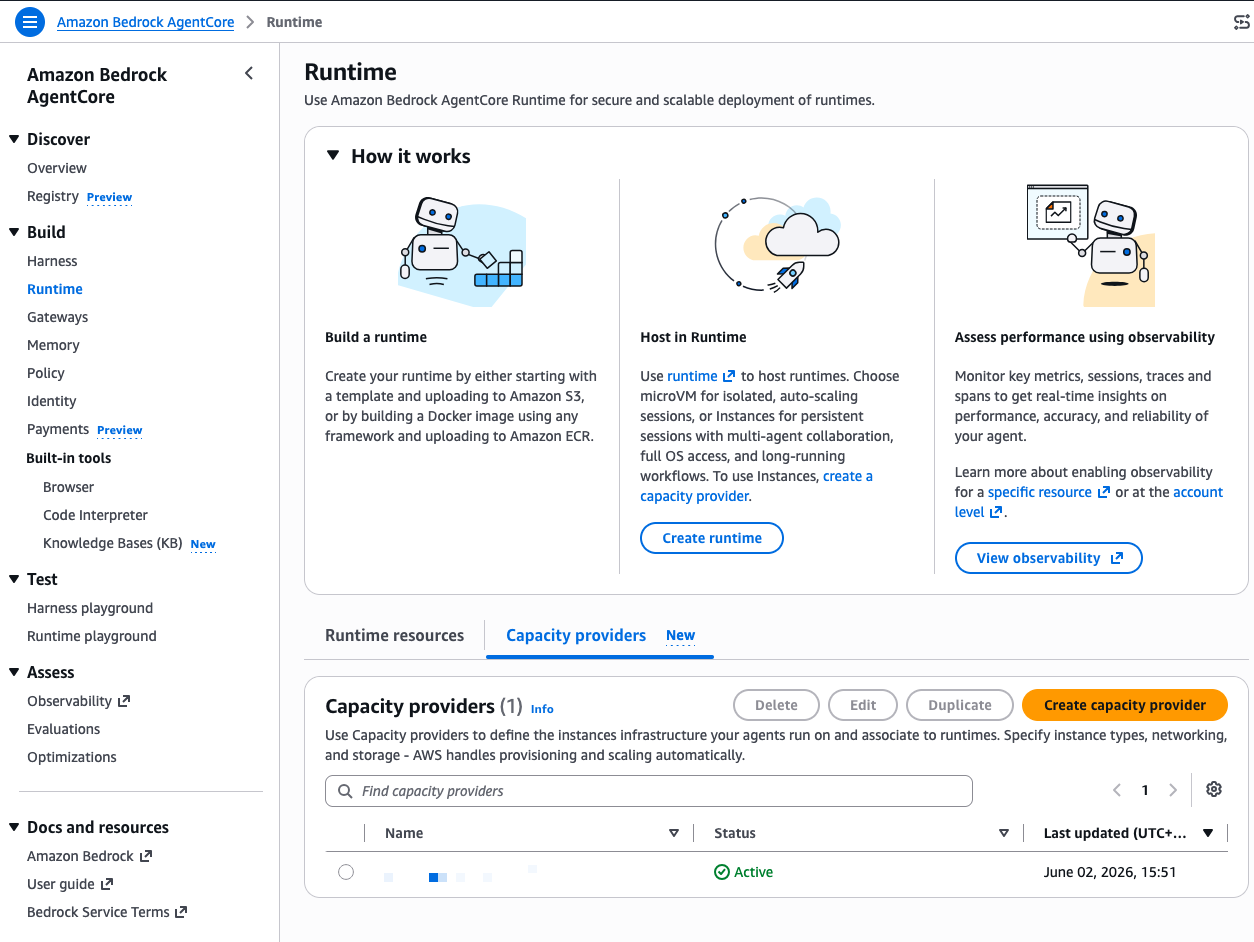
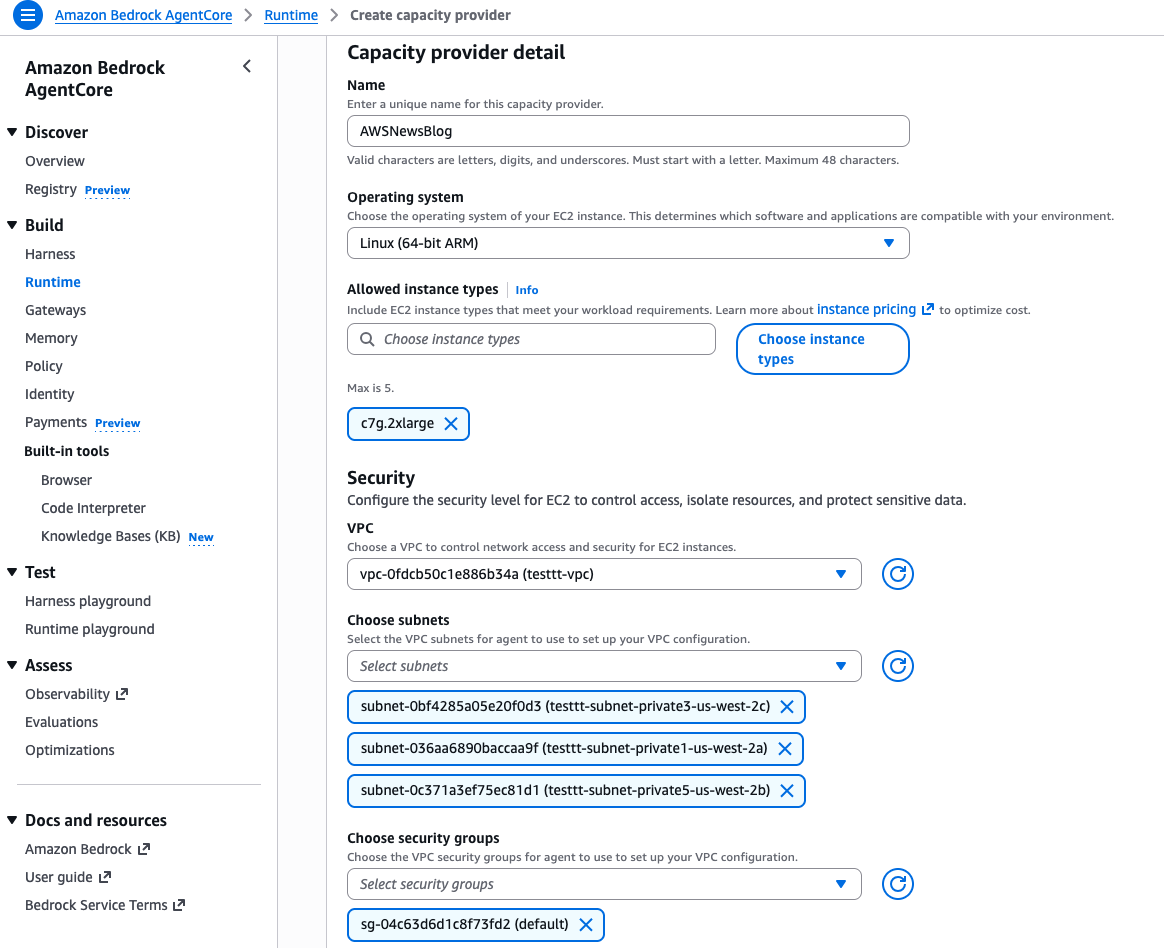
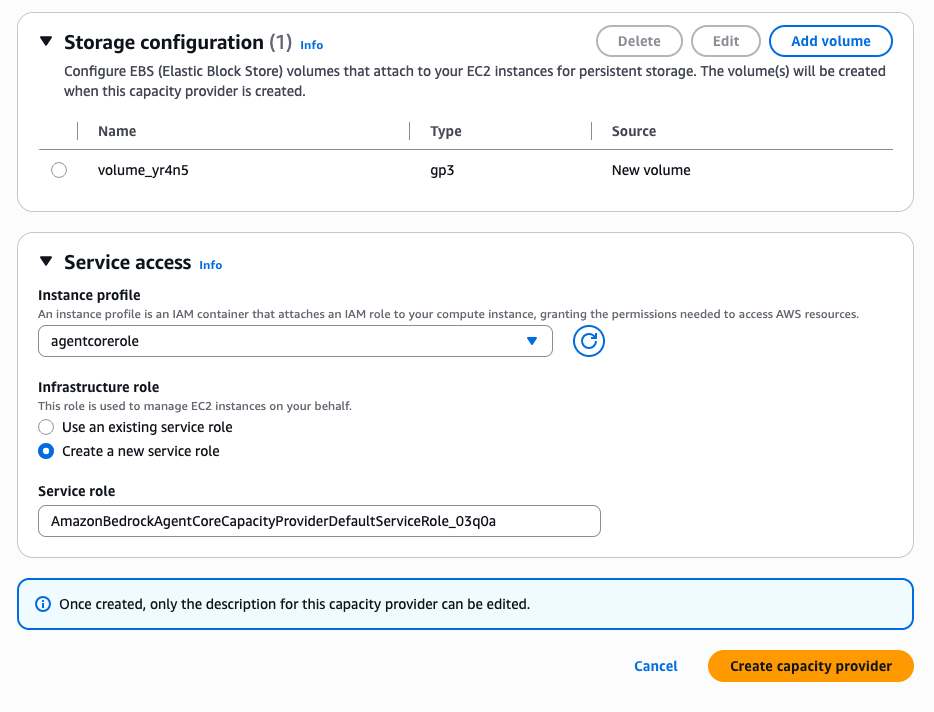
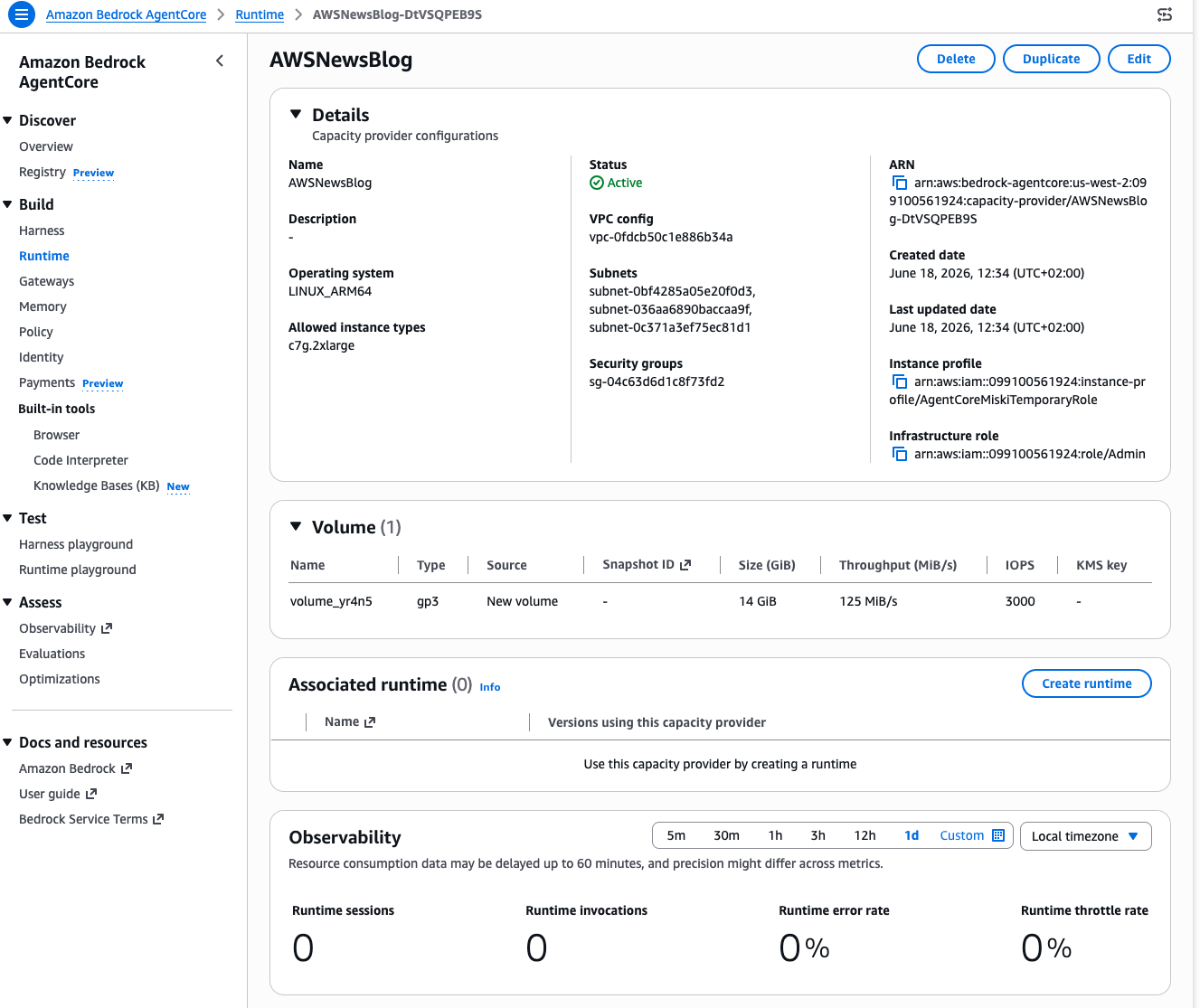
Implementing runtime instances begins within the Amazon Bedrock AgentCore console, where administrators define custom capacity providers to configure the underlying EC2 hardware. By specifying parameters such as the operating system, preferred instance types, virtual private cloud subnets, and security groups, teams can tailor the compute environment to match their precise performance requirements. Once the capacity provider is active, developers create individual runtimes, link them to the provisioned capacity, and upload their packaged agent code.
With comprehensive support for command-line interfaces, software development kits, and infrastructure-as-code tools, runtime instances provide a streamlined pathway for enterprises seeking to transition complex, multi-day, multi-agent AI systems from experimental development into robust, scalable production environments.