

In the complex landscape of modern digital infrastructure, maintaining continuous visibility into global network health is vital for enterprises, Internet Service Providers (ISPs), and cloud architects alike. Cisco’s ThousandEyes division, renowned for tracking global internet and cloud traffic, provides ongoing insights into the operational performance of major network service providers, cloud infrastructure vendors, and Unified Communications as a Service (UCaaS) providers. Through continuous monitoring, ThousandEyes maps out the subtle shifts, widespread degradations, and acute disruptions that ripple across international digital ecosystems.
Digital service delivery relies on an intricate web of interconnected networks, transit providers, edge platforms, and content delivery networks. When disruptions occur, their effects can cascade rapidly from localized routing anomalies to multi-regional blackouts affecting businesses and consumers worldwide. By capturing weekly snapshots of these occurrences, network operators gain a clearer understanding of systemic vulnerabilities and recurring stability trends across the globe.

Internet Report for September 14–September 20
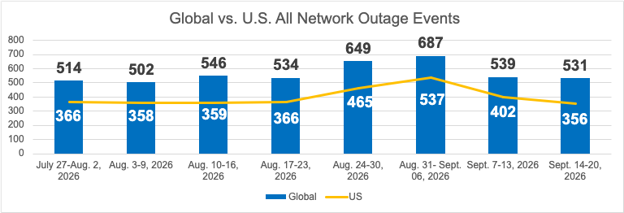
During the week of September 14 through September 20, ThousandEyes recorded 531 global network outage events spanning ISPs, cloud service provider networks, collaboration application networks, and various edge components such as Domain Name System (DNS) services, content delivery networks (CDNs), and security-as-a-service platforms. This total reflected a marginal 1% decrease compared to the 539 outages observed during the preceding week. Focusing specifically on the United States, network professionals registered 356 outages, representing an 11% decline from the 402 outages logged a week earlier.
Amid these broader trends, two notable outages drew considerable attention from network engineers for their operational impacts. On September 16, AT&T encountered a network disruption that affected customers and enterprise partners across multiple geographical regions, including the United States, Mexico, and India. The incident lasted approximately 18 minutes, beginning around 3:09 AM EDT. Initial telemetry indicated that the disruption centered on AT&T nodes situated in Ashburn, Virginia. Approximately five minutes into the event, nodes located in Chicago, Illinois, and Dallas, Texas, began exhibiting similar outage conditions. This geographical expansion coincided with a measurable uptick in the volume of impacted downstream customers and enterprise partners. Normal operating conditions were restored at roughly 3:30 AM EDT.
Later the same day, Salesforce suffered a significant global service disruption that impacted enterprise users worldwide. Initial manifestations of the issue appeared around 9:50 AM CEST, presenting as a series of persistent server errors and request timeouts typical of a backend service failure. Subsequent disclosures from Salesforce confirmed that the disruption originated from requests stalling on an internal login service. The primary phase of the disruption persisted for approximately 4.5 hours before services began a gradual recovery around 2:30 PM CEST. The incident was officially declared cleared at 5:26 PM CEST, concluding a multi-hour ordeal for global cloud users.
Internet Report for September 7–September 13
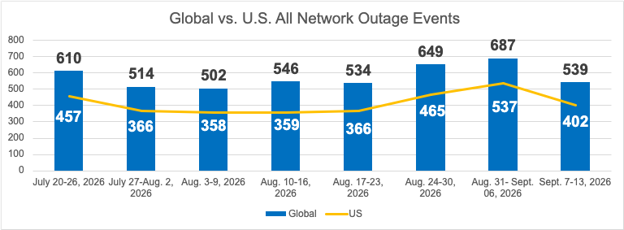
Earlier in the month, for the week of September 7 through September 13, ThousandEyes logged 539 global network outage events across the same category of infrastructure providers. This figure represented a notable 22% decrease from the 687 outages reported during the previous week. Similarly, U.S.-centric outages fell by 25%, dropping from 537 to 402 incidents week-over-week.
Despite the overall reduction in network instability, specific incidents underscored the fragility of regional ISP infrastructure. On September 9, Cox Communications, a major U.S.-based ISP headquartered in Georgia, encountered a brief yet wide-reaching disruption. The 14-minute outage began around 11:00 AM EDT and initially concentrated on provider nodes located in Chicago, Illinois. Roughly 10 minutes into the event, an increased number of Chicago-based nodes began exhibiting failure signatures, a shift that correlated directly with a rise in affected partners and customers across an extensive international footprint. Beyond the U.S. and Mexico, downstream impacts were registered in distant markets including Japan, the United Kingdom, Argentina, Brazil, South Korea, Australia, Uruguay, India, Egypt, Turkey, and Denmark. The disruption was successfully cleared by 11:15 AM EDT.
Just two days later, on September 11, Verizon Business experienced a swift network disruption affecting customers and partners across an equally diverse international footprint. Lasting approximately eight minutes, the incident commenced around 11:20 AM EDT and initially focused on nodes located in Chicago, Illinois, Seattle, Washington, Los Angeles, California, and San Jose, California. Five minutes into the event, the nodes in the Pacific Northwest and California cleared, only to be replaced by nodes in Washington, D.C., and Florida exhibiting outage conditions. This evolution in the affected routing paths coincided with a reduction in downstream customer impact. Normal operations resumed fully by 11:30 AM EDT.
Internet Report for August 31–September 6
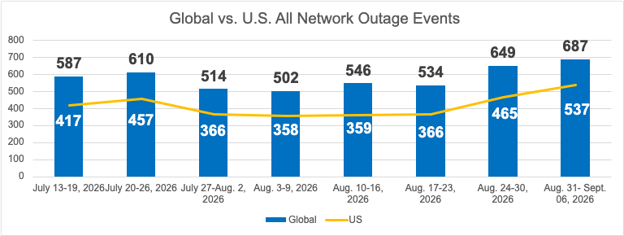
The late-summer period brought heightened network instability, highlighted by the metrics recorded between August 31 and September 6. During this week, ThousandEyes tracked 687 global network outage events, representing a 6% increase over the 649 incidents recorded the previous week. U.S.-specific outages also climbed by 15%, reaching 537 events compared to 465 during the prior weekly cycle.
A primary driver of global friction during this window was a complex, multi-phased disruption experienced by Cogent Communications on September 2. As a major multinational transit provider headquartered in the United States, Cogent’s issues rippled across downstream networks in more than 20 countries spanning North America, South America, Europe, Asia, and the Pacific. The disruption unfolded in waves over a total span of three hours and five minutes, accumulating two hours and 41 minutes of actual outage conditions. Beginning at approximately 9:40 AM EDT around Los Angeles nodes, the event expanded rapidly within 10 minutes to encompass nodes in New York, Chicago, Phoenix, Atlanta, and Dallas. As the geographic footprint of the failing nodes widened, the volume of impacted downstream partners grew proportionally. After a brief period of apparent clearing, nodes in Los Angeles, Atlanta, and Phoenix relapsed, followed by a subsequent wave involving Dallas and Atlanta. Full resolution was not achieved until approximately 12:45 PM EDT.
Shortly thereafter, on September 6, AT&T experienced another notable domestic outage. Lasting a cumulative 57 minutes within a broader one-hour and five-minute window, the disruption began at 3:25 AM EDT and centered primarily on Ashburn, Virginia nodes. After an initial recovery phase, the affected Ashburn infrastructure relapsed briefly before the issue was entirely resolved at 4:30 AM EDT.
Internet Report for August 24–August 30
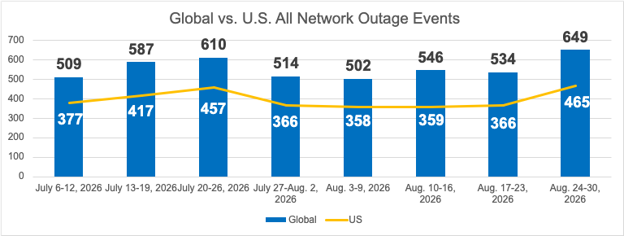
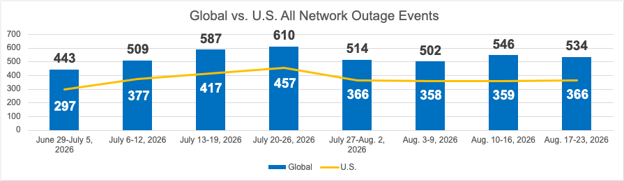
For the week spanning August 24 through August 30, global outage figures remained elevated. ThousandEyes reported 649 global network events, marking a 22% increase from the 534 incidents logged the previous week. In the United States, outages rose 27% to reach 465 events.
Among the notable events during this interval was a recurring disruption experienced by Cox Communications on August 25. Beginning at 1:30 PM EDT, the 14-minute outage initially affected nodes in Chicago and Phoenix. Following an apparent recovery, the same nodes relapsed into outage conditions before the issue was fully cleared at 1:55 PM EDT, impacting users in the U.S., Mexico, and the United Kingdom.
Additionally, on August 26, Astute Internet, a regional ISP based in Vancouver, British Columbia, encountered a brief nine-minute disruption starting at 4:15 AM EDT. The incident began on Vancouver nodes before shifting to Seattle, Washington, which temporarily amplified the downstream customer impact across the U.S. and Canada before stability was restored at 4:25 AM EDT.
Internet Report for August 17–August 23
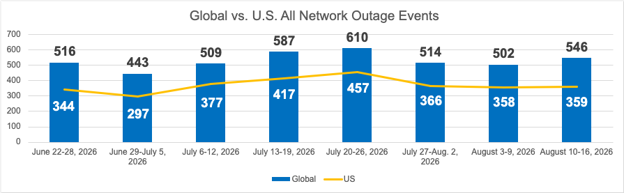
Network volatility continued into the middle of August. Between August 17 and August 23, ThousandEyes documented 534 global network outages, representing a minor 2% decline compared to the previous week’s 546 incidents. U.S. outages remained virtually static at 366 events.
The week’s most operationally complex event involved Arelion, the global Tier 1 provider formerly known as Telia Carrier. On August 21, Arelion suffered a widespread international disruption affecting users across approximately 30 countries. Commencing at 9:25 PM EDT, the incident lasted a cumulative one hour and 21 minutes over a three-hour window. Beginning around Chicago and Atlanta nodes, the outage exhibited multiple waves of recovery and relapse, eventually expanding to incorporate nodes in Seattle, Dallas, San Jose, Sweden, and the United Kingdom. The escalation in affected nodes directly mirrored an increase in downstream customer disruption before the network fully stabilized at 12:35 AM EDT.
Internet Report for August 10–August 16
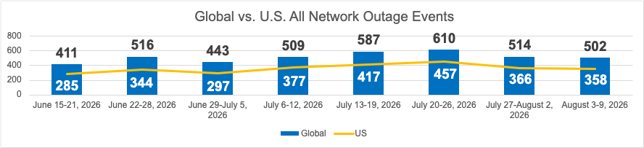
During the week of August 10 through August 16, global metrics showed 546 network outage events, a 9% increase over the 502 incidents recorded previously. U.S. figures held steady at 359 outages.
Arelion featured in another notable event during this period, experiencing a brief 20-minute outage on August 14. Beginning at 4:00 AM EDT, the disruption affected nodes in Chicago, Boston, Newark, and Dallas. As Boston and Newark nodes quickly isolated themselves from the failing cluster, downstream customer impact correspondingly dropped before complete resolution at 4:25 AM EDT. Cox Communications also recorded a brief 14-minute regional disruption on August 11, originating in Chicago and expanding temporarily to Cleveland and Tempe.
Internet Report for August 3–August 9
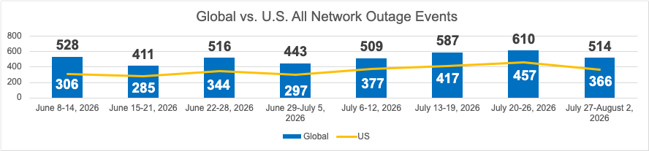
Early August figures reflected minor downward adjustments in overall event volume. ThousandEyes reported 502 global outages for the week of August 3 through August 9, down 2% from the preceding week. U.S. occurrences mirrored this trend, dropping 2% to 358 events.
Significant incidents during this window included a 32-minute disruption experienced by Cogent Communications on August 6, which centered on Chicago nodes and expanded its reach over a one-hour operational window. Similarly, Zayo Group encountered a 17-minute disruption on August 5, originating in Seattle before expanding its footprint and impacting downstream enterprise partners across the U.S. and Canada.
Internet Report for July 27–August 2
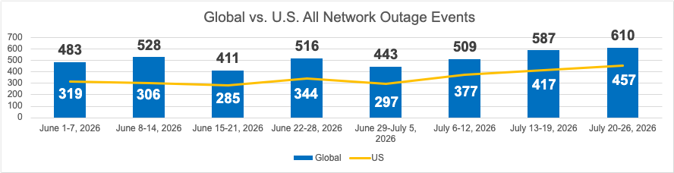
As July transitioned into August, ThousandEyes recorded 514 global network outage events, marking a 16% decline from the 610 incidents logged the prior week. U.S. events fell 20% to 366 occurrences.
On July 27, AT&T experienced a 20-minute domestic network disruption starting at 3:29 AM EDT. The incident migrated dynamically from New York nodes to Chicago, and subsequently to Ashburn, Virginia, before clearing at 3:50 AM EDT. Later in the week, on July 30, Liberty Global encountered an hour-long international disruption centered on Miami-based routing infrastructure, affecting downstream operations across multiple continents.
Internet Report for July 20–July 26
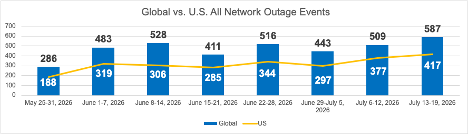
Mid-summer network metrics for July 20 through July 26 showed 610 global outages, representing a 4% increase week-over-week, alongside a 10% rise in U.S.-specific events.
A prominent infrastructure event occurred on July 23, when Microsoft experienced a network disruption affecting its West US region. Lasting approximately one hour and three minutes, the incident impacted downstream services across a vast international coalition of regions. Microsoft later identified the root cause as a software bug encountered during routine maintenance, which inadvertently removed IP routes between their West US datacenter and the wide area network (WAN) from more devices than intended. Initiating an emergency rollback at 1:45 PM EDT, Microsoft restored baseline routing by 2:26 PM EDT, with full service recovery achieved by mid-afternoon.
Internet Report for July 13–July 19
During the week of July 13 through July 19, global outage events rose 15% to reach 587 incidents, while U.S. figures climbed 11% to 417 events. Notable incidents included a 13-minute disruption at Zayo Group on July 13, and a 33-minute disruption affecting Charter Communications (operating as Spectrum) on July 14, which centered on New York routing nodes and impacted domestic and international partners alike.
Internet Report for July 6–July 12
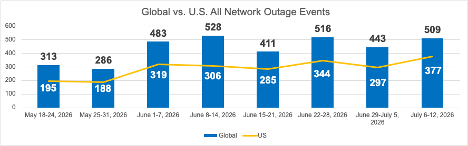
ThousandEyes reported 509 global network outages between July 6 and July 12, reflecting a 15% increase compared to the previous week. U.S. events climbed 27% to 377 occurrences. Notable events included a 38-minute disruption on Comcast Communications originating in Chicago on July 9, and a brief nine-minute disruption at Unitas Global on July 11, which briefly expanded from New York to international nodes in London and Singapore.
Internet Report for June 29–July 5
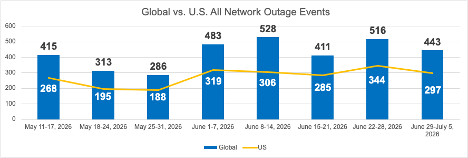
The week of June 29 through July 5 yielded 443 global network outages, down 14% from the preceding week. The most expansive event during this period occurred on July 2, when Arelion experienced a complex, multi-regional disruption lasting 51 minutes over a nearly two-hour operational window. Affecting dozens of countries across Europe, the Americas, Asia, and the Pacific, the outage progressed dynamically from Chicago nodes to Seattle, New York, Denmark, Los Angeles, Ashburn, Dallas, and Sweden. Cogent Communications also recorded a brief 13-minute disruption originating in Denver on June 29.
Internet Report for June 22–June 28
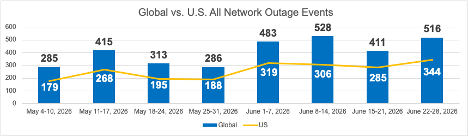
Late June metrics indicated 516 global network outages, marking a 26% increase week-over-week. Cogent Communications experienced a nine-minute disruption on June 27 centered on Atlanta and Washington, D.C., nodes, while Cox Communications encountered a 12-minute disruption on June 25 originating in Chicago.
Internet Report for June 15–June 21
During the week of June 15 through June 21, global outage events fell 22% to 411 incidents. Operational friction during this week included a 29-minute disruption at Comcast Communications on June 17, centered in Los Angeles, and a 45-minute disruption at AT&T on June 19, which originated in New York nodes before expanding its downstream impact.
Internet Report for June 8–June 14
ThousandEyes tracked 528 global network outages between June 8 and June 14, representing a 9% increase over the previous week. Alongside a multi-region disruption affecting Charter Communications on June 10, the period was notable for a service degradation impacting Google Gemini. Beginning at 6:10 AM EDT on June 10, the AI chatbot experienced global reply failures lasting approximately seven hours. Because ThousandEyes observed no underlying network connectivity issues on Gemini’s frontend infrastructure, analysts confirmed the disruption stemmed entirely from internal backend system processing failures.
Internet Report for June 1–June 7
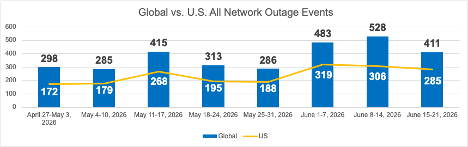
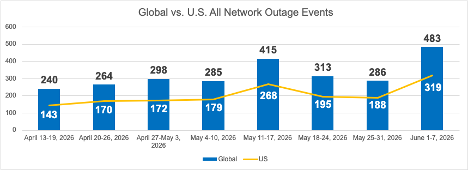
Early June experienced a significant surge in recorded events. ThousandEyes reported 483 global network outages, a 69% increase compared to the 286 incidents logged the previous week. U.S. figures mirrored this spike, jumping 70% to 319 events.
GTT Communications contributed significantly to this total on June 4, experiencing a 56-minute disruption spanning multiple regions. Originating in New York nodes, the outage subsequently drew in infrastructure in Washington, D.C., and Alexandria, Virginia. Additionally, Arelion recorded a brief 15-minute disruption on June 2 centered on Los Angeles routing nodes.
Internet Report for May 25–May 31
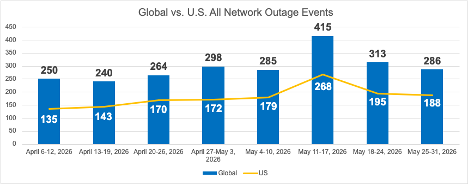
For the week of May 25 through May 31, global network outages declined 9% to 286 events. Notable operational events included a 15-minute disruption at Cogent Communications on May 25, which dynamically shifted across nodes in Dallas, Houston, Denver, and Miami, and an eight-minute disruption at Unitas Global on May 27, affecting Atlanta and New York nodes.
Internet Report for May 18–May 24
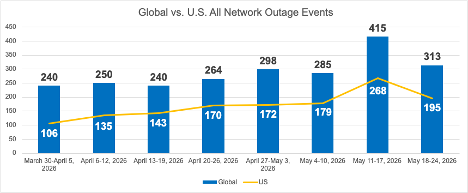
During the week of May 18 through May 24, ThousandEyes documented 313 global outages, a 25% decrease from the previous week. GTT Communications encountered a 35-minute disruption on May 20 centered in Seattle, while Arelion experienced a 25-minute multi-regional event on May 19 that involved shifting node failures across Los Angeles, Warsaw, Ashburn, San Francisco, and San Jose.
Internet Report for May 11–May 17
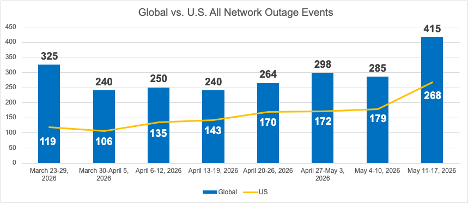
Mid-May metrics showed 415 global outages, representing a 46% increase week-over-week. Comcast Communications experienced a 17-minute disruption on May 13 centered in Atlanta, while AT&T encountered a brief nine-minute event the same day involving routing nodes in Phoenix and Midland, Texas.
Internet Report for May 4–May 10
ThousandEyes recorded 285 global outages between May 4 and May 10, reflecting a minor 4% drop. The week’s most notable event was a 39-minute disruption at Zayo Group on May 7, which began in Newark, New Jersey, before expanding across nodes in Los Angeles, San Jose, Phoenix, Dallas, San Francisco, and Washington, D.C., correlating with a marked rise in downstream enterprise impact.
Internet Report for April 27–May 3
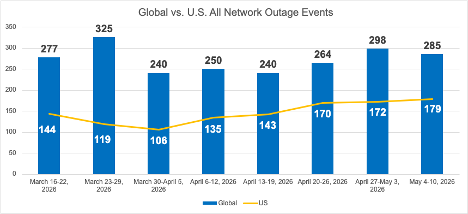
During the final week of April and opening days of May, ThousandEyes logged 298 global outages, up 13% week-over-week. Cogent Communications experienced a 17-minute disruption on May 2 originating in Los Angeles, and AT&T encountered a 14-minute domestic routing event on April 28 centered in Phoenix and Dallas.
Internet Report for April 20–April 26
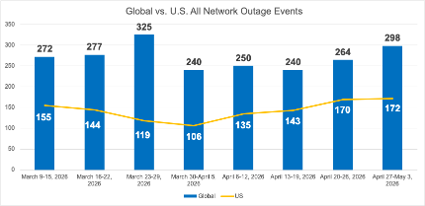
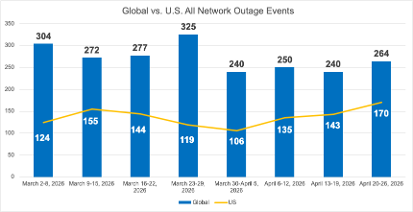
Mid-spring metrics for April 20 through April 26 showed 264 global outages, a 10% increase over the previous week. Verizon Business experienced a one-hour and three-minute disruption on April 22, originating in Phoenix and Chandler, Arizona, before expanding into Los Angeles. Zayo Group also encountered a 29-minute disruption on April 25 affecting nodes in Newark and London.
Internet Report for April 13–April 19
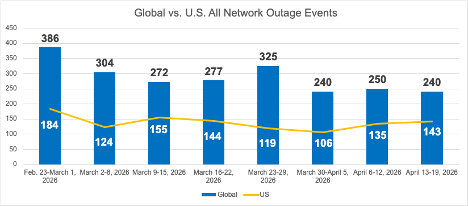
ThousandEyes reported 240 global outages for the week of April 13 through April 19, a 4% decline. Zayo Group experienced a 15-minute multi-regional event on April 15, while NTT America recorded a 35-minute disruption on April 16 that shifted dynamically between Chicago, Los Angeles, Ashburn, and Dallas nodes.
Internet Report for April 6–April 12
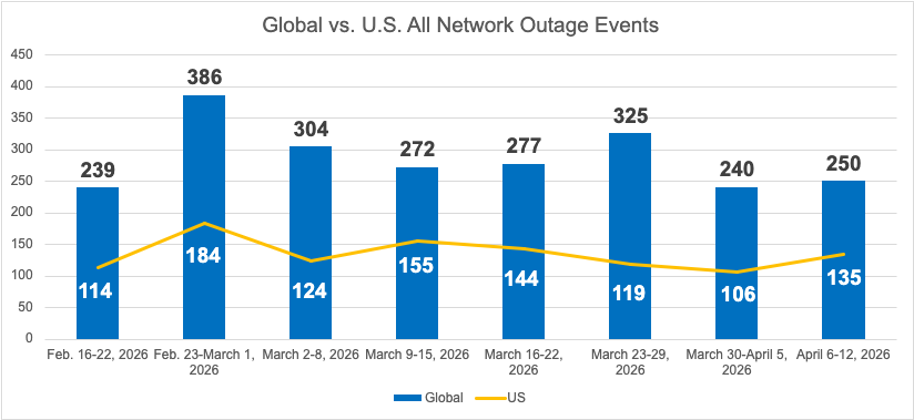
During the week of April 6 through April 12, global outages rose 4% to 250 incidents. Lumen experienced a 44-minute disruption on April 6 centered on Newark nodes, and Cogent Communications encountered a 21-minute disruption on April 8 originating in Mexico City before shifting across Texas routing infrastructure.
Internet Report for March 30–April 5
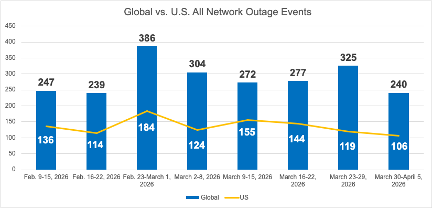
Spring reporting indicated 240 global outages for the week of March 30 through April 5, down 26% week-over-week. Alongside a multi-phased disruption at Charter Communications on March 31, Microsoft 365 suffered a global service disruption on April 2. Lasting one hour and 14 minutes, the incident resulted from a subset of infrastructure in Microsoft’s Central U.S. datacenter entering an unexpected degraded state, generating widespread server timeouts across the Americas, Europe, Asia-Pacific, and the Middle East.
Internet Report for March 23–March 29
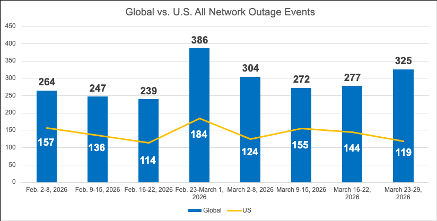
ThousandEyes tracked 325 global outages between March 23 and March 29, representing a 17% increase. Zayo Group encountered a one-hour and 24-minute disruption on March 23 centered in Seattle and Newark, while GTT Communications experienced a 34-minute multi-European and domestic routing event the same day.
Internet Report for March 16–March 22
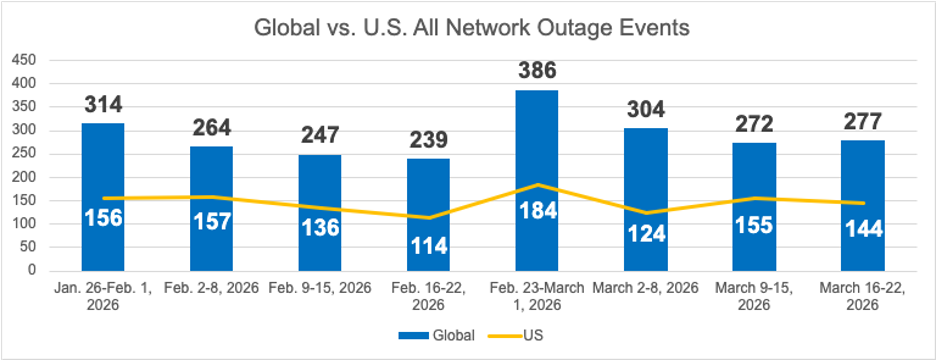
During the week of March 16 through March 22, global outages remained stable at 277 incidents. Arelion experienced a one-hour and 38-minute multi-regional disruption on March 20 originating in Ashburn, and Refinitiv Limited encountered a 37-minute financial technology infrastructure disruption on March 22 centered in New York and Newark.
Internet Report for March 9–March 15
ThousandEyes recorded 272 global outages between March 9 and March 15, an 11% decline. Zayo Group experienced a 43-minute disruption on March 13 centered in Seattle, and Cogent Communications recorded a 27-minute disruption on March 12 originating in Denver.
Internet Report for March 2–March 8
Early March metrics indicated 304 global outages, down 21% week-over-week. PCCW experienced a 48-minute international disruption on March 4 originating in Marseille and Los Angeles before concentrating in Hong Kong nodes. Additionally, ServiceNow encountered a one-hour and three-minute global instance disruption on March 6 originating in Austin and Seattle.
Internet Report for February 23–March 1
The transition from February to March saw a pronounced surge in network instability, with global outages jumping 62% to 386 incidents. Verizon Business experienced a 38-minute multi-regional disruption on February 26 centered in Boston and Philadelphia, while GitHub encountered a 39-minute global service disruption the same day centered on Washington, D.C. nodes.
Internet Report for February 16–February 22
During the week of February 16 through February 22, ThousandEyes logged 239 global outages. The period was notably impacted by a service disruption at Cloudflare on February 20. Stemming from a software bug introduced during an automated internal maintenance task, Cloudflare unintentionally withdrew customer IP address advertisements via its Bring Your Own IP (BYOIP) service. This misconfiguration caused connection timeouts and failures for users attempting to reach affected services globally. Normal routing stability returned after approximately one hour and 40 minutes once engineers halted the task and restored IP advertisements. Cogent Communications also recorded a one-hour and five-minute disruption on February 17 centered in Denver.
Internet Report for February 9–February 15
Mid-February metrics showed 247 global outages, a 6% decrease. Madgenius experienced a one-hour and 11-minute hosting disruption on February 13 centered in Columbus, Ohio, and Hurricane Electric encountered a 15-minute transit disruption on February 10 involving nodes across Texas, Georgia, and North Carolina.
Internet Report for February 2–February 8
ThousandEyes documented 264 global outages between February 2 and February 8, down 16% week-over-week. Zayo Group recorded a 16-minute disruption on February 6 centered in Newark, and Comcast Communications experienced a 12-minute regional disruption on February 3 originating in Ashburn.
Internet Report for January 26–February 1
During the week of January 26 through February 1, global outages rose 33% to 314 incidents. Cloudflare suffered an interruption lasting two hours and 13 minutes on January 27, affecting nodes in Chicago, Winnipeg, and Aurora. Lumen also encountered a 20-minute multi-regional transit disruption the same day centered in Washington, D.C. and Detroit.
Internet Report for January 19–January 25
ThousandEyes reported 236 global outages between January 19 and January 25, marking a 10% decline. Unitas Global experienced a 14-minute disruption on January 21 centered in Dallas and Chicago, while GTT Communications recorded a 16-minute disruption on January 25 centered in Washington, D.C.
Internet Report for January 12–January 18
Mid-January figures indicated 263 global outages, up 3% week-over-week. Madgenius recorded a one-hour and 16-minute hosting disruption on January 16 centered in Columbus, and TATA Communications encountered a 23-minute international disruption on January 17 originating in Singapore before cascading through nodes in Los Angeles, Santa Clara, Tokyo, and San Francisco.
Internet Report for January 5–January 11
Early January metrics showed 255 global outages, a 28% increase over the prior week. Charter Communications experienced a one-hour and 10-minute disruption on January 6 centered in New York and Washington, D.C., and Verizon Business recorded a 24-minute disruption on January 11 centered in Austin, Texas.
Internet Report for December 29, 2025–January 4, 2026
Closing out the transitional holiday window between December 29, 2025, and January 4, 2026, ThousandEyes reported 199 global network outages, representing a 14% decrease from the previous week. U.S. outages fell 29% to 71 events.
Notable incidents during the final days of the year included a one-hour transit disruption at Hurricane Electric on January 2, 2026, which centered on Los Angeles and Phoenix nodes and affected downstream partners across Asia and the Americas. Additionally, Cogent Communications concluded the year with a brief nine-minute disruption on December 31, 2025, which shifted swiftly from Washington, D.C. to Boston routing infrastructure before achieving full resolution.