
For years, building websites within the WordPress ecosystem meant accepting a familiar set of compromises. Traditional page builders made web design accessible to non-coders, but they frequently introduced rigid layout boxes, heavy reliance on third-party plugins, bloated codebases, and performance trade-offs that could drag down site speeds.
Now, a new entrant is looking to challenge those long-standing conventions. Kirki has emerged as the WordPress community’s first freeform visual website builder featuring an infinite canvas. By rethinking the foundational mechanics of website creation, the platform aims to provide cleaner performance, complete design freedom, and zero plugin dependency, shifting away from the traditional norms of WordPress development.

Whether targeted by designers seeking pixel-perfect control, developers looking for cleaner code output, or business owners hoping to avoid unnecessary technical complexity, Kirki positions itself as a comprehensive solution designed to remove the structural limitations that have long defined WordPress page builders.

A Closer Look at Kirki and Its All-in-One Approach
As a no-code visual website builder for WordPress, Kirki is engineered to bridge the gap where conventional page builders fall short. Rather than functioning as a surface-level styling tool that requires a constellation of extensions to achieve advanced functionality, Kirki operates as an all-in-one ecosystem.

The platform offers a robust free version available directly from the WordPress.org plugin directory. Unlike the restricted trial versions or watered-down teasers common in the software-as-a-service market, Kirki’s free tier provides a feature-packed building experience on an infinite canvas without requiring financial commitment.

For users seeking to scale their projects, the platform offers structured pricing tiers, including a starter plan priced at $59 per year for a single site, alongside a lifetime access option. Crucially, the platform avoids the tiered feature gating common among competitors, ensuring that dynamic content tools, popup builders, form creation suites, and growing template libraries are included from day one across plans.

Benchmarking Website Performance and Code Output
Because website performance directly influences user experience, search engine optimization, and conversion rates, independent performance audits were conducted to evaluate how Kirki stacks up against established alternatives like Elementor under identical conditions.

Both builders were installed on a clean WordPress environment utilizing the default Twenty Twenty-Five theme. Identical layouts incorporating comparable design elements were constructed, followed by Lighthouse performance audits measuring load times, server responsiveness, and Core Web Vitals.

The performance disparities were pronounced. Kirki generated a significantly cleaner Document Object Model, utilizing far fewer nested division tags and eliminating unnecessary structural wrappers. This lean architecture translated directly into faster load times and higher overall performance scores. Conversely, the comparative setup introduced heavier markup and additional scripts even on simplified layouts, dragging down responsiveness metrics. For developers and site owners prioritizing technical efficiency and rapid asset delivery, the architectural differences position Kirki ahead in pure code optimization.

Exploring the Infinite Canvas and Core Architectural Features
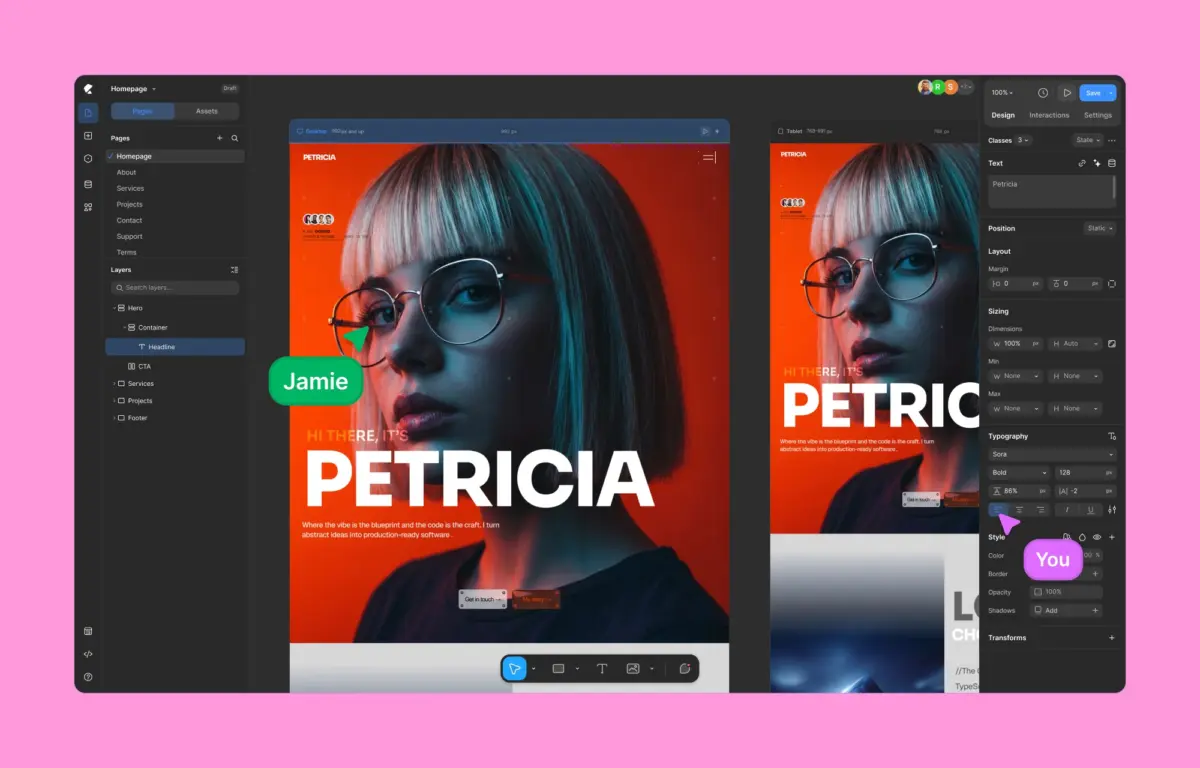
The defining characteristic that sets Kirki apart from legacy page builders is its infinite canvas. Free from the constraints of rigid row-and-column grids, designers can pan freely, zoom in and out, place elements with coordinate precision, overlap sections, and layer backgrounds entirely within a visual workspace. The interface supports both light and dark modes to accommodate user preferences during extended development sessions.

This canvas architecture enables concurrent editing across all responsive views simultaneously. Rather than forcing users to toggle back and forth between desktop, tablet, landscape, and mobile preview modes, Kirki displays all viewports side by side on the same canvas in real time. Adjustments made to larger breakpoints cascade intelligently down to smaller screens, minimizing repetitive configuration while offering granular control where specific overrides are required.

Furthermore, the platform incorporates a seamless handoff system for design tools like Figma. Creators can import pre-designed layouts directly into Kirki to instantly generate functional, responsive WordPress pages without manual rebuilding. This capability is supported by an unlimited breakpoint system that allows custom layout behaviors tailored to specific screen resolutions.

Native Dynamic Content, Reusable Styling, and Advanced Interactions
Addressing another major pain point in traditional WordPress development, Kirki integrates content management natively, eliminating the need to install external plugins like Advanced Custom Fields for dynamic data binding. Users can connect custom fields, manage query loops, and build templates directly inside the editor.

To manage design at scale, Kirki relies on a class-based styling system paired with global CSS variables. Styling an element automatically generates reusable CSS classes, allowing global design tokens for colors, typography, spacing, and sizing to propagate uniformly across an entire website. Advanced users retain the flexibility to inject custom CSS or page-level JavaScript when specific programmatic requirements arise.

When dealing with user experience and visual engagement, the platform features a timeline-based animation and interaction editor. Creators can build scroll-driven animations, hover states, and complex multi-step transitions visually. Text elements can be animated character by character or word by word, moving beyond standard generic effects into custom interactive storytelling.

Enterprise-Grade Collaboration and Quality Control
To accommodate professional agencies and multi-user environments, Kirki introduces real-time co-editing to the WordPress landscape. Multiple team members can work within the same page simultaneously, observing live cursor movements and color-coded edits as they occur. Integrated canvas commenting allows stakeholders to pin feedback directly to specific page elements, streamlining the review cycle for freelancers and client-facing teams.

Before publishing, an automated Page Audit tool scans the layout for technical compliance, checking accessibility standards, image alt text attributes, missing links, and overall SEO readiness. This built-in quality control ensures that aesthetic freedom does not come at the expense of technical compliance.

Supported by an expanding library of pre-designed template kits, standalone pages, and modular sections, Kirki continues to attract attention from professionals evaluating modern alternatives to traditional tools. By merging the design fluidity of modern web applications with the underlying power of WordPress, the platform offers a compelling glimpse into the future of content management system architecture.