
Underneath beds and inside dusty storage closets across the globe, forgotten boxes of compact discs remain untouched, holding memories of a bygone physical era of music. For many enthusiasts, these silver platters represent tracks that are missing entirely from modern streaming platforms, or versions of songs that have been altered, remastered, or replaced on services like Spotify. For one Linux user, the task of digitizing a massive collection of accumulated compact discs has finally been made easier thanks to the arrival of a brand new application designed specifically for modern desktop environments.
Laser is a newly developed CD ripping application built using GTK4 and libadwaita for Linux operating systems. Developed to bring optical media extraction up to date with contemporary design standards, the software provides a streamlined option for users looking to rescue their physical music libraries and bring them into the digital age. The timing of the software’s release coincides with an interesting demographic shift in consumer habits. While optical drives vanished from mainstream laptop designs roughly a decade ago, physical music formats are refusing to fade away entirely. Recent industry data from the United Kingdom indicates that compact disc sales are experiencing a notable resurgence. Younger consumers, increasingly priced out of the gentrified and often prohibitive costs associated with collecting vinyl records, are turning back toward cheaper physical formats like CDs. For those utilizing laptops or desktop computers, pairing these physical media with an affordable, portable external USB CD or DVD drive is all that is required to enjoy music offline.
This renewed interest in physical audio formats helps explain why software developers are once again turning their attention to optical disc tools on Linux, long after the mainstream computing industry abandoned built-in disc drives.
Laser Focused on One Task
Laser arrives as a modern alternative to legacy Linux CD ripping tools, featuring a user interface that aligns seamlessly with the visual language of contemporary desktop environments. Older utilities, while historically functional, often rely on aging toolkit dependencies. For instance, applications like Sound Juicer continue to work for some users, but they remain anchored to older interface frameworks like GTK3. Meanwhile, mainstream media players such as Rhythmbox historically included built-in capabilities to extract audio from compact discs, though users on distributions like Ubuntu frequently encounter functional bugs where clicking the extraction button yields no response at all.
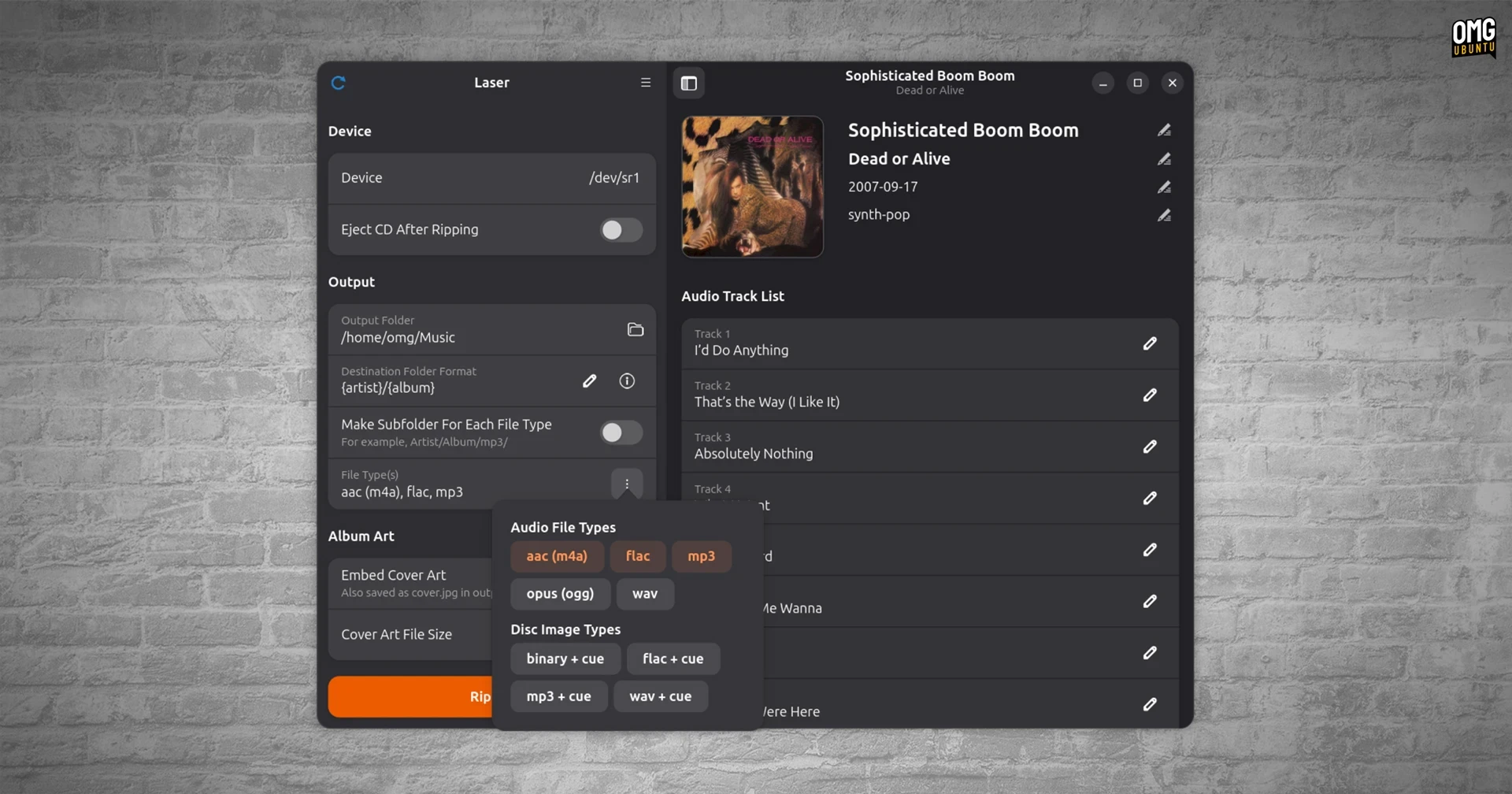
To circumvent these hurdles, users can install Laser easily via Flathub. Upon launching the application and inserting an audio compact disc into an attached optical drive, the software immediately reaches out to online databases to automatically retrieve comprehensive track metadata and album cover art. The program provides functionality to download and embed this artwork directly into the metadata of the newly ripped audio files, ensuring that the graphics display correctly when imported into modern local music player applications. Alternatively, users who prefer specific artwork can manually select a local image file from their hard drive.
Flexibility is a key component of the application’s design. Individual track titles can be modified directly within the interface before the extraction process begins. This feature proves particularly valuable when online database listings fail to match the specific pressing a user owns, or when an individual prefers a precise, personalized formatting style for remixes, collaborative tracks, and featured guest artists. Furthermore, the application allows users to define how directory structures and file organization are handled for the newly extracted files.
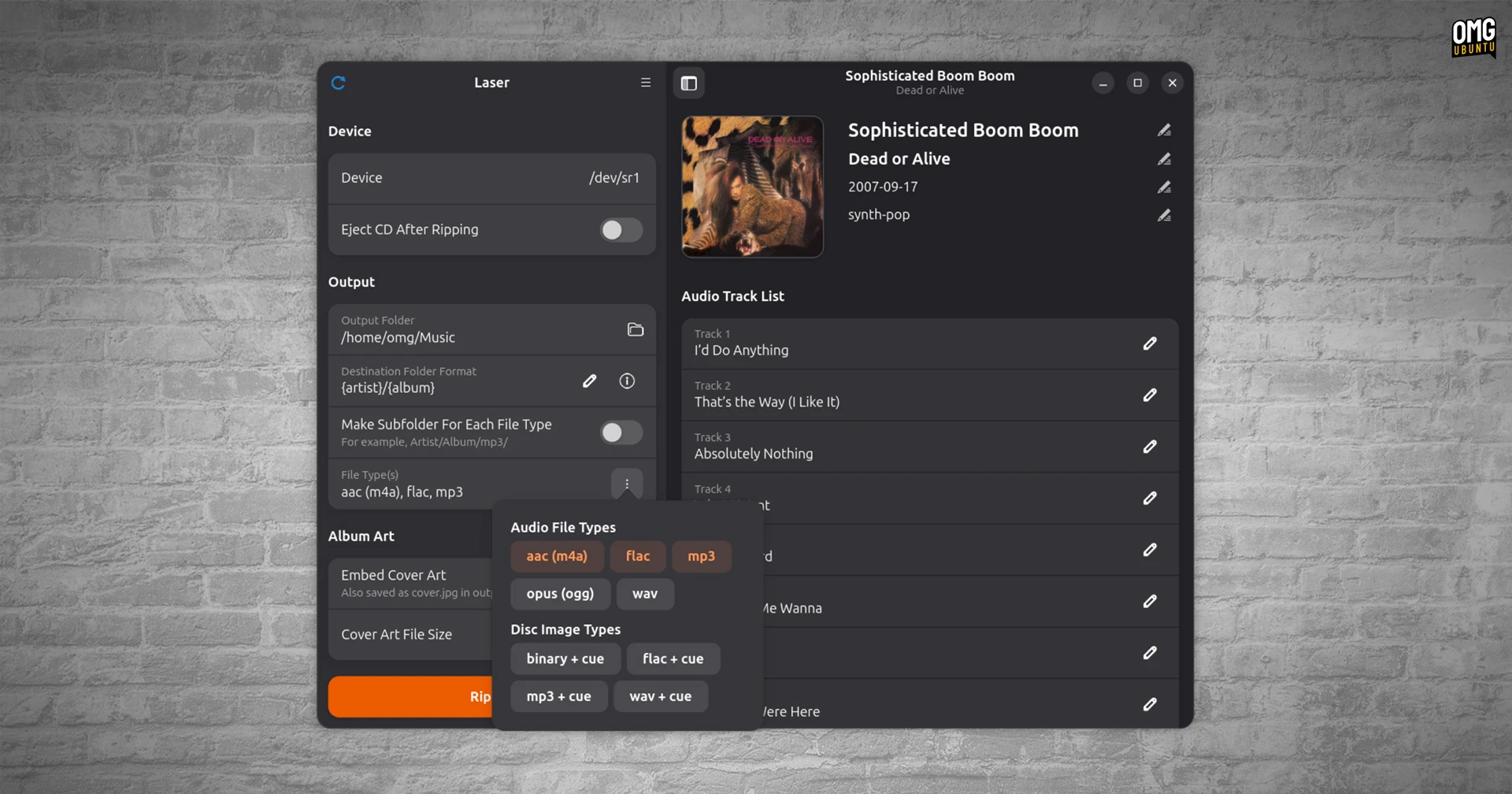
When the configuration is complete, Laser supports extraction to multiple audio formats simultaneously, giving users the freedom to rip their discs into lossless or lossy formats including FLAC, MP3, AAC, Opus, and WAV. Encoder quality, bitrate, and compression levels can all be adjusted to suit individual storage and quality preferences. For purists and archival enthusiasts, the tool also offers the ability to back up entire discs into a single image file accompanied by a CUE sheet, preserving the exact layout of the original release. Once the extraction procedure concludes successfully, the application automatically ejects the compact disc, provided the underlying hardware drive supports programmatic ejection.
It Can’t Do Something It Should
Despite its modern interface and broad format support, the application exhibits one notable limitation in its current design. Laser currently lacks a mechanism allowing users to select individual tracks for extraction. When a disc is loaded, the software processes every single track from beginning to end, regardless of whether the user wants the entire album or only a select few songs.
This behavior represents a peculiar omission for a contemporary utility. While deleting unwanted audio files manually from a storage directory after the ripping process is finished remains a relatively simple workaround, omitting unwanted tracks from the extraction queue in the first place would significantly speed up the workflow for users who only care for specific singles.
Quirks aside, the application performs its primary function reliably. For those undertaking the daunting project of digitizing hundreds of compact discs, the software delivers clean, high-quality audio files ready to be added to a local Linux media server. Once integrated, these files can be easily streamed and accessed across various networked devices throughout a home, transforming physical clutter into a localized, accessible digital library.
The process of working through a massive archive, however, tends to uncover unexpected realities about the scale of past music consumption. Digging through a large storage box reveals that nostalgia can quickly turn into a time-consuming endeavor. Sifting through physical media often brings back forgotten memories, such as tracking down long-obscure releases from 1990s pop acts to verify whether childhood memories of specific hit singles were entirely accurate, or simply the product of fading recollection. For Linux users ready to tackle their own neglected stacks of optical media, Laser is available now as a flatpak package directly on Flathub.