
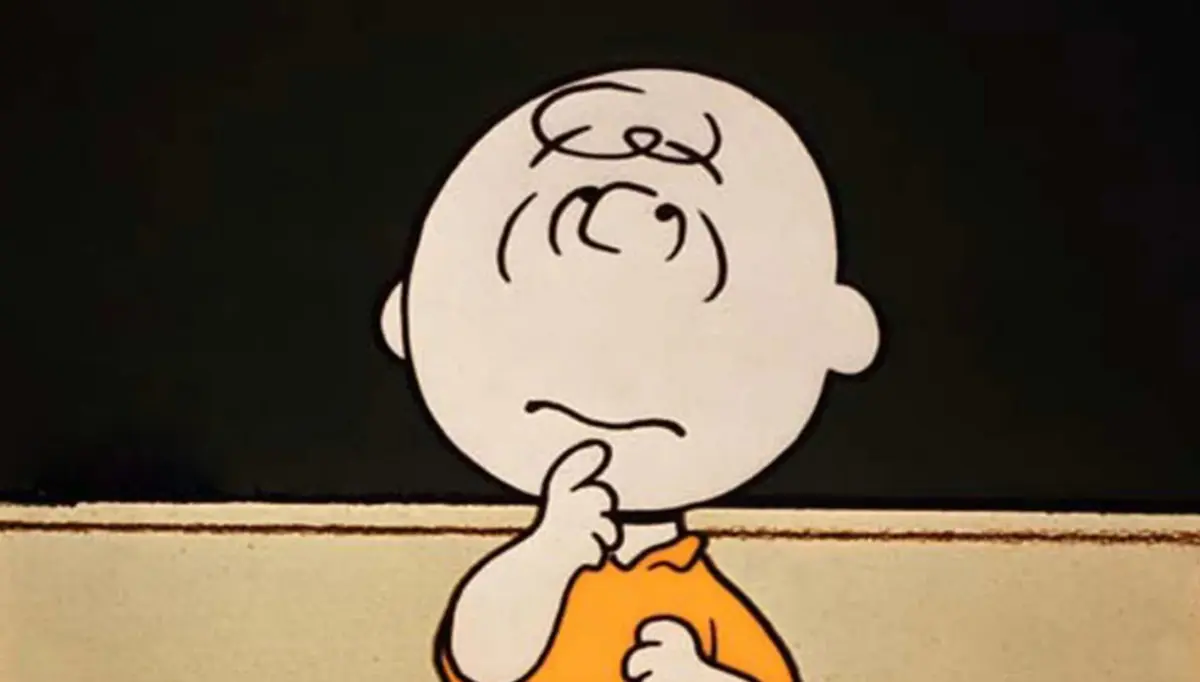
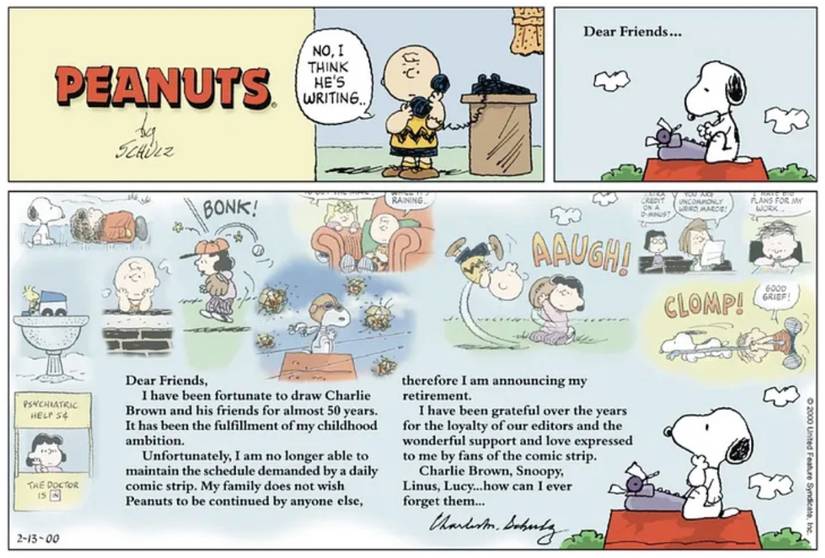
American cartoonist Charles Schulz passed away on February 12, 2000, at the age of 77. The very next day, the final Peanuts comic strip was published in newspapers across the world, bringing a definitive close to a remarkable 50-year run featuring Charlie Brown, Snoopy, and the rest of the beloved neighborhood gang.
While that timing might initially seem meticulously planned—as if the strip was created as a final farewell—the reality of newspaper syndication meant something entirely different. Peanuts strips, particularly elaborate Sunday editions, were routinely created weeks in advance of their actual publication date. Consequently, the alignment of Schulz’s passing and the final strip’s release was a poignant, albeit completely coincidental, stroke of timing.
Schulz had publicly announced his retirement two months prior to his death, following complications from several strokes and advancing colorectal cancer. He had drawn his final comic strip shortly after making that retirement public. Although Schulz was fully aware of his terminal diagnosis months in advance, he could not have known the exact date of his passing. Yet, through a twist of calendar math, his final published work served as a gentle, unintended obituary for the legendary creator.

The profound timing was entirely fitting for a man whose creative output left an indelible mark on American culture and modern humor. Over the course of a half-century, Schulz produced nearly 18,000 individual Peanuts comic strips. Some offerings were lighthearted and sweet, others relied on dry physical comedy, and a select few delivered astonishing moments of philosophical depth. Among these stands a strip published on February 3, 1966, which houses what many consider to be Schulz’s absolute finest quote—a remarkably high bar for a creator of his immense productivity and talent.
Charlie Brown and the Spelling Bee
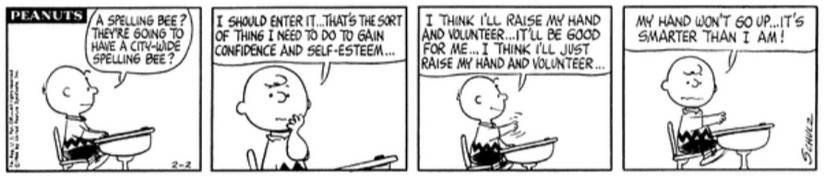
The memorable quote arrived in the middle of an extended, multi-part storyline centered around Charlie Brown participating in a school spelling bee. The narrative arc began on February 2, 1966, and continued across daily newspapers until February 20. In total, the story spanned 16 consecutive daily strips, excluding Sundays. Sunday strips traditionally required a much longer lead time and a more self-contained structure because they catered to a broader casual readership that often only picked up the weekend funny pages.
Within the framework of the story, Charlie Brown enthusiastically volunteers to represent his class in the school spelling bee. True to his classic, self-deprecating form, however, he spectacularly botches his very first opportunity at the microphone when he is asked to spell the word "maze" and instead confidently offers the spelling "m-a-y-s."

Overwhelmed by embarrassment and stress, Charlie Brown trudges back to his wooden school desk and buries his face in his arms. When his teacher gently instructs him to lift his head back up, a flustered Charlie Brown snaps under the pressure and talks back, resulting in an immediate trip to the principal’s office. After serving his brief punishment, he returns to the classroom and offers a sincere apology to his teacher, closing the immediate chapter of his academic humiliation.
The Birth of a Philosophy
However, the true cultural highlight of the entire multi-week storyline occurred during its second installment, right after Charlie Brown first announced his intention to volunteer for the spelling bee. The strip opens with a characteristically incredulous Lucy Van Pelt, who simply cannot fathom why Charlie Brown would willingly subject himself to public scrutiny and potential humiliation by entering a spelling bee.
Faced with Lucy’s sharp skepticism and teasing disbelief, Charlie Brown wheels around and shouts in frustration, demanding to know what could possibly be wrong with his decision. "Well, what’s wrong? What’s wrong with trying?! I can try, can’t I?" he asks, before delivering a line of dialogue that transcends the Sunday comics page:
"What’s the good of living if you don’t try a few things?"
The sentiment is breathtakingly brilliant in its simplicity. It is a thoughtful, grounded statement that offers a universal reminder for navigating the uncertainties of human existence. Yet, the profound nature of the remark is entirely lost on both characters within the panel. Lucy and Charlie Brown are portrayed as children, and they are understandably not meant to grasp the weighty philosophical implications of their casual dialogue—even though genuinely profound moments frequently surfaced throughout the history of Peanuts.
There is compelling evidence to suggest that even Charles Schulz himself failed to recognize the sheer brilliance of the words he had placed in Charlie Brown’s mouth.
Charlie Brown on the Big Screen
The extensive 20-part spelling bee storyline eventually served as the primary narrative foundation for the very first feature-length Peanuts motion picture, titled A Boy Named Charlie Brown, which premiered in theaters on December 4, 1969. The film, written by Schulz himself, remains a significant yet somewhat overlooked milestone in animation history. It faithfully adapts the core narrative of the spelling bee arc, expanding the plot significantly to fill an 85-minute runtime.
Despite the expansion, certain elements from the original newspaper comic strips were left on the cutting room floor, most notably Charlie Brown’s unforgettable philosophical declaration. Whether Schulz felt the line did not fit the pacing of the cinematic adaptation or simply failed to view it as anything out of the ordinary remains unknown.
Regardless of its omission from the silver screen, the statement stands on its own. That simple sentence carries just as much weight and wisdom as anything uttered by prominent thinkers, philosophers, or leaders throughout history. After all, what is the ultimate point of human existence if people do not dare to try a few things while they are here? Charles Schulz certainly took that philosophy to heart throughout his legendary career, and the cultural landscape was forever changed as a result.