
For many digital music enthusiasts, a familiar relic sits tucked away in storage: a physical box of compact discs, slowly collecting dust while waiting for the day someone finally gets around to digitizing them. Whether it involves obscure tracks missing from streaming platforms, specific master recordings absent from online catalogs, or long-forgotten albums by artists that feel more like a product of the Mandela effect than reality, the chore of ripping CDs has long been viewed as an outdated technological rite of passage.
Now, a new software tool is offering a fresh incentive to tackle that backlog. Released for Linux users, Laser is a modern CD-ripping application built using the GTK4 and libadwaita toolkits. Designed to blend seamlessly with the aesthetic of contemporary desktop environments, it has arrived just as interest in physical music formats undergoes a surprising cultural renaissance, particularly among younger demographics navigating the modern landscape of digital streaming and inflated vinyl prices.
The revival of physical media is well-documented. Recent market data from the United Kingdom highlights a booming trade in CD sales, driven largely by younger buyers who have grown weary of the gentrified pricing associated with vinyl records. For those seeking an affordable alternative to experience physical music without sacrificing modern convenience, a simple and inexpensive external CD or DVD drive is all it takes to play compact discs directly through a laptop or desktop computer.
Yet, for a long time, the software ecosystem on Linux had largely failed to keep pace with this shifting hardware landscape. It has been roughly a decade since optical disc drives effectively vanished from standard laptop designs, leaving legacy tools as the primary option for users looking to extract audio from silver discs. Older applications like Sound Juicer have remained functional over the years, but they rely on older frameworks such as GTK3, making them look increasingly out of place on modern, polished Linux distributions. Meanwhile, alternative built-in solutions like Rhythmbox feature CD extraction capabilities, but users often encounter bugs where clicking the extract button yields no response at all.
Enter Laser, a utility specifically engineered to bridge the gap between vintage physical formats and modern computing environments.
Laser Focused on One Task
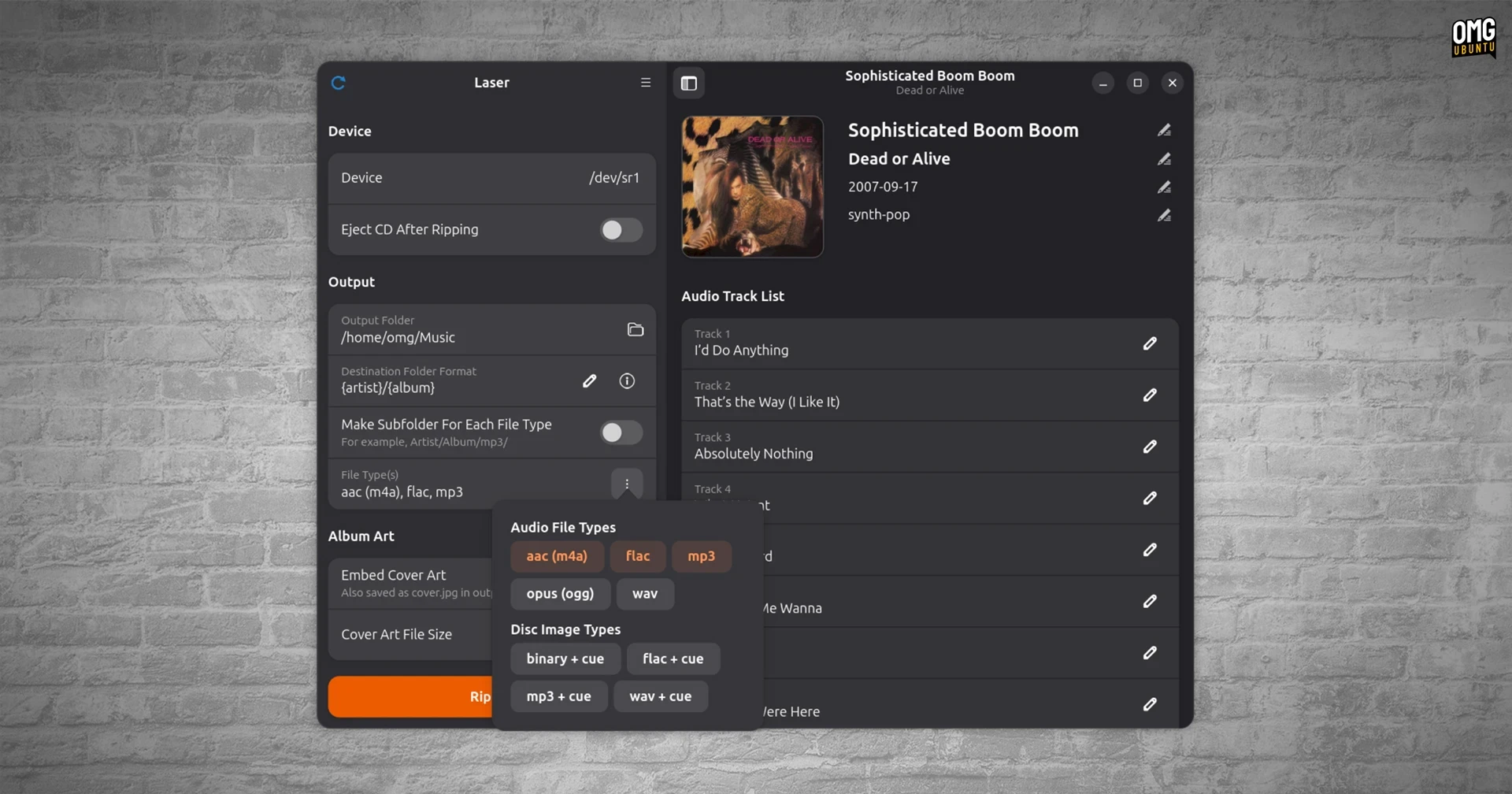
Developed to provide a streamlined, contemporary user experience, Laser positions itself as a dedicated tool for a single, straightforward purpose. Upon installation via Flathub—the centralized distribution hub for Flatpak applications—users can insert an audio compact disc into an attached optical drive and watch as the software immediately communicates with online databases to pull track metadata and album artwork automatically.
The application offers practical flexibility when it comes to visual presentation. Users can choose to download and permanently embed the retrieved artwork directly into the metadata of the ripped audio files, ensuring that the cover images display correctly across various modern music player applications. Alternatively, users who prefer specific imagery can select a local image file from their system to use as the album art.
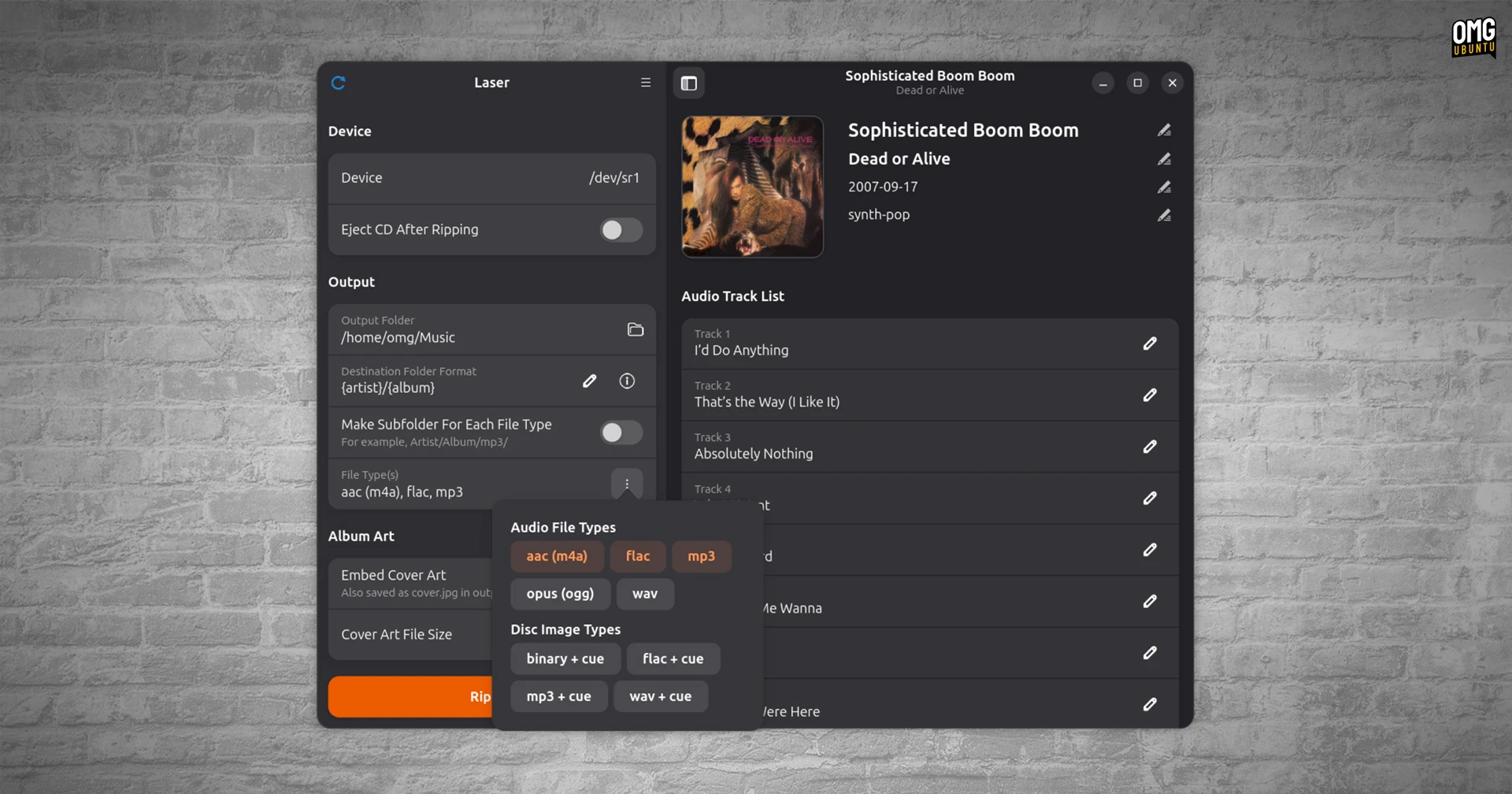
Beyond automated metadata retrieval, the application accommodates meticulous organization. Individual track titles can be manually edited prior to the ripping process, offering a vital feature for archivists whose physical CD pressings feature different track listings, region-specific variations, or precise formatting preferences regarding remixes and featured artists. Furthermore, the software allows users to define custom directory structures for how the extracted files are organized on their local storage drives, preventing the creation of disorganized music libraries.
When the configuration is complete, Laser handles the extraction phase with comprehensive format support. Rather than locking users into a single proprietary or default codec, the application can encode and export audio files to multiple formats simultaneously, including FLAC, MP3, AAC, Opus, and WAV. Users retain full control over encoder quality settings and compression levels, and the application also supports archiving entire discs into a single image file accompanied by a traditional CUE sheet.
A Curious Omission in a Streamlined Package
Despite its modern interface and robust feature set, Laser includes one prominent limitation that has caught early users by surprise: the software currently provides no way to select individual tracks for extraction.
When a compact disc is loaded into the drive, Laser proceeds to rip every single track present on the disc, regardless of whether the user actually wants the entire album or only a select few songs. For those attempting to curate specific tracks from compilation albums or audiobooks, this design choice requires an extra administrative step, forcing users to manually delete unwanted files from their storage drives after the extraction process has concluded. While the cleanup process is minor, the inability to cherry-pick tracks prior to ripping represents a noticeable workflow bottleneck that could otherwise save significant time.
That quirk aside, the application delivers reliable performance for its core function. For those dealing with large archives of physical media, it provides an efficient pathway to convert aging discs into high-quality digital files that can be integrated into a local Linux media server and streamed seamlessly to other connected devices throughout a home network.
For many digital hoarders, however, the real hurdle isn’t the software—it’s the sheer scale of the physical media sitting in storage. Diving back into decades-old collections often serves as an unexpected exercise in nostalgia, occasionally confirming long-held memories that seemed too bizarre to be true. Sorting through the physical remnants of 1990s pop culture can unexpectedly prove that obscure records by forgotten novelty acts genuinely existed, even if logic suggests they perhaps never should have.
With Laser now readily available for installation through Flathub, Linux users equipped with an external optical drive and a box of forgotten compact discs finally have a modern, visually cohesive tool to bring their physical music archives into the twenty-first century.