
For nearly three decades, rightsholders and anti-piracy advocates have sought to connect digital copyright infringement to broader criminal enterprises, frequently arguing that unauthorized streaming and downloading operations share financial and logistical ties with organized crime syndicates and international terrorism. This framing, which first surfaced in the late 1990s as the International Federation of the Phonographic Industry (IFPI) raised alarms over transnational criminal networks smuggling illicitly duplicated compact discs across international borders, has evolved significantly over the years.
The terrorism angle was formally introduced into the policy debate in 2003 during a hearing held by the U.S. House of Representatives examining intellectual property theft’s connections to organized crime and terrorism. Around the same period, then-Interpol Secretary General Ronald Noble testified before Congress, asserting that intellectual property crime had transformed into a preferred funding mechanism for various militant and terrorist groups.

Perhaps the most frequently cited connection emerged in 2009, when a prominent research report funded by the motion picture industry linked film piracy directly to criminal gangs and terrorist organizations. Although critics noted that the study blurred the analytical lines between physical counterfeiting and digital piracy, its core arguments have been persistently referenced by industry stakeholders in policy discussions ever since.
In recent years, Washington-based advocacy organizations have continued to champion this narrative. The Digital Citizens Alliance, working in close collaboration with representatives from the creative industries, has repeatedly bundled digital piracy with broader online harms. In 2017, the organization released a report that associated unauthorized streaming operations with militant recruitment materials, malware distribution, and disinformation campaigns. More recently, in May of this year, the group published findings linking illicit Internet Protocol Television (IPTV) services to the international drug trade, illegal arms trafficking, and organized mafia networks.
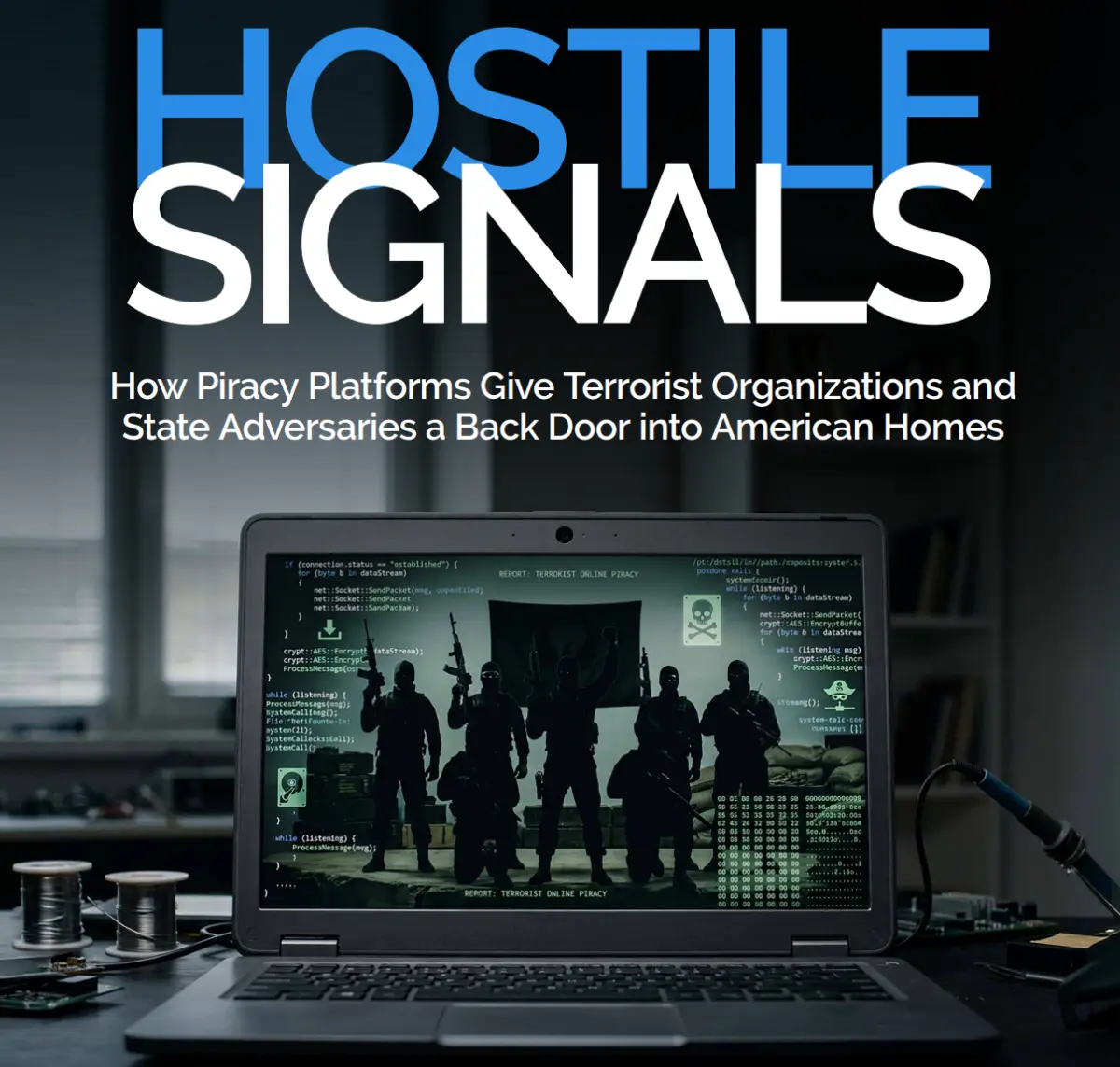
Expanding on these themes, the Digital Citizens Alliance released a new research report titled “Hostile Signals.” The study introduces a distinct geopolitical angle, arguing that contemporary piracy operations do not merely provide financial revenue for bad actors, but can also function as effective broadcasting channels capable of circumventing international economic sanctions and government broadcasting bans. To emphasize the gravity of its findings, the report notes that the twenty-fifth anniversary of the September 11 terrorist attacks is rapidly approaching, concluding its introductory remarks with the solemn refrain, "Never Forget." The timing of the press release, arriving just ahead of the anniversary, underscores the strategic messaging employed by the report’s creators.

To gather empirical data for the study, researchers from Atlanta-based cybersecurity and risk management firm risk3sixty subscribed to twenty-five commercial pirate IPTV services using standard U.S. internet connections between May and August. According to the findings, seventeen of these unauthorized platforms carried at least one television channel directly tied to a designated terrorist organization or a sanctioned state-run broadcaster.
The data compiled by the researchers highlights the prevalence of specific foreign networks across these illicit platforms. Al-Manar, the official television station of Hezbollah—an organization with a long history of anti-Western activity and responsibility for hundreds of American deaths over the decades—was found on all seventeen of the identified piracy services. Furthermore, the Houthi-run Al-Masirah channel was available on nine of the platforms, Iran’s state-backed Al-Alam appeared on seven, and Hamas-affiliated Al-Aqsa TV was accessible on two.
The report explicitly highlights the persistence of these networks, noting that Hezbollah’s media outlet was readily accessible through commercial piracy platforms operating within the United States. The study names several specific services alleged to carry these problematic channels, including Lion OTT, Sansat VIP, OTTOcean, Belitvision, and Wish IPTV, all of which were successfully accessed and tested from domestic internet connections.

Federal authorities have previously targeted these foreign networks through various legal and technical enforcement actions. The United States government officially banned the satellite broadcast feed of Al-Manar in 2004, and subsequent federal investigations led to criminal convictions, including a case where a Brooklyn resident was sentenced to nearly six years in federal prison for providing material support to a designated terrorist organization after reselling the channel to local customers in New York. Despite these historical enforcement efforts and regulatory crackdowns, the report contends that modern pirate IPTV services have inadvertently established a secondary distribution channel, or back door, that bypasses traditional regulatory barriers.
"A piracy subscription has restored what two decades of federal action removed," the report concludes, warning that policymakers, national security officials, and the general public should be deeply concerned about these developments. The authors argue that unauthorized streaming platforms have effectively created a new avenue for terrorist organizations and state adversaries to disseminate recruitment messaging and radicalizing content directly to domestic audiences within the United States.
At the same time, the report acknowledges several important nuances and limitations regarding viewership patterns and content context. The findings do not provide empirical data concerning actual audience consumption or viewership numbers for these specific foreign channels. Furthermore, the broadcasts in question are transmitted entirely in Arabic, typically without English subtitles or translation, and are embedded within massive commercial lineups that often feature thousands of alternative entertainment, sports, and news channels.

Additionally, industry observers point out that many of the streams highlighted in the report, including those originating from Hezbollah-affiliated networks, remain freely accessible on the open internet through the broadcasters’ own official websites. For instance, while the United States Department of Justice seized thirteen domain names associated with Hezbollah in 2023, including seven bearing the channel’s name, the primary operational website for the broadcaster continues to operate under Lebanon’s national domain extension. Because this domain falls outside the direct jurisdiction of U.S. authorities, it remains accessible and continues to stream live broadcasts to international visitors, including those in the United States.
Despite the widespread availability of these streams on the open web, the report leverages the presence of sanctioned broadcasters on pirate networks to advocate for a specific policy remedy: the implementation of comprehensive website-blocking legislation in the United States. The authors argue that technical site-blocking measures, which rightsholders have long championed to combat copyright infringement, could similarly be deployed to restrict access to unauthorized foreign broadcasters and terrorist-linked content.
"These findings reinforce the need for the United States to adopt measures to prevent overseas piracy networks from operating in the country," the report states.

The release of the study coincides with an ongoing legislative debate in Washington regarding domestic site-blocking bills. Proposals such as the American Copyright Protection Act, introduced by Representative Darrell Issa, and the Foreign Anti-Digital Piracy Act, sponsored by Representative Zoe Lofgren, have placed the issue firmly on the congressional agenda. Representative Issa has recently indicated that a bipartisan and bicameral legislative compromise is nearing completion.
This policy push echoes similar arguments made earlier in the year by industry leaders. In August, Motion Picture Association Chairman Charles Rivkin and representatives from the National Intellectual Property Rights Coordination Center highlighted the enforcement limitations of traditional domain name seizures during major international sporting events, using the occasion to renew calls for comprehensive site-blocking mandates.
As discussions regarding online enforcement continue to unfold among lawmakers and stakeholders in the nation’s capital, content owners are expected to utilize the findings of the "Hostile Signals" report as supporting evidence that robust anti-piracy measures can yield broader national security benefits. The report closes by reiterating its opening sentiment, framing the fight against digital piracy not only as an economic imperative for the creative industries, but as an extension of broader security efforts.