
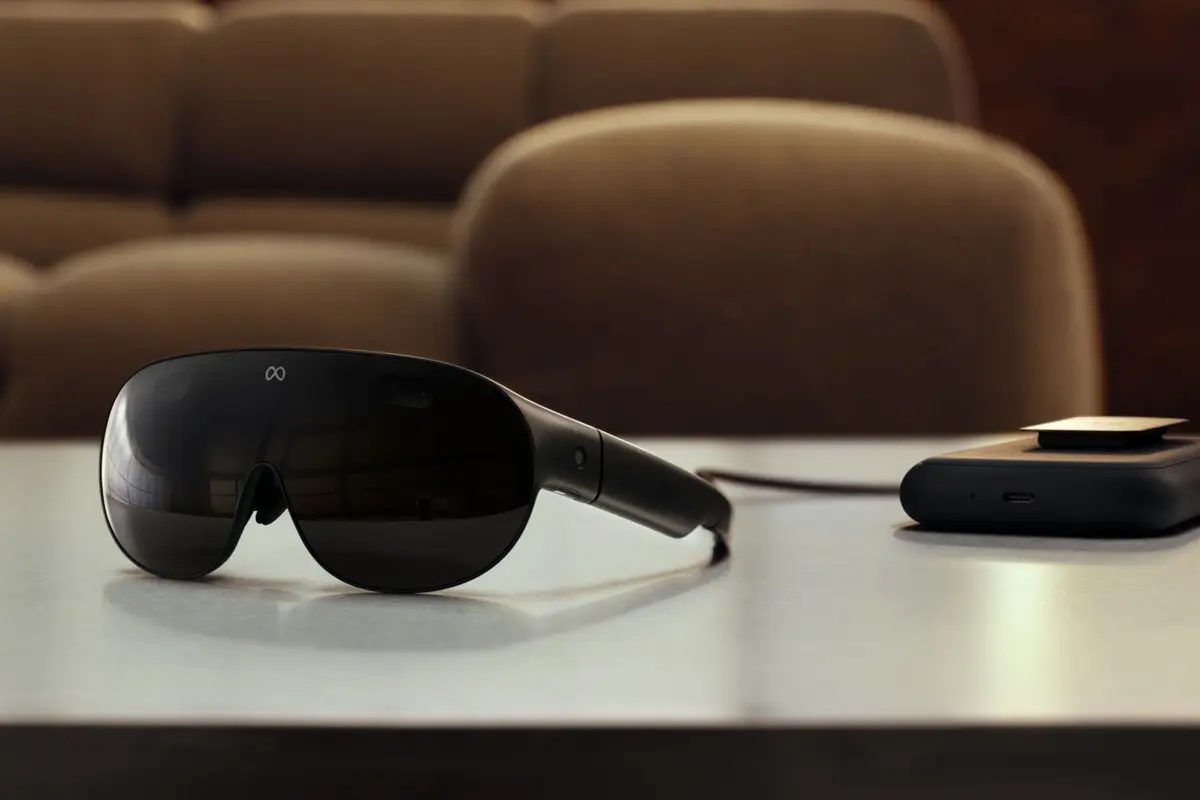
Meta has officially pulled back the curtain on its highly anticipated next-generation mixed reality headset, formally named the Meta VR Glasses. Previously developed and whispered about under the internal codename "Project Phoenix," the device represents a major hardware shift for the company, trading all-in-one headset bulk for a lightweight, compute-tethered design aimed at redefining everyday spatial computing, casual media consumption, and immersive entertainment.
While the official announcement was made today, consumers eager to get their hands on the hardware will have to wait a little longer. The Meta VR Glasses are slated to go on sale sometime in Spring 2027 with a retail price of $1,300. Although Meta has not yet pinned down an exact calendar release date for the spring launch window, the company has offered a comprehensive look at the device’s underlying hardware, software ecosystem, and an extensive slate of incoming content designed specifically for the platform.
Meta VR Glasses – Hardware
The defining engineering achievement of the Meta VR Glasses centers on what the company describes as its "5K Infinite Display." Utilizing advanced micro-OLED panels, the device delivers a striking 5.5MP resolution per eye—specifically 2,412 by 2,288 pixels—operating at a high pixel density of 37 pixels per degree (PPD). This marks a substantial visual upgrade over the Meta Quest 3, which sits at 25 PPD.
While the raw resolution numbers are lower than the 11.7MP per-eye resolution found on Apple’s Vision Pro, Meta emphasizes that the VR Glasses achieve a comparable or superior perceived sharpness due to a tighter, more focused diagonal field-of-view of roughly 88 degrees, broken down horizontally at 70 degrees and vertically at 66 degrees.
The most striking departure from traditional standalone headsets is the physical form factor of the headset itself. By offloading the primary computing components and the battery to a separate pocketable puck—connected via an advanced optical cable to a proprietary port on the glasses—the headset portion resting on the user’s head weighs a mere 100 grams.
The accompanying compute puck weighs approximately 300 grams and houses Qualcomm’s cutting-edge Snapdragon Reality Elite processor, officially designated as the XR2 Gen 3. The puck’s internal battery is engineered to deliver over three hours of mixed-use media playback and operation per charge. Furthermore, users can maintain uninterrupted sessions by keeping the puck plugged into its included 45W USB-C power supply, supporting fast-charging capabilities even during active use.
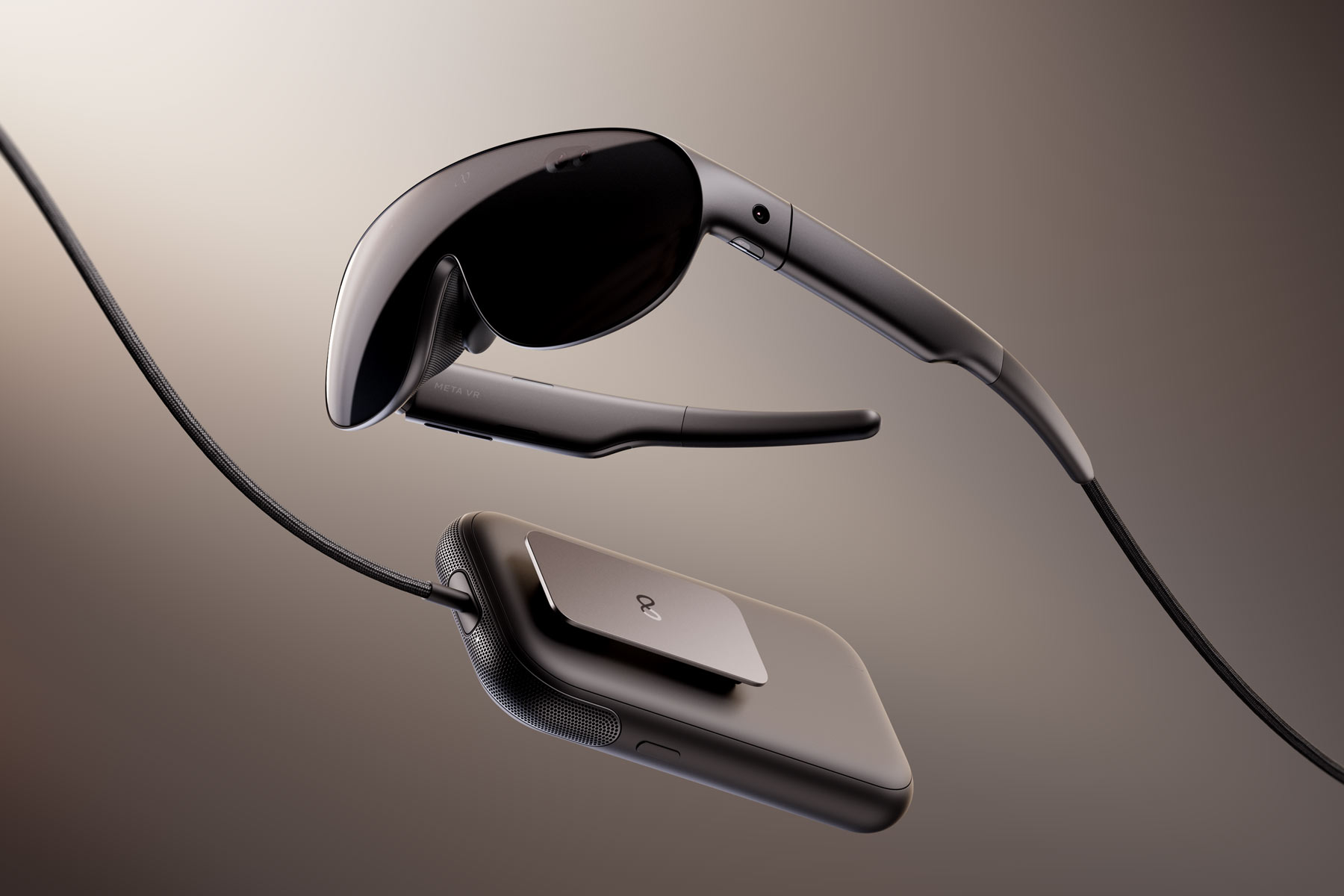
Optics and ergonomics have also received meticulous attention. The lenses feature manual, independent adjustments for an interpupillary distance (IPD) ranging between 56mm and 70mm. For users with corrective vision needs, the lenses can be easily fitted with custom prescription inserts developed through a partnership with Zenni Optical.
Sensor integration is deeply woven into the hardware architecture. The device features a robust array of hardware including four eye-tracking cameras—two dedicated to each eye—which facilitate rapid UI selection, intuitive navigation, and biometric iris detection for secure unlocking. Front and downward-facing camera sensors expand the range and responsiveness of hand-tracking capabilities. For mixed reality passthrough, high-fidelity color sensors deliver a crisp 26 PPD view of the physical world. Naturally, the device retains the sophisticated six-degrees-of-freedom (6DoF) spatial tracking originally pioneered across Meta’s broader Quest product line.
Following the design philosophy established by Meta’s Ray-Ban Display smart glasses, the primary input method relies on a fluid combination of gaze and hand gestures rather than physical controllers. Users can simply look at an interface element to highlight it, pinch their index finger and thumb together to select, or rub their thumb up, down, or sideways to scroll seamlessly through digital content.
Despite leaning heavily into controller-free interaction, Meta has ensured backwards compatibility and optional flexibility. The Meta VR Glasses fully support Meta’s Touch Plus controllers. Users who prefer physical inputs can either purchase them separately or utilize the controllers they already own from a Meta Quest 3 or Quest 3S.
Productivity features are further enhanced by the inclusion of Surface Keyboard technology, which originally rolled out to the Quest ecosystem earlier in the year. This feature transforms any flat physical desk or table surface into a virtual keyboard and trackpad. Additionally, users can pair a wide variety of standard Bluetooth peripherals, including physical keyboards and gaming gamepads.
To accommodate different physical ergonomics, the Meta VR Glasses will be sold in two distinct sizing SKUs: Standard and Large. At launch, the hardware will be offered with 128GB of internal storage, complemented by a built-in microSD card slot located on the compute puck that allows users to expand their storage capacity up to 1TB.

When the device officially hits store shelves next spring, Meta is planning a broad international rollout. The initial launch wave will span the United States, United Kingdom, Canada, Mexico, Germany, Poland, France, the Netherlands, Belgium, Italy, Switzerland, Austria, Ireland, Iceland, Finland, Spain, Sweden, Norway, Denmark, Japan, Taiwan, Korea, Singapore, Australia, and New Zealand.
Meta VR Glasses – Software & Games
Operating on the familiar software foundation of the Quest ecosystem, the Meta VR Glasses will launch with immediate access to the existing library of Quest VR games and applications. Beyond traditional virtual reality software, Meta has curated a dedicated lineup of more than 75 games and productivity apps specifically optimized for the device’s native hand-gesture input system.
Headline gaming titles adapted for hand-tracking include a modified version of the rhythm phenomenon Beat Saber, the immersive 3D puzzle adventure Dragon Grove, the courtroom investigation sim Phoenix Wright: Ace Attorney – Dual Destinies, and a gesture-driven adaptation of Tetris Effect.
Entertainment and media streaming are similarly prioritized. Major streaming platforms, including Disney+ and Peacock, will feature native 3D viewing capabilities at launch, alongside services like HBO, YouTube, and Amazon Prime Video. Additional streaming platforms can be accessed directly through the device’s built-in web browser.
Reinforcing its media credentials, the Meta VR Glasses carry an official "IMAX Enhanced" certification. The device supports Dolby Vision and Dolby Atmos immersive spatial audio, enabling users to experience select cinematic features in IMAX’s exclusive expanded aspect ratio.
Beyond gaming and casual viewing, Meta is heavily marketing the device as a versatile productivity tool. The hardware supports wireless multi-screen virtual desktop streaming from compatible Mac, PC, and mobile devices. Furthermore, native DisplayPort-In functionality allows users to hardwire the headset directly into laptops, home video game consoles, and portable gaming handhelds, positioning the Meta VR Glasses as a flexible personal display for modern digital workflows.