
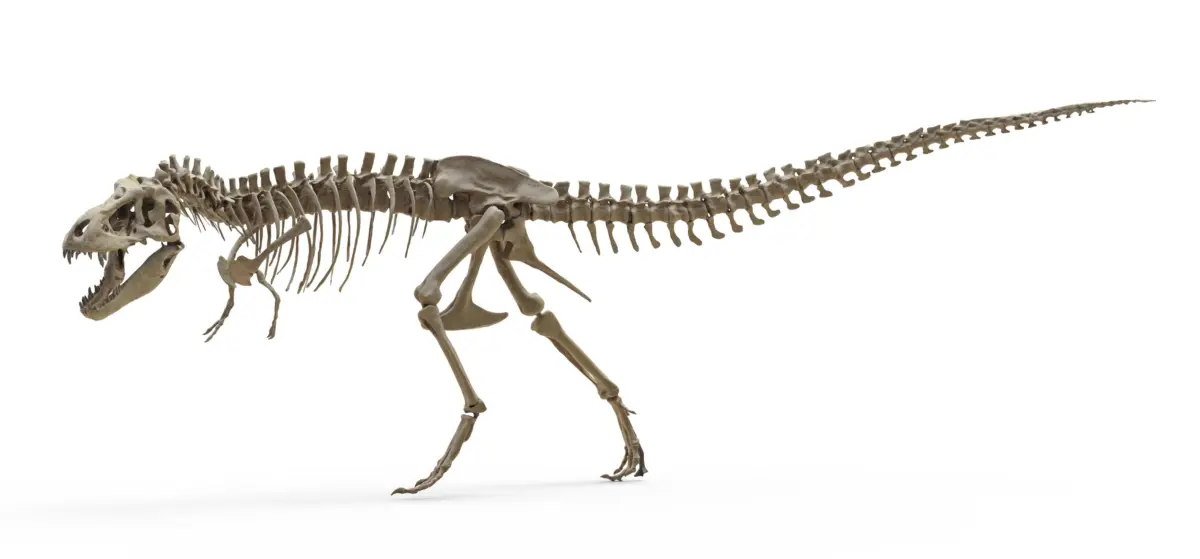
For most of the 20th century, popular culture and scientific consensus alike pictured Tyrannosaurus rex as a sluggish, tail-dragging reptile. In this older view, the giant predator was an ectotherm—a cold-blooded creature that had to spend its mornings basking in the sun to warm its massive body before it could summon the energy to hunt. That paradigm shattered in the late 1980s and 1990s, replaced by the active, agile, and bird-like animal popularized in films like Jurassic Park. Yet, even as our understanding of dinosaur behavior evolved, a fundamental physiological question remained unanswered: Did T. rex rely on warm blood to power its highly active lifestyle, or did it maintain its body heat through some other means?
Now, scientists may have brought us much closer to a definitive answer. A team of researchers led by Randon J. Flores and Robert A. Eagle, geochemists at the University of California, Los Angeles (UCLA), has successfully measured the internal body temperature of T. rex by analyzing its fossilized teeth. According to this ancient dental thermometer, the tyrant lizard king had an average body temperature of approximately 36.3° Celsius (97.3° Fahrenheit)—a thermal profile strikingly similar to that of a modern elephant.
Dental thermometry
Paleontologists have spent decades debating dinosaur physiology, historically relying on indirect lines of evidence to reconstruct the metabolic rates of extinct animals. Researchers have analyzed bone microstructure (histology) to estimate growth rates, studied the geographical distribution of fossils to see if dinosaurs lived in cold polar regions, and examined predator-to-prey ratios in ancient ecosystems. While some of these studies strongly suggested that many dinosaurs were endotherms—capable of internally generating their own body heat, much like modern mammals and birds—others proposed that different dinosaur lineages may have developed unique, intermediate thermal strategies.
Earlier attempts to directly calculate the body temperatures of dinosaurs, including T. rex, relied on measuring the ratios of oxygen isotopes preserved in fossilized bones and teeth. However, this approach carried a significant flaw: the ratio of oxygen isotopes in an animal’s skeletal remains is not determined by temperature alone. It is also heavily influenced by the isotopic composition of the water present in the animal’s body during its lifetime. Because the precise chemical makeup of the drinking water and bodily fluids of a creature that died millions of years ago is virtually impossible to pin down, these early measurements remained highly debated and uncertain.
To bypass this scientific hurdle, Flores, Eagle, and their colleagues turned to a cutting-edge geochemical technique known as clumped isotope thermometry. Eagle originally introduced this methodology to the field of dinosaur paleontology more than a decade ago during his pioneering research on Jurassic sauropods.
The technique focuses on the carbonate minerals that make up tooth enamel. Within these minerals, rare and heavy isotopes of carbon (carbon-13) and oxygen (oxygen-18) occasionally bond with one another. The physical clustering, or "clumping," of these heavy isotopes is entirely temperature-dependent. At colder temperatures, these heavy isotopes tend to bond and clump together more frequently; at warmer temperatures, the thermal energy causes them to disperse more randomly. Because tooth enamel forms deep within the core of a living animal, the concentration of these clumped isotope bonds acts as a permanent, unaltered recording of the organism’s internal body temperature at the time of dental development. Crucially, this physical bonding process is completely independent of the isotopic composition of the body water, providing scientists with a highly reliable paleo-thermometer.
The teeth
For their study, the research team analyzed three T. rex teeth provided by the Natural History Museum of Los Angeles County. All three specimens were recovered from Montana’s famous Hell Creek Formation, a geologic region that preserves the very end of the Cretaceous period, just before the catastrophic asteroid impact that ended the age of the non-avian dinosaurs. Two of the teeth belonged to a single young adult T. rex that is estimated to have weighed upwards of 3 tons. The third specimen was an isolated, partial tooth belonging to a separate individual. For comparison and environmental context, the researchers also analyzed five fossilized teeth from ancient crocodilians that lived alongside T. rex, sharing the same river systems and floodplains.
Before the team could draw any conclusions from their chemical analysis, they had to address a major concern: diagenesis. They needed to prove beyond a doubt that 66 million years of burial, pressure, and groundwater exposure had not chemically altered the teeth. The researchers focused their efforts on the outer layer of enamel, which is far denser, more crystalline, and significantly more resistant to chemical alteration over geological time than bone or internal dentin.
To verify the chemical integrity of the samples, the team ran a battery of rigorous analytical checks. First, they compared the isotopic signatures of the enamel with those of the underlying dentin from the same teeth. Because dentin is more porous and prone to alteration, a post-burial chemical change would likely have homogenized the signatures of both materials. Instead, the enamel and dentin retained distinctly different isotopic profiles, indicating that the original chemical signatures had been preserved.
Furthermore, the team used infrared spectroscopy to analyze the structural composition of the fossils. The results showed that the fossilized enamel closely resembled the structure of modern alligator enamel, and its carbonate content matched the expected baseline for modern reptilian teeth. Finally, carbon isotope analysis revealed the distinct dietary signal expected from an apex predator. Satisfied that the teeth still held their original Cretaceous chemistry, the researchers proceeded with their temperature calculations.
A warm reptile
The results of the clumped isotope analysis revealed a remarkably warm-bodied predator. The two teeth belonging to the juvenile T. rex yielded internal temperature readings of 37.3°C and 35.9°C. Meanwhile, the partial tooth from the second individual registered a body temperature of 34.7°C. When averaged together, the data indicates that T. rex maintained a steady internal body temperature of 36.3°C, with a margin of error of plus or minus 2.5°C.
This thermal profile positions T. rex right alongside large modern mammals. Its average temperature is a near-perfect match for Indian and African elephants, which typically run at about 36°C, and it sits comfortably within the body temperature range of large, flightless modern birds like ostriches and emus. While this is slightly cooler than smaller modern flying birds, which maintain average body temperatures above 41°C to support the extreme metabolic demands of flight, it is significantly warmer than modern cold-blooded reptiles.
By contrast, the crocodilians analyzed in the study yielded an average body temperature of 30.9°C. This matches the preferred temperature range of modern crocodilians, which maintain an internal temperature between 30°C and 35°C by actively shuttling back and forth between the water and sunny basking spots on riverbanks. The distinct thermal gap observed between the Cretaceous crocodilians and the T. rex mirrors the temperature difference seen today between large mammals and modern reptiles living in the same environments.
To determine whether T. rex was actively regulating its body heat or simply warming up to match a hot environment, the researchers needed to reconstruct the ambient climate of the Hell Creek Formation. They analyzed clumped isotopes in fossilized freshwater mussels collected from the same geological layer. Because mussels are ectothermic and live in shallow waters, their shells record the local water temperatures, which averaged about 26°C during the summer months.
The team also utilized a state-of-the-art, high-resolution climate model of the Late Cretaceous, featuring a highly detailed grid of roughly 60 kilometers. They simulated two different environmental scenarios: a colder climate model and a hotter climate model. Even under the hotter scenario, the warmest summer months in Cretaceous Montana peaked at around 33°C, while the mean annual temperature remained near 21°C.
These findings demonstrate that T. rex was consistently and significantly warmer than its surrounding environment. However, as the study’s authors point out, a high body temperature alone does not automatically explain the metabolic mechanisms at play.
Room to roam
When discussing massive extinct animals, scientists must account for a phenomenon known as inertial homeothermy, or gigantothermy. Because large bodies have a low surface-area-to-volume ratio, they lose heat very slowly. A multi-ton reptile can maintain a warm and stable body temperature simply due to its sheer physical bulk, without needing a high, mammalian-style metabolic rate to generate heat.
However, the team argues that gigantothermy alone cannot fully explain their findings. The body temperature of the 3-ton young adult T. rex was significantly higher than what standard body-size scaling models predict for a cold-blooded animal of that weight. While these biophysical models remain a subject of ongoing debate in paleontology, Flores, Eagle, and their colleagues assert that their results contribute to a growing body of evidence supporting the theory that T. rex was a homeothermic endotherm—an animal that actively maintained a high, stable body temperature through its own internal metabolic processes.
To understand how this warm-blooded physiology affected the dinosaur’s ecology, the researchers developed a computer simulation of a "virtual species." They gathered thermal tolerance data from 465 living species of mammals and birds, representing animals that maintain stable body temperatures across a wide range of environmental conditions, from -13°C to 43.6°C. The researchers then focused on the specific 34.7°C to 37.3°C temperature range measured in the T. rex teeth and combined this physiological envelope with seasonal rainfall and temperature data from their Cretaceous climate simulations.
By projecting this ecological suitability curve onto a map of Late Cretaceous North America—accounting for the unique shorelines of the Western Interior Seaway that split the continent at the time—the model generated a clear picture of the predator’s potential range. The simulation concluded that T. rex possessed the physiological capability to inhabit almost any region of the continent.
Known T. rex fossil sites are primarily concentrated in areas that the model identified as highly suitable, though these sites represent only a small portion of the dinosaur’s total potential habitat. The authors suggest this discrepancy is a reflection of where fossils are easily preserved and collected, rather than a true limit on the animal’s geographic range. Notably, the model showed high suitability at extreme northern and southern latitudes. This matches actual fossil discoveries, including tyrannosaurid remains found in the cold, high-latitude environments of Alaska, as well as potential T. rex fossils recovered from the arid Trans-Pecos region of Texas.

According to the team’s calculations, extreme heat was likely not a limiting factor for the giant predator either. They calculated a combined metric of heat and humidity that defines the lethal limit for modern warm-blooded animals and found that this threshold was never crossed anywhere in North America during the Late Cretaceous. Furthermore, a highly cold-tolerant physiology aligns perfectly with recent fossil evidence suggesting that the tyrannosaurid lineage originally migrated to North America from Asia by crossing the Bering Land Bridge—a high-latitude route that would have required significant thermal resilience.
Seasonal bias
Despite the compelling nature of the findings, the researchers emphasize that there is still much to learn about the physiology of T. rex. To prevent damaging the rare and highly valuable fossils, the team took only very small samples of enamel from each tooth. Because teeth grow incrementally over time, these small samples may have only captured a single season of growth rather than a complete multi-year average.
The team notes that two different areas sampled from the teeth of the juvenile T. rex yielded highly consistent temperatures, and none of the three analyzed teeth appeared as an statistical outlier. However, they freely acknowledge that with a total sample size of only three teeth, they cannot entirely rule out the possibility of a seasonal bias in their data.
If these results are confirmed by future studies, they will solidify the image of T. rex as a highly active, warm-bodied predator with the metabolic flexibility required to thrive across a diverse range of environments, from humid southern floodplains to chilly polar forests. Looking forward, the research team hopes to use clumped isotope thermometry to analyze a wider variety of dinosaur species, aiming to map out just how common this warm-blooded physiology was across the dinosaur family tree and pinpoint exactly when in geological history it first evolved.