

Pirate streaming platforms that cater specifically to a Chinese-speaking audience have historically operated outside the immediate crosshairs of Hollywood’s major anti-piracy forces. While major domestic entities like the Alliance for Creativity and Entertainment (ACE) and the Motion Picture Association (MPA) occasionally target these networks, and international trade bodies like the Office of the United States Trade Representative (USTR) frequently monitor global piracy hubs, Chinese-centric sites often maintain a lower profile in Western enforcement circles.
A prominent example of this dynamic is Olevod, a widely used streaming portal accessible via both .com and .tv domains. Over the years, the site has drawn the attention of rights enforcement bodies, appearing in batches of DMCA subpoenas obtained by ACE and featuring on Australia’s expanded piracy blocklist curated by major studios like Netflix and Disney. Despite these actions, Olevod managed to avoid inclusion in annual USTR lists highlighting key foreign piracy threats, continuing to cultivate and maintain a stable, dedicated audience of Chinese-speaking expatriates and residents living outside of mainland China, including a significant population within the United States.
That relative isolation came to an abrupt halt when Tencent, one of China’s preeminent entertainment and streaming giants, launched a determined legal offensive in the United States. Last October, Tencent filed a comprehensive copyright infringement complaint against Olevod in a federal court located in Florida, setting the stage for a high-stakes jurisdictional showdown that could reshape how foreign rightsholders combat offshore piracy targeting U.S. audiences.
Tencent’s initial legal complaint targeted the core architecture of Olevod’s operations, pointing out that the platform offers full-length, unauthorized copies of more than 150 of the company’s most popular television shows and films. Among the catalog cited in the court documents are major streaming hits that have collectively accumulated tens of billions of views within China.

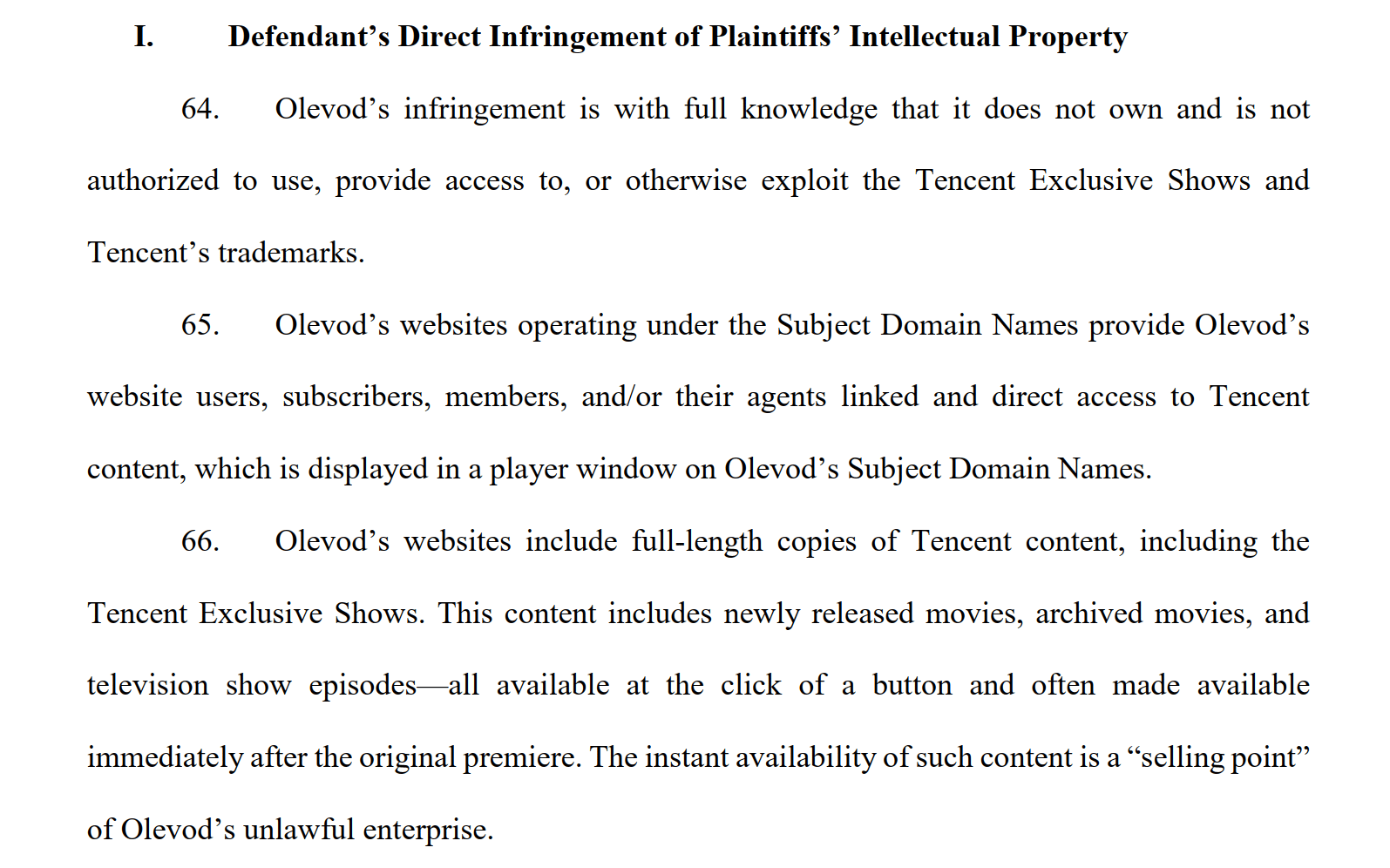
According to court filings, Olevod operates on a hybrid revenue model. Visitors can access a vast library of films, archived movies, and television episodes for free, albeit accompanied by third-party advertisements, or they can opt to purchase a paid VIP membership designed to remove ads entirely. The complaint emphasized the sheer speed and accessibility of the infringement, noting that Olevod’s websites make newly released content available at the click of a button, frequently appearing on the platform almost immediately after their official domestic premieres.
Furthermore, Tencent highlighted the deliberate geographical positioning of the pirate service. Olevod actively markets itself across search engines like Google, running advertisements positioning its service as an "online video media platform for overseas Chinese." Ironically, to avoid legal scrutiny from domestic authorities and rightsholders inside China, the site actively blocks visitors attempting to access the platform from mainland China, funneling its illicit distribution efforts entirely toward international diasporas.
The legal exposure outlined in Tencent’s complaint carried staggering financial stakes. Beyond allegations of direct copyright infringement, the lawsuit accused the platform of trademark infringement. Tencent’s legal team pointed out the controversial nature of the advertisements appearing alongside its intellectual property, noting that banners for online gambling, adult pornography, and counterfeit academic diplomas frequently populated pages displaying Tencent’s official names and logos.
The complaint meticulously cataloged 670 registered episodes distributed without authorization. With statutory damages reaching up to $150,000 per infringed work under U.S. copyright law, the theoretical maximum financial liability facing the site exceeded $100 million. Recognizing that collecting such a massive sum from offshore operators is often practically impossible, Tencent also requested a sweeping preliminary and permanent injunction. This request asked the federal court to compel internet service providers, web hosting companies, domain name system (DNS) resolvers, virtual private network (VPN) providers, and financial institutions—including banks and payment processors—to sever all technical and financial support to Olevod within a tight seven-day window.
Rather than defaulting or ignoring the proceedings, a common path chosen by many offshore pirate operations, Olevod chose to mount an aggressive defense. The company retained experienced Florida-based legal counsel and moved to dismiss the lawsuit entirely, arguing that the U.S. federal court lacked personal jurisdiction over the entities operating the site.

The defense identified the corporate entity behind Olevod as Jiayi Network Technology SL, a commercial enterprise registered in Spain with no physical or corporate ties to the United States. According to the defense team, Olevod’s actual technical infrastructure relies on servers physically located in Germany and France. Furthermore, the site prices its services in foreign currencies like Chinese yuan and euros, while routing financial transactions through popular domestic payment networks such as Alipay and WeChat Pay. The defense stressed that the company maintained no physical offices, employed no staff, and held no business contracts inside the United States.
In response, Tencent countered by presenting tangible evidence of domestic engagement. The tech conglomerate demonstrated that Olevod actively accepted transactions in U.S. dollars via PayPal, aggressively sold digital advertising space to generate revenue, and utilized specific network routing infrastructure tied to a mail drop facility located in Destin, Florida.
The jurisdictional battle initially favored the defense. In June, Magistrate Judge Panayotta Augustin-Birch issued a formal report and recommendation advising the court to dismiss the case. While acknowledging that Tencent had successfully proven that individuals located within Florida possessed the technical ability to access Olevod’s domains, the magistrate concluded that Tencent had failed to provide sufficient evidence demonstrating that a single Florida resident had actually watched a Tencent copyrighted program on the platform.
Judge Augustin-Birch warned that establishing jurisdiction merely on the grounds of general website accessibility would create a dangerous legal precedent. She wrote that such a standard would "subject every company or individual that has a website anywhere in the world, and whose website can be accessed in Florida, to suit in Florida," referencing established legal limitations on general jurisdiction.
Despite the magistrate’s recommendation, District Judge David Leibowitz delivered a sharply contrasting ruling, rejecting the dismissal motion and keeping Tencent’s lawsuit firmly alive.
Judge Leibowitz’s decision was heavily influenced by newly submitted traffic analytics derived from Semrush, a prominent digital marketing and traffic research platform. The data revealed that Olevod.com had attracted an estimated 123,400 visits from users located in Florida during the single month of June, establishing the state as the fourth-largest source of U.S. traffic for the platform.
While these traffic numbers bolstered Tencent’s argument, the presence of localized monetization tools proved to be the decisive factor for the court. The active sale of advertising space visible to Florida consumers, coupled with the purchase of premium subscriptions by U.S. based users, demonstrated that Olevod was purposefully conducting commercial business within the state. Judge Leibowitz explicitly compared Olevod’s operational model to prior intellectual property cases involving digital merchants selling counterfeit luxury goods, such as fake Louis Vuitton bags, where online storefronts targeting local consumers successfully triggered long-arm jurisdiction.
Writing in his order, Judge Leibowitz emphasized that the core of Tencent’s legal grievance centers on the trafficking of pirated intellectual property, and the judicial record clearly established that Jiayi had built a profitable business model executing that exact activity within Florida through localized ad sales and premium subscriptions. The judge noted that the digital nature of streaming content, as opposed to physical counterfeit goods, does not alter the legal reality, describing Olevod not as a casual hobbyist operating from a residential home, but rather as a sophisticated corporate enterprise operating complex interactive platforms.
Tencent’s legal strategy in Florida reflects a broader emerging trend among major Chinese entertainment companies seeking legal recourse within United States courts. In a parallel proceeding last year, rival Chinese streaming giant iQIYI filed a similar copyright infringement lawsuit against another Chinese-language pirate portal, Aiyifan TV, utilizing the same Florida legal representation.
While the anonymous operators behind Aiyifan TV failed to appear in court, resulting in a default judgment of liability within months, iQIYI encountered judicial skepticism when attempting to secure an expansive $196.55 million in damages alongside a broad domain-transfer injunction. The presiding judge criticized the massive per-work financial demands as appearing to be pulled "out of thin air," leaving that specific damages determination pending further evidentiary support.

Unlike the operators of Aiyifan TV, Olevod chose to actively contest the litigation, though its initial efforts to dismiss the case on jurisdictional grounds have now failed. It is important to note that Judge Leibowitz’s recent ruling addresses strictly the issue of judicial authority and personal jurisdiction; the court has not yet adjudicated the underlying copyright infringement claims, nor has it determined what financial penalties, if any, Olevod might ultimately be ordered to pay.
Olevod has been given a legal deadline to formally file its answer to Tencent’s comprehensive complaint. Whether the site’s operators will continue funding a defense or ultimately abandon the fight and follow Aiyifan into default remains uncertain. At the time of reporting, both of Olevod’s primary web domains remain fully operational and accessible online.
For Chinese rights holders and international content distributors, the federal court’s order establishes an important legal precedent. It confirms that foreign pirate streaming platforms relying on ad-supported models and paid subscriptions can be successfully hauled into a U.S. court, even in the absence of a domestic corporate plaintiff, local physical servers, or a physical office on American soil. Whether this ruling will trigger a broader wave of litigation against other overseas Chinese-language piracy networks remains to be seen as the case proceeds toward its next legal phase.