
The high-stakes federal lawsuit targeting several of the world’s most prominent private torrent trackers—including PTP and BTN—has taken an extraordinary and baffling turn. What began as a standard copyright infringement action has rapidly devolved into a courtroom drama centered on questions of identity, improbable coincidences, and allegations of judicial misconduct.
Last month, defense attorneys representing the private torrent trackers dropped a bombshell in federal court, informing the judge that the case may have been initiated by an impostor. Following this revelation, U.S. District Judge Andrea R. Wood placed the litigation on a sanctions track and scheduled a crucial in-person hearing.
The developments that followed have only deepened the mystery. Defense attorneys Erin Russell and Haley Finch formally asked the court to hold the plaintiff in contempt of court. Their motion accused the individual filing the lawsuit of deliberately misrepresenting his identity, falsely claiming copyright ownership over works he did not create, and utilizing a deceptive mail-drop address to mask his true location.
The "Real" Matthew Schneider Appears

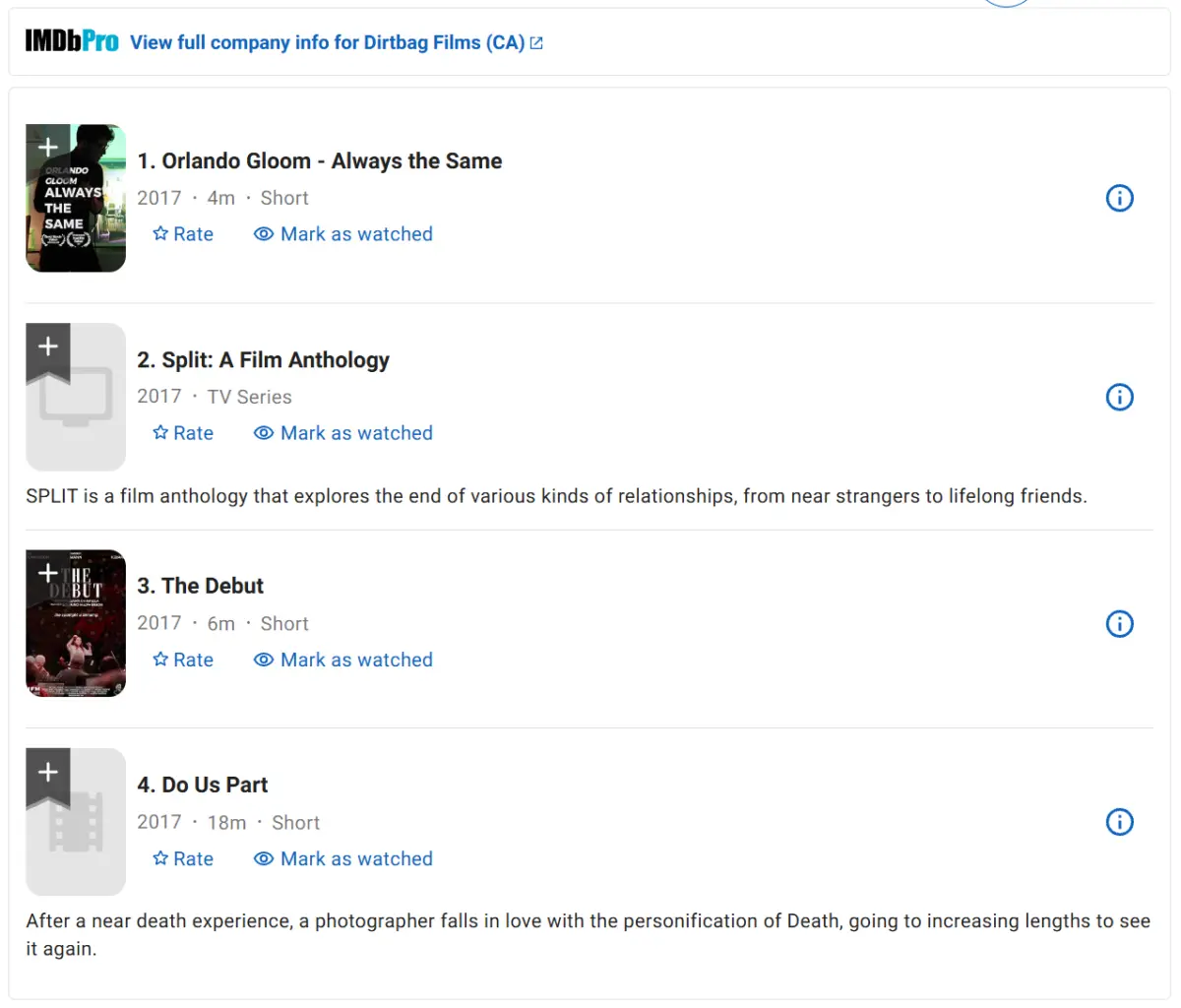
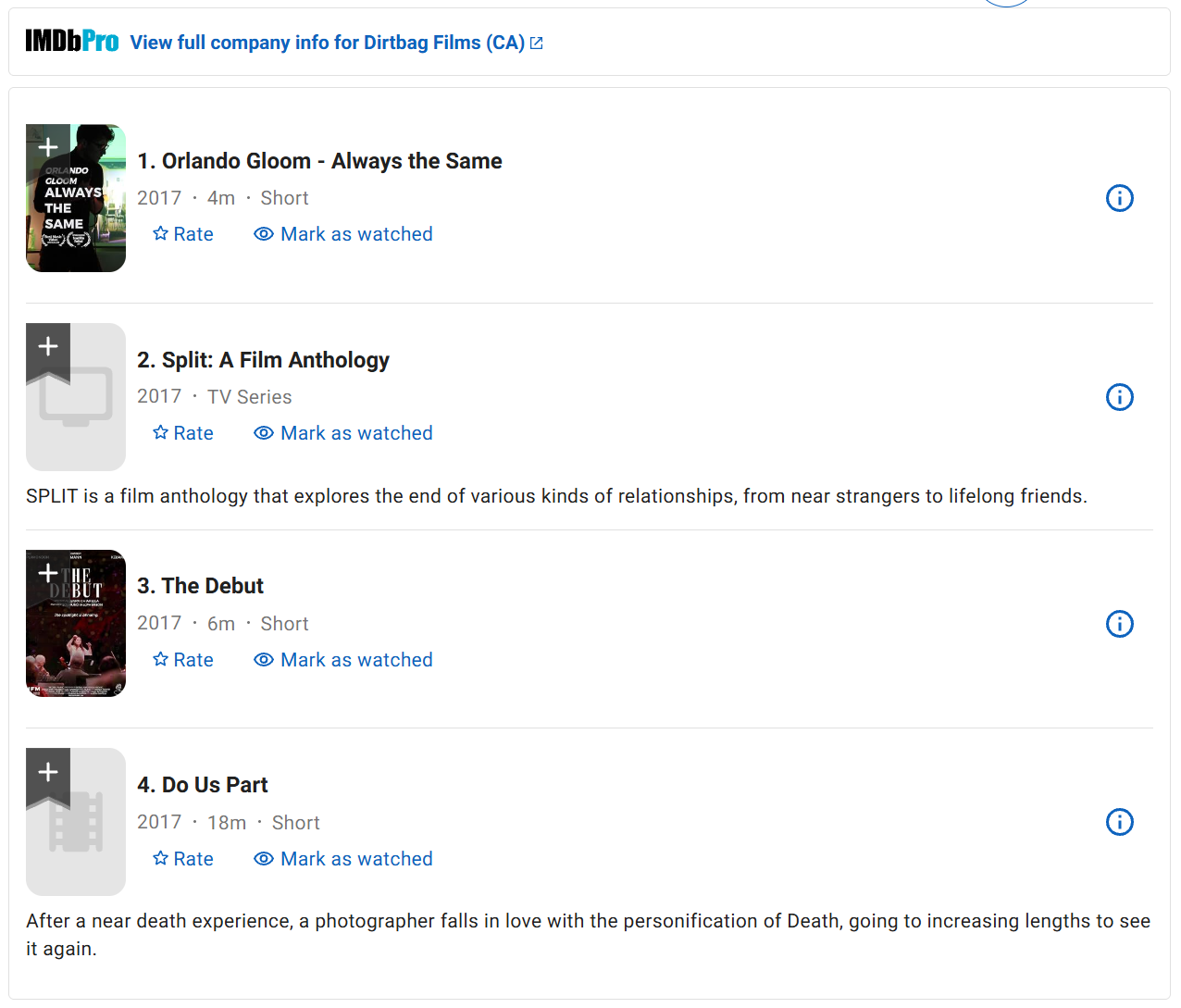
To substantiate their claims, defense counsel submitted a sworn declaration from Matthew A. Schneider, a resident of Ottawa, Ontario. This Canadian individual matches the IMDb credits cited in the plaintiff’s original complaint, which listed three specific films: "Split: A Film Anthology," "Do Us Part," and "Orlando Gloom, Always the Same."
Under oath, the Canadian filmmaker clarified that while he indeed created these creative works years ago alongside high school friends, he has no connection whatsoever to the federal lawsuit currently proceeding through the court system.
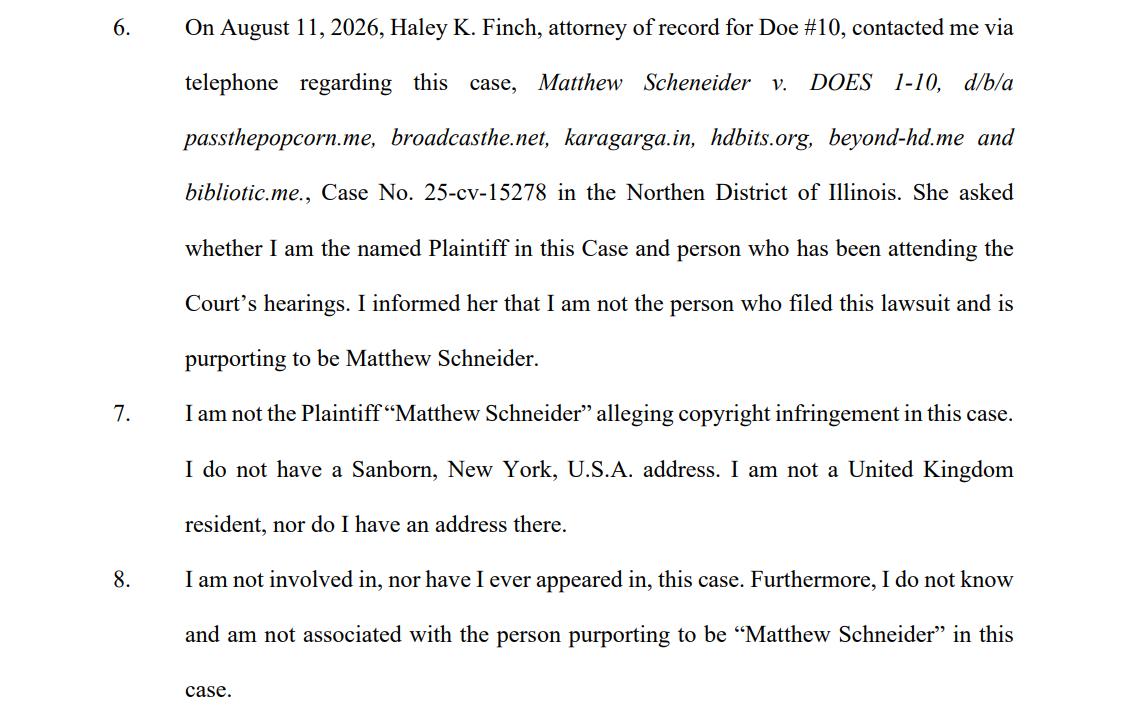
"I am not involved in, nor have I ever appeared in, this case. Furthermore, I do not know and am not associated with the person purporting to be ‘Matthew Schneider’ in this case," the declaration reads.
The films in question were originally produced under the banner of a high-school filmmaking collective known as "Dirtbag Films." Solmund MacPherson, a collaborator from that same group, also submitted a sworn declaration confirming that the collective never sold the rights to their films. Furthermore, MacPherson stated that he did not recognize the "matthew.schneider94" email address that appeared consistently across every filing in the federal lawsuit.
To assist the court, MacPherson successfully tracked down an archival copy of "Do Us Part," a project in which the Canadian Schneider makes an on-screen speaking appearance. This footage, alongside an archived Instagram post featuring a photograph of the Canadian filmmaker—who has since transitioned away from the filmmaking industry—provides the court with concrete points of comparison regarding his voice and physical appearance.
A Different Matthew Schneider
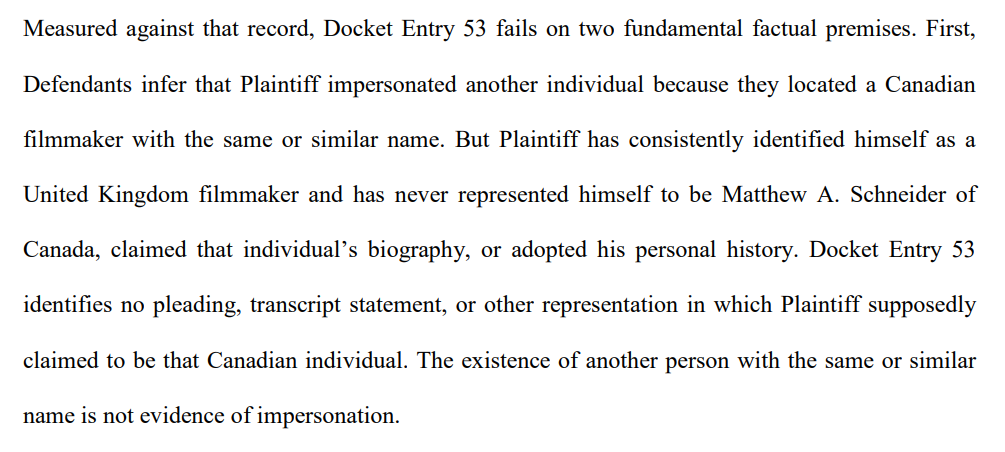
Presented with compelling evidence that the named plaintiff did not match the creator credited on IMDb, the litigant opted not to drop the lawsuit. Instead, in a response filed in court late last week, he advanced a remarkable argument: the existence of an entirely separate individual who shares the exact same name.
The plaintiff asserted in his court filings that he has consistently identified himself throughout the legal proceedings as an independent filmmaker and creative professional based in the United Kingdom. He maintained that he never explicitly claimed to be the Canadian filmmaker and never made any reference to Dirtbag Films.
"The existence of another person with the same or similar name is not evidence of impersonation," the plaintiff argued in his opposition.
However, the uncanny overlap between the two individuals extends far beyond a shared name. The self-described UK-based filmmaker claims to have independently produced his own films bearing the exact same titles as the Canadian Dirtbag Films productions.
Identical Film Titles Raise Red Flags
As evidentiary support for his claims, the plaintiff submitted a court exhibit containing metadata for his own alleged versions of the three disputed films. According to the metadata, these projects were created in the United Kingdom in 2011 for "Split: A Film Anthology," and 2012 for both "Do Us Part" and "Orlando Gloom, Always the Same."
This timeline places the UK productions five to six years prior to the 2017 creation of the Dirtbag films in Canada. The plaintiff uses this chronological discrepancy to argue that he could not possibly have copied works that did not yet exist at the time of his own alleged creations.
A closer examination of the submitted exhibit reveals a stark lack of traditional verification materials. While the document details filenames, video resolutions, and frame rates, it completely omits standard industry markers such as copyright office registration numbers, cast lists, crew members, visual stills, and IMDb listings.
The statistical probability of two independent filmmakers sharing the identical name and subsequently producing three separate movies with matching titles remains exceedingly low. This improbability is heightened by the inclusion of "Orlando Gloom" in one of the titles, which directly references the name of a musician for whom the Dirtbag collective produced an associated music video.
A Procedural Counterattack
Rather than merely defending his identity, the individual litigating as Matthew Schneider launched an aggressive procedural counterattack against the defense team. In his formal response, he accused defense attorneys Russell and Finch of engaging in improper ex parte communications with Judge Wood, specifically pointing to a telephone call made to the judge’s chambers prior to the August hearing.
Defense counsel Russell had previously described that phone call as an extraordinary step made necessary by the circumstances of the case. The plaintiff countered by arguing that the communication violated established bans on one-sided contact with a presiding judge, citing American Bar Association professional conduct rules alongside a Seventh Circuit ruling that permits courts to sanction attorneys for such actions.
Through his filings, the plaintiff demanded that the court disclose the specific dates and substance of those communications, requested that the judge disregard any statements made outside his presence, and asked the court to consider imposing formal sanctions against defense counsel.
Additionally, the plaintiff pointed out professional and personal intersections, noting that both of the Canadian declarants and attorney Finch share ties to the same Winnipeg high school. He argued that these connections undermine the independence of the declarations unless subjected to further judicial scrutiny. Whether the pre-hearing call constituted an improper communication or a justifiable effort to alert the court to a potential fraud remains a central question for Judge Wood to resolve.
Unresolved Questions Remain
Notably, the plaintiff’s recent court response exclusively defended three of the ten works originally listed in the complaint. The remaining five short films and two literary works—which defense attorneys assert have no verified creator associated with them—were left entirely unaddressed in the filings.
All participating legal parties are scheduled to appear at a forthcoming in-person hearing designed to bring clarity to the tangled proceedings. For their part, the defense attorneys representing the private torrent tracker operators remain firm in their conviction that the plaintiff is not who he claims to be. If validated, this conclusion forces a broader inquiry into the true motivations of the individual driving the litigation.
The purported impostor has consistently demonstrated a primary interest in uncovering the real-world identities behind the anonymous operators running the targeted torrent trackers. However, those efforts have been firmly stalled; none of the major tech and financial platforms subpoenaed during the discovery phase—including Reddit, GoDaddy, Cloudflare, PayPal, Stripe, Namecheap, and X Corp—have produced any user records. All production requests were formally placed on hold by the court in May and remain frozen.
In a late development, the person litigating as Matthew Schneider filed a notice of voluntary dismissal. Despite this sudden procedural retreat, the pending defense motion for a rule to show cause remains active and unresolved, leaving the scheduled court hearing firmly on the judicial calendar.