
Decades after its final stable release and years after fading from standard software repositories, the beloved open-source music player Banshee has made an unexpected return. Thanks to developer Alan Pope, widely known in the Linux community as "popey," users can now run Banshee on modern Linux distributions through the Snap Store. This revival brings Banshee 2.6.2—the final stable version originally released in 2014—directly into the modern computing era, functioning as an intriguing exercise in software preservation and a nostalgic trip down memory lane for long-time Linux enthusiasts.
Rather than serving as a purely superficial repackaging, this new Snap deployment includes targeted compatibility fixes and successfully restores selected online services. However, the software packaging and distribution descriptions explicitly note that not all historical backend services remain operational given the massive shifts in web standards and APIs over the past decade. Described affectionately by its packager as a reanimated corpse rather than a full-scale reincarnation, the Banshee snap leverages the containerized nature of Snap packages. By bundling legacy dependencies directly inside the container without impacting the host system, container formats like Snap effectively function as modern software time capsules, making it possible to execute applications that would otherwise break or fail to compile on contemporary Linux libraries.
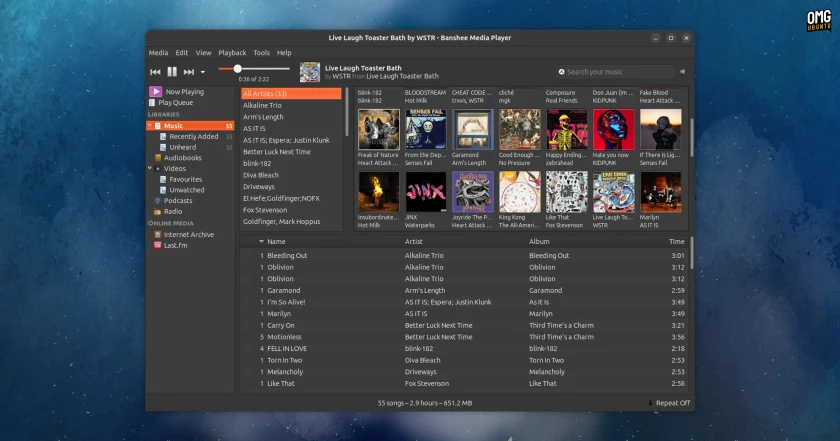
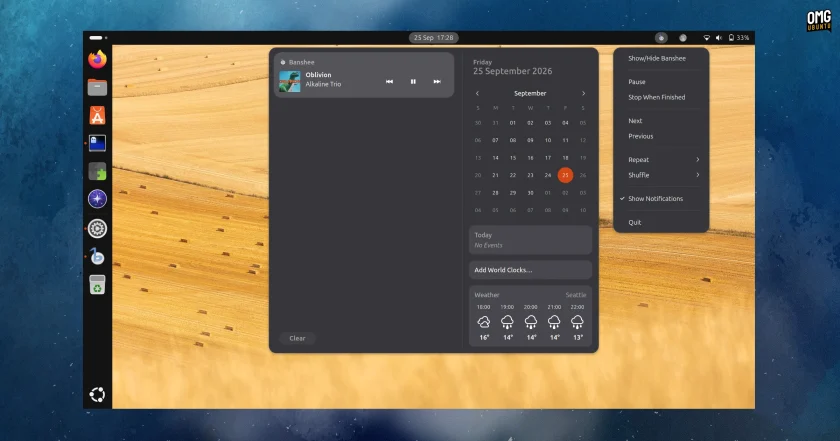
Beyond acting as a nostalgic curio for retro-computing fans, the Banshee snap is a fully functional music player. Users can simply point the application at a local folder filled with audio tracks to load them into the library, where they can browse, organize, and play their local music collections. For accessing files stored on external drives or secondary partitions, users must ensure the snap is granted the appropriate filesystem permissions. Testing the application on modern environments like Ubuntu 26.04 LTS reveals that the core media playback experience remains surprisingly robust. Upon initial launch, the program prompts the user to select a designated music directory, quickly ingesting tracks and handling a wide array of audio file formats without missing a beat. Album cover art renders correctly, and native integration with Media Player Remote Interfacing Specification (MPRIS) along with system media keys functions seamlessly, allowing for effortless hardware-level playback control.
Nevertheless, the passage of time introduces certain inevitable limitations. Attempts to log into online services such as Last.fm fail because the application triggers a "Could not launch URL" error dialog during the authentication workflow, reflecting the retirement or transformation of those vintage endpoints. Similarly, video playback capabilities within Banshee are non-functional. Video formats, display resolutions, and underlying codecs have undergone radical transformations since 2014, rendering legacy video decoders obsolete. Furthermore, features like DVD playback, which were notoriously unreliable even during Banshee’s operational heyday, remain defunct and largely irrelevant to modern use cases.
Banshee and Ubuntu Go Way Back
The return of Banshee to the Ubuntu ecosystem carries a heavy dose of historical irony, given the software’s prominent role in the distribution’s history over a decade ago. Banshee enjoyed a celebrated tenure as Ubuntu’s default music player between 2011 and 2012. Its inclusion marked a major milestone within the broader open-source ecosystem, not merely because it temporarily replaced the immensely popular Rhythmbox media player, but because of the underlying technology stack it utilized: Mono.
Mono is an open-source reimplementation of key components of Microsoft’s .NET framework, the C# programming language, and its associated runtime libraries, originally spearheaded by GNOME co-founder Miguel de Icaza. During its peak adoption era, Mono was a deeply polarizing subject within the Linux community. Many developers and system administrators harbored intense skepticism and outright hostility toward the technology, fearing it might serve as a legal trap or proprietary Trojan horse designed to compromise the open-source philosophy through intellectual property assertions and potential patent threats from Microsoft.
Ultimately, those worst-case fears never materialized. Over the years, Microsoft’s posture toward open-source software shifted dramatically, eventually leading the corporation to assume stewardship of the Mono project before formally handing its maintenance over to the Wine project. Ubuntu’s eventual decision to phase out Mono-based applications—including Banshee, gBrainy, and Tomboy—from its default software installations was driven by pragmatic engineering constraints regarding disk space limitations and dependency management rather than any looming legal threats.
Banshee’s ultimate exit from mainstream Linux distributions was ultimately sealed by bitrot and modernization. Ubuntu users last interacted with native packages of Banshee in 2018, around the same time the application was officially purged from the Debian archives. This removal occurred because the software continued to rely heavily on deprecated libraries and legacy toolkits that Debian maintainers were actively deprecating and removing from their repositories to maintain system security and stability.
Installing and Evaluating the Banshee Snap
For users eager to experience the software firsthand, installing the revival is straightforward. Ubuntu users can simply open the App Center, search for Banshee, and initiate the installation directly, or alternatively execute a single command within the terminal emulator to pull down the container package. Because the Banshee snap relies upon the Core22 runtime foundation, supporting dependencies are automatically retrieved and configured if they are not already present on the host system.
While evaluating whether the software is worth utilizing, the answer depends largely on user intent. As an exploratory journey into computing history, it succeeds brilliantly, allowing enthusiasts to recreate the desktop computing ambiance of the early 2010s. However, the application remains firmly anchored to its historical era. Built as a GTK2 application, Banshee struggles when deployed on modern Linux desktops equipped with high-resolution displays utilizing fractional scaling, where graphical user interface elements scale unevenly or fail to adapt altogether. Furthermore, any software bugs, interface quirks, or performance limitations present in the final 2014 release remain intact within the containerized environment.